

Civic Education News Roundup: Student Voting and the State of the Field of Civic Thought.

In case you missed either of these great guest posts, we’ve got a look forward and a look back at our field:


Check out CERL’s Conversations on Civic Education: Themes from the June APSA Teaching and Learning Symposium at Georgetown University, a great conference I got to attend (more to come on that … ).
The American Council of Trustees and Alumni (ACTA) published a new report, The Story of Our Nation: How Well Do College Students Know America? A Civic Literacy Assessment of College Students, focusing on knowledge of history and founding documents. Unfortunately, the answer is “not as well as we hoped.” Andrew Handel, director of the Education and Workforce Development Task Force, writes for the American Legislative Exchange Council (ALEC): “New Survey Shows Why States Must Renew Focus on Civics Education.” I’ll note that given recent events, it’s hardly surprising that “Only thirty-seven percent of students know that the Legislative branch of the government has the power to declare war.”
But there are exceptions, like the students who competed in the National Civics Bee or the Presidential 1776 Award contest this month; “Here are the questions in the presidential civics competition: How would you fare? Thousands of students took part for the U.S.’s 250th anniversary.”
Jonathan Becker and Yael Bromberg, who are co-teaching a summer course on student voting and voting rights at Bard with Erin Cannan that they opened to students across the country, wrote a pair of pieces for the spring issue of Liberal Education from AAC&U:
Give Them Ballots: Liberal education prepares students for citizenship. Colleges and universities must ensure they can vote. By Jonathan Becker, touching on the legal challenge to NSLVE data as well as the history of voter engagement in higher ed.
A Detour for Democracy: When polling sites move off campus, students face new barriers—and elections shift. By Yael Bromberg, on the legal context for student voting on college campuses and action steps that campuses can take.
There’s plenty of work to do:
New Poll: Nearly Half of Americans Don’t Know What America’s 250th Is Celebrating, by Emily Ekins for the Cato Institute. “A little less than half (49%) of Gen Z agree that the Founding Fathers were courageous leaders who risked their lives and possessions to secure independence and liberty, compared to the vast majority (89 percent) of seniors — a 40-point difference. Young Americans are seven times as likely as seniors to adopt a revisionist argument that the Founding Fathers declared independence from Britain mainly to increase their own power and wealth (28 percent vs. 4 percent).”
Poll: America at 250 is riven with doubt and pessimism — but with glimmers of hope: National pride, faith in major institutions and belief in the “American Dream” declined in new NBC News polling sponsored by More Perfect.
Most Schools Report Teaching Civics. But Hands-on Lessons Aren’t as Common, from Education Week.
“The RAND Corporation and the Center on Reinventing Public Education surveyed 325 K-12 district leaders from October to December 2025 about civics education in their schools. … A little over a third of district leaders said their schools presented optional experiential civics learning, while 13% required it. Community service and volunteering was more popular, with 61% of districts giving students the option to participate and 23% requiring it. … In interviews with 11 district leaders, those educators said their teachers needed more instructional resources and professional learning — especially when it came to facilitating discussions around difficult topics.”
Civic learning in the spotlight:
Why civics education needs to feel more relevant to young people: Connecting students to the founding principles can equip them to solve our country’s challenges, by David Bobb for Stand Together.
Catholic scholars reflect on the American experiment at The Catholic University of America (CUA), co-hosted by the University of Notre Dame’s Center for Citizenship and Constitutional Government.
Rutgers University New Brunswick Hosts Bonner Foundation Summer Leadership Institute 2026: Across more than 30 workshops, strategy sessions, and place-based learning experiences, more than 350 participants engaged with topics including civic engagement, student leadership, social innovation, ethical storytelling, faculty partnerships, fundraising, career development, and community-engaged learning.
Civic Prosperity at 250: From Sacred Honor to Shared Flourishing, by Sanda Balaban for the Braver Angels Civic Scholars Council series with Harvard’s Social Impact Review.
A Toast to America at 250: a University of Missouri undergraduate research team led by Professor Lily Santoro embarked on an ambitious project sponsored by the Knight Lab, reaching out to scholars from around the globe and asking them to share international perspectives on the United States’ 250th anniversary.
Youth Service America (YSA) is leading a national alliance of organizations working to build A New Era of Youth Service in America. Their goal is to double youth participation in service over the next 10 years through field-building, funding, activation campaigns, and education.
Libraries and AI in Public Life: A Recap from the Obama Presidential Center, from the Digital Public Library of America.
From the National Constitution Center, Exploring how to make civics fun, engaging, and relevant for families: Ben Sheehan, author of What Does the Constitution Say: A Kids’ Guide to How Our Democracy Works, joins the podcast to discuss how civics can be accessible, entertaining, and genuinely enjoyable for people of all ages.
Learning from History:
Unfinished Revolution: Social Movements, Freedom Struggles, and American Democratic Development, an incredible panel discussion with Elizabeth Matto, Rutgers University (moderator); Marcus Board Jr., Howard University; Christina Wolbrecht, University of Notre Dame; LaGina Gause , University of California, San Diego; and Melvin Rogers, Brown University.
A Pluralist Manifesto: This 4th of July, here’s how to teach America’s diverse origins. Eboo Patel writes for Persuasion: “The distinguishing feature of schools of Civic Thought is a focus on American foundations, and when you focus on American foundations, you find that America is, inescapably, a diversity project — an experiment in diverse identities coming together to build a greater whole,” especially in diverse religious identities.
After the Birthday Cake: Baking a 15-Year Arc of Civic Renewal: The Declaration’s 250th anniversary opens a 15-year civic window. Thomas Jefferson’s Monticello President Jane Kamensky and Made By Us Executive Director Caroline Klibanoff discuss why we must use it to build knowledge, skills, and character for the next generation of citizens.
George Washington failed before he succeeded, by Colleen Shogan for the Washington Post.
Schools of Civic Thought
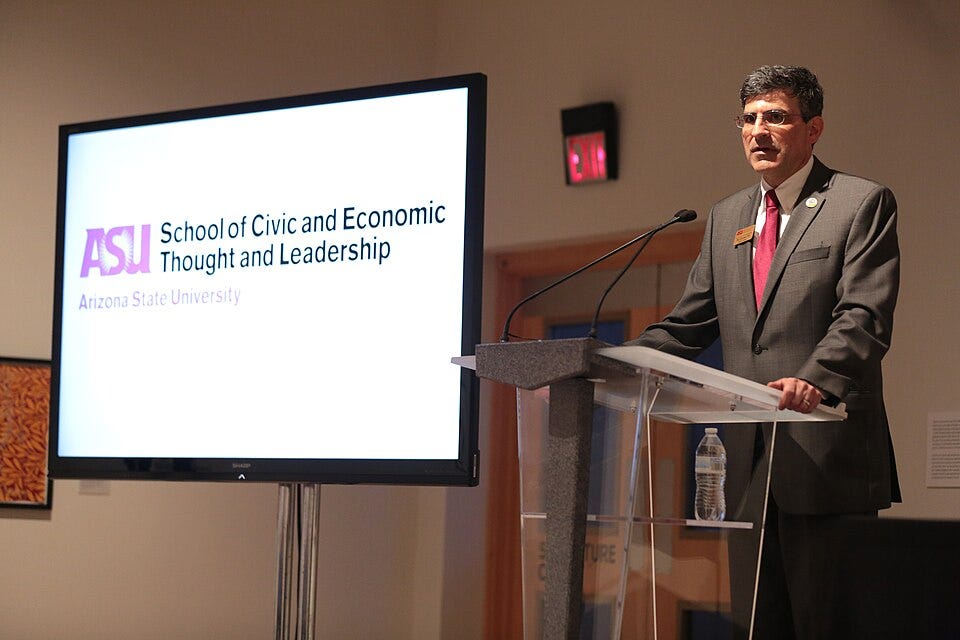
Paul Carrese reports on the state of the field for Schools of Civic Thought for the American Enterprise Institute, and provides recommendations on how to offer an academically rigorous blend of liberal arts education and civic education while “weather[ing] protests from an elite faculty culture thoroughly dominated by liberal-progressive views.” Paul notes that these centers pursue hiring, teaching, and public outreach in ways that are distinctive and sometimes even contrary to typical practices in the academy, but recommends collaboration and bridge-building with colleagues at each center’s home institution. Civic Thought and Leadership is, in his view, a new and distinct academic discipline. “Fifty years from now, this movement could mark not just the founding of a few schools and centers across the country but the beginning of a broader restoration of the university’s civic mission.”
Sustaining Schools of Civic Thought and Leadership: Excellence, Opposition, and a New Academic Field, by Paul Carrese for the American Enterprise Institute
.jpg)
The Ohio State University’s Salmon P. Chase Center for Civics, Culture, and Society and other civic centers in Ohio could now have the status of an independent college and also offer mandated civics courses, thanks to newly proposed legislation:
Ohio bill would broaden power of university civics center directors: The politically created academic centers have drawn fierce criticism from faculty, who say they expand state intrusion into higher education. By Ben Unglesbee for Higher Ed Dive.
Bill mandates Ohio university students take required course at ‘intellectual diversity centers,’ by Karen Kasler for Statehouse News Bureau on Senate Bill 461 from Sen. Jerry Cirino (R-Kirtland).
And the University of Kentucky will get its own Center of American Civics:
In a last-minute add-on, lawmakers directed UK to open a ‘Center of American Civics.’ By McKenna Horsley for the Kentucky Lantern.
Iowa Rep. Taylor Collins is celebrating recent legislation for a civics requirement in higher ed:
The College Fix also covers this trend: Civics education expands ahead of America’s 250th anniversary.
Civil dialogue:
Embracing Disagreement: an interview with Joan Gabel, the Chancellor of the University of Pittsburgh, about Pitt’s Year of Discourse and Dialogue, for Citizens & Scholars’ College Presidents for Civic Preparedness.
In Philadelphia, the spirit of 1776 meets the politics of 2026: Democrats and Republicans gather for 250th and Braver Angels conference and actually find common ground, from Deseret News.
Stories of success in civic learning:
Engagement in a Civic Education Desert: At Rose State Community College in Oklahoma City, educators are putting innovative practices to work to engage students. An interview with Dr. Emily Stacey for New America.
A Town-Gown Partnership Focused on Climate Resilience: As climate change spurs extreme heat waves and flooding in Georgia, Agnes Scott College and the city of Decatur are working together to forge solutions. By Kathryn Palmer for Inside Higher Ed
Democracy Starts with “We”: Learning to Strengthen Democracy. As democratic institutions face growing strain, the question is no longer whether democracy needs strengthening, but how. At UC Berkeley’s Goldman School of Public Policy, the answers to that question begin in the classroom. Featuring courses taught by Jake Grumbach, Galen Sheely, Micah Weinberg, and Erika Weissinger. The Lab also partnered with the Brennan Center for Justice to round up state-level election reforms in 2025, and saw a great slate of capstone projects produced by students.
From the Field to the Community: Driving Local Change by Lexa Hunter, an Engaged Athlete Fellow through TheTeam, for The Fulcrum.
Civic education in the states:
States Answer the Call for Stronger Civics Ahead of the 250th, by Shawn Healy for CivXNow Coalition.
Program at UVU aims to help history teachers better teach the next generation: at Utah Valley University’s Center for Constitutional Studies, professors teach K-12 educators everything from separation of powers to federalism to theories of constitutional interpretation and more to help them in their curricula. Throughout that time, the teachers are also trained how to use a research platform, the Center for Constitutional Studies, which is being developed with Pembroke College at Oxford University, called the Quill Project.
On July 4, schools should celebrate a fourth ‘R’: reading, ‘riting, ‘rithmetic and rectitude, by Kalman Hettleman, a member of the Maryland Commission on Innovation and Excellence in Education (also known as the Kirwan Commission).
New publications
The Viewpoints Project has published their 2026 annual report:
“After a three-day, in-person training retreat, fellows converted their personal growth into action, translating our training into custom, peer-led programming for more than a dozen events that reached over 200 of their peers. … Fellows concluded the year measurably more confident and more capable with skills related to facilitating curious disagreement. … Moving into year two, we look forward to expanding the fellowship to nearly 60 fellows across six campuses.”
Two-Thirds of Youth Have Shifted Their Political Views in Recent Years: Young Americans are more likely to be moving left than right on the ideological spectrum. By CIRCLE researchers Sarah Burnham, Seona Maskara, Ruby Belle Booth, and Alberto Medina.
The Crisis of Democratic Participation and How to Fix It, report by Thomas Asher, Columbia World Projects and the Committee on Global Thought: “The institutions that once supplied belonging, civic education, and genuine participation have shrunk or disappeared. … Real renewal requires rebuilding from the bottom up.”
Civic learning resources:
The People’s Guide to Voting Rights from Democracy Forward covers the voting landscape of the 2026 midterm elections and informs voters about their rights and options. It also examines the most pressing threats to free and fair elections, and provides trusted resources for every step of the process. It is designed for all voters, regardless of party, and includes information for election workers and volunteers.
Visions of America: The Revolution Through the Eyes of Seven Everyday Founders, a graphic novel-ized series from the New York Times Magazine with commentary from historians. Jane Kamensky’s introduction to the series asks about “the Many Founders of the United States: In the past 50 years, the way we tell the story of the Revolution has become dramatically more complex. Can it still inspire us all?”
Upcoming Events:
How Higher Education Can Foster Constructive Immigration Dialogue, July 22nd at 2 PM Eastern, a webinar exploring how higher education institutions can foster dialogue across political and ideological differences.
Campus Compact’s Higher Education Democracy Exchange (HEDEX) is going live. It provides the infrastructure for the field and aims to bring together people, resources, and practices advancing democratic engagement across campuses, disciplines, communities, and regions. Wednesday, July 29, 2026, 1:30 PM-2 PM ET.
Frontiers of Democracy 2026 — “The United States at 250: Meeting the Moment for Democracy, in the U.S. and Around the World” conference at Tufts University, Oct. 2-4.
International Association for Research on Service-Learning & Community Engagement (IARSLCE) 2026 Conference at Loyola University New Orleans, Oct. 11-13.
The National Conference on Citizenship (NCoC) will hold its 2026 conference in Lexington, Kentucky. on Nov. 16-17. NCoC will convene experts and practitioners to explore what it takes to build civic infrastructure with intention and sustained action.