


In a time when Americans cannot agree on much of anything, the need for more and better civic education in our K-12 schools and universities wins a consensus. Conservatives and progressives widely recognize that we have systemically underinvested in teaching young people how American government works, the principles of self-governance, and how to participate effectively in the process.
Civic education, at its best, helps prepare young people to be the next stewards of America’s constitutional democracy. But today’s political environment increasingly asks it to do something else: Save democracy itself. For many, civic education has become a shorthand for producing better citizens according to one political vision or another, rather than its classical purpose of equipping young people to think, deliberate, and participate.
To this end, the central question, then, is not simply how we expand civic education, but what we believe it is ultimately for. Too often, advocates treat civic education as a solution, or even the solution, to democratic dysfunction itself, rather than as one institution among many that prepares citizens for democratic life.
Clear evidence exists that the subject has been systemically deprioritized in our K-12 schools and universities in recent decades. In a recent New York Times op-ed piece, Harvard professor Danielle Allen attributes this decline primarily to political polarization, arguing that, “adults could not agree on what should be taught about our country’s political history, and as a result the kids had been taught nothing at all.”
Danielle is right that the renewed attention to civic education is encouraging, and that the Educating for American Democracy initiative represents one of the field’s most significant achievements in recent decades. By bringing together scholars and practitioners from across the ideological spectrum, the effort demonstrates that meaningful common ground remains possible even amid deep disagreement.
But even if we succeed in bringing civic education back into our schools, foundational challenges remain. Political disagreement today is not only about what happened in history or which facts students should learn. More fundamentally, many Americans disagree about the very purpose of democracy itself. The challenge runs deeper than polarization over curriculum. It reflects competing understandings of what the American system of democratic self-government is ultimately designed for.
For some, democracy is primarily about protecting individual liberty. For others, it is about advancing equality. For others still, it is about preserving a moral and cultural inheritance grounded in religious character. These are not gaps in knowledge- they are fundamental disagreements about what democracy is for — and no curriculum can close that gap.
I co-founded a civic education organization, Generation Citizen (GC), in 2008, when it was still difficult to persuade funders and policymakers to take the field seriously. I led the organization for 12 years, and continue to support its work. Having spent more than a decade leading GC, I’ve watched the field’s resurgence with both appreciation and unease. The appreciation is genuine: Efforts to promote pluralism, collaboration, and engagement across differences are sorely needed. The unease stems from what that resurgence has revealed about why so many people began to care.
Prior to 2016, civic education struggled to attract sustained attention. After Donald Trump’s election, that changed almost overnight. Our organization’s budget quadrupled in less than a year. But the flood of interest belied a basic assumption that many of our supporters implicitly, and sometimes explicitly, would note: Americans could only have voted for Trump because they lacked an adequate understanding of democratic institutions and norms. Civic education was less a tool for developing independent civic thinkers than a corrective — a way to bring misguided citizens back to the right conclusions.
That assumption has not gone away. In the work I lead today, focused on broader democracy reform, civic education almost always emerges as a societal corrective from both the left and right. When concerns arise about executive overreach, the weaponization of government, or threats to electoral institutions, from divergent partisan perspectives, a common reflex is to bemoan the lack of civic knowledge and capabilities amongst young people and call for more civic education. The logic is straightforward: If Americans better understood democratic institutions, they would be more likely to support them. But understanding how an institution works and trusting it are not the same thing.
Recent research we conducted with colleagues at Johns Hopkins and ReD Associates illustrates this distinction. In deep interviews with conservatives across the country, we found that skepticism toward democratic institutions often stemmed not from ignorance of how those institutions work, but from a belief that they had become disconnected from the purposes they were meant to serve. Participants could often describe institutions in considerable detail. Their challenges with these institutions focused on whether they remained legitimate, trustworthy, and aligned with their understanding of the common good. These individuals didn’t lack civic education. They had civic grievances — and those are not the same problem, and do not have the same solution.
Effective civic education can help young people understand institutions but it cannot, by itself, persuade them that those institutions deserve their trust. Conflating learning about institutions and asking young people to trust them asks civic education to solve problems that are ultimately political rather than educational.
This temptation to use civic education as a political corrective is not confined to one side of American politics. The Trump Administration recently announced the America 250 Civics Education Coalition, a partnership of organizations largely aligned with the Make America Great Again movement, many of which advocate a “patriotic education” emphasizing national pride and shared civic inheritance. Where the post-2016 progressive impulse was to use civics to rebuild faith in institutions, this coalition’s goal is seemingly to use civics to instill a particular national identity. The ultimate goal is different, but the assumption underneath is similar. Both approaches begin with a vision of what an ideal democratic citizen should believe, and work backward to a type of civic education designed to produce that citizen. Both treat the outcome as settled and the education as a means of getting there.
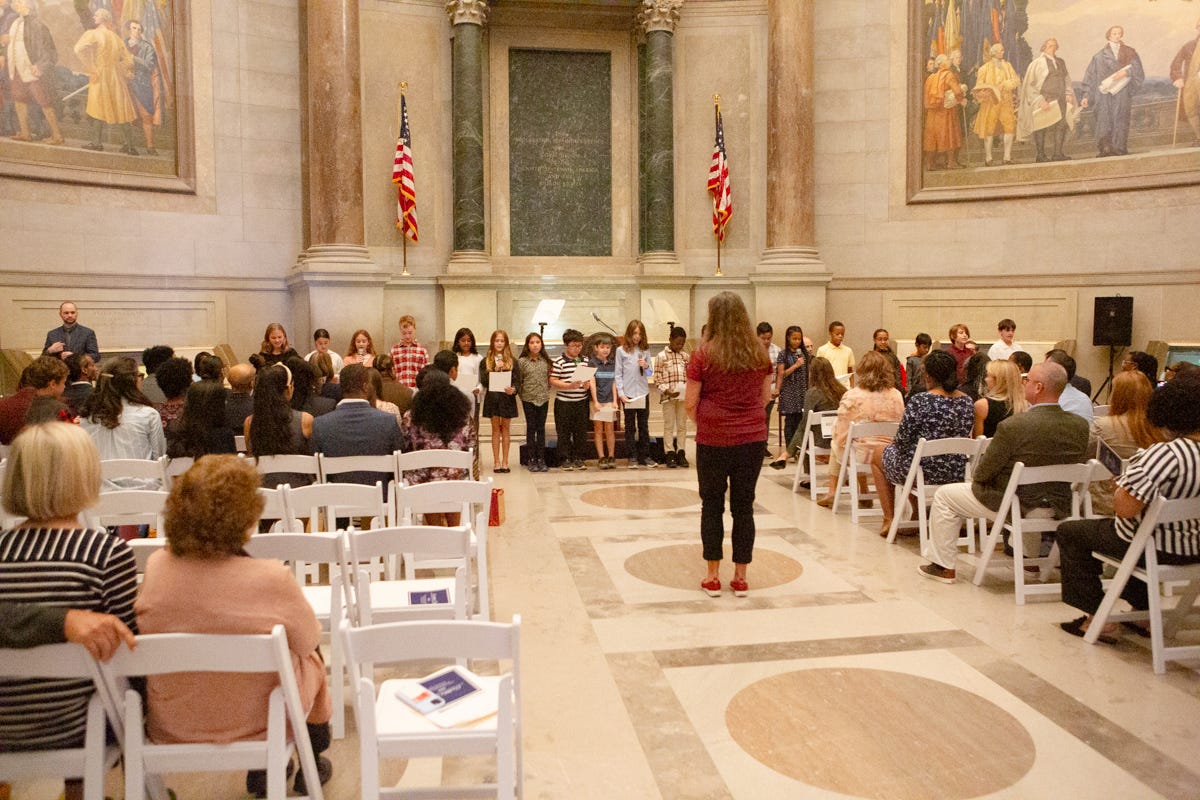

The work of Danielle and her colleagues on Educating for American Democracy illustrates the most promising path forward precisely because it does not pretend these disagreements can be resolved. The EAD framework invites students into enduring debates about patriotism and solidarity, equality and liberty, rights and responsibilities. Its ambition is not to eliminate disagreement but to prepare students to engage it thoughtfully. That strikes me as the right aspiration.
A better standard of effective civic education may be both more narrow and more demanding. Can a student accurately state the strongest version of a political position they themselves reject? Can a student explain why others might not trust an institution they themselves trust? This type of civic education focuses on the disagreements that have always defined American democracy, and always will.
Yet even a framework as carefully constructed as EAD cannot answer the larger question that continues to shape our politics: what and who is democracy ultimately for? No curriculum or framework can resolve that debate, because it is itself one of the central questions democratic citizens inherit.
The answer, then, is not to expect less from civic education, but to expect something different. Schools should absolutely teach students how American government works, how elections function, what constitutional principles have shaped our history, and how citizens can participate effectively in public life. They should expose students to competing traditions of American political thought, like those that argue for limited government versus a more expansive state. Students should study moments in history when our institutions strengthened democracy and moments when those same institutions fell short. In other words, they should prepare students to think politically, not simply to think alike.
Effective civic education can help young people understand institutions but it cannot, by itself, persuade them that those institutions deserve their trust. Conflating learning about institutions and asking young people to trust them asks civic education to solve problems that are ultimately political rather than educational.
But what should change is how we judge the long-term effects of civic education. Right now, both sides of this debate — supporters who helped to quadruple our budget after 2016, and the coalition building “patriotic education” today — risk measuring success the same way: By their perception of the health of democracy. In other words, they assess the effectiveness of civic education by asking whether students end up trusting the right institutions, or believing the right story about the country. These implicit metrics are not about good education, but about political persuasion and conversion.
A better standard of effective civic education may be both more narrow and more demanding. Can a student accurately state the strongest version of a political position they themselves reject? Can a student explain why others might not trust an institution they themselves trust? This type of civic education focuses on the disagreements that have always defined American democracy, and always will.
Civics education cannot save democracy. It can, however, prepare citizens capable of renewing it.
 | A guest post by
|
Civics education, like many another democracy fixes, won’t solve our problems on its own, it has to be part of an intentional and thoughtful regime. Like rebuilding any muscle we’ve stopped using, variety isn’t a nice to have, it’s a need to have.
I wrote a book titled, A Student Guide to Truth, Democracy and Civic Responsibility. Below is the table of contents. It is completely non patrician and intended to teach young people not what to think, but how to think. It is designed to do exactly what you are trying to do.
Table of Contents
Introduction
Part I - Your Role and Responsibility as a New Voter
Chapter One - What Is a Citizen, Really?
Chapter Two - Why Democracies Need Truth to Function
Chapter Three - Choosing the Right People Matters More Than Policies
Chapter Four - Information Overload: Learning to Navigate a Noisy World
Chapter Five - First Things First: You Have to Register
Chapter Six - Who Will Actually Be on My Ballot?
Part II - Understanding the System You Have Inherited
Chapter Seven - Deliberative Democracy: How Good Decisions Are Actually Made
Chapter Eight - Voter Turnout: Who Shows Up and Who Doesn’t
Chapter Nine - Gerrymandering: When Maps Shape Elections
Chapter Ten - The Electoral College: How the President Is Really Elected
Chapter Eleven - Referendums and Ballot Initiatives
Chapter Twelve - Lobbying in America: Influence, Access, and Democracy
Chapter Thirteen - Do Lawmakers Really Listen to Ordinary Citizens?
Chapter Fourteen - Two Ways Democracies Organize Power: Presidential vs. Parliamentary Systems
Chapter Fifteen - The Courts: How Laws Are Interpreted—and Why It Matters
Chapter Sixteen - Media, Attention, and Modern Democracy Part III - Becoming A Conscious Citizen
Chapter Seventeen - Fairness, Inequality, and System Balance
Chapter Eighteen - Moral Intelligence and Character
Chapter Nineteen - Talking to Friends and Family
Chapter Twenty - Global Challenges that Require Global Solutions
Chapter Twenty One - Silent Decline
Chapter Twenty Two -Think in Terms of Generations
Chapter Twenty Three - Quiet Influence and Everyday Citizenship
Chapter Twenty Four - A Democracy Worth Building