

A guest post by Michael Blauw, Director of Civic Learning and Strategic Partnerships for the Center for Civic Education.
“And some things that should not have been forgotten were lost.” —J.R.R. Tolkien
My favorite opening to any film is the prologue of The Fellowship of the Ring. An ethereal voice sets the stage for the entire trilogy by speaking of a threat that can’t quite be named. The tragedy that haunts the whole of Tolkien’s world isn’t really (only) a villain—it’s entropy. Things that should have been remembered were forgotten. Something powerful passed out of memory.
I think about those opening words when I think about the story of America’s civic education infrastructure—its almost miraculous rise, its near death, and what might yet be its rebirth.
There are few now who remember this story, and since it is July of the 250th anniversary of the Declaration of Independence, the media is awash with good history and tributes that call us to remembrance. So it’s fitting for us to remember some of America’s highest accomplishments that shouldn’t be forgotten.
Here’s a civic education story you should know: America tackled a civic education crisis once before, and that’s good reason to hope that we can do it again.
In the mid-1960s, educational leaders were sounding alarms that would feel familiar today: Civics was disappearing from American schools. Civic curricula were being marginalized by the “Sputnik moment” and the resulting rush to prioritize the sciences during the space race. Meanwhile, administrators and educators expressed growing concern over the dwindling professional development for social studies teachers. Decades of school consolidation produced educational environments increasingly estranged from the communities they served. We were losing the civic mission of schools.
As a result, students were graduating without a working understanding of our government and founding documents, and that rang the alarm for the Supreme Court. In 1963, Justice William Brennan convened a meeting with constitutional experts and law school deans to develop strategies for improving public comprehension of the Constitution and the Bill of Rights. The dean of UCLA Law School attended and decided to answer the call. UCLA soon formed an interdisciplinary Committee on Civic Education in 1965, and what it subsequently built over the next decades was something that could genuinely be called a national infrastructure for civic learning, federated in design, bipartisan in trust, and—as it turned out—more durable than anyone might have expected.
Building a National Civic Infrastructure
With initial federal backing via the National Defense Education Act and the nascent Department of Education, UCLA’s committee launched the Law in a Free Society program, which later changed its name to the Center for Civic Education. The Center joined a national consortium—which included Street Law, the Constitutional Rights Foundation (now Teach Democracy), and the American Bar Association—that worked together to advocate for civic learning initiatives through the Law-Related Education Act. This group represented an early, coordinated effort to embed democratic principles into the heart of American school systems nationally. For decades, they invested together in program development, teacher training, and community partnership.
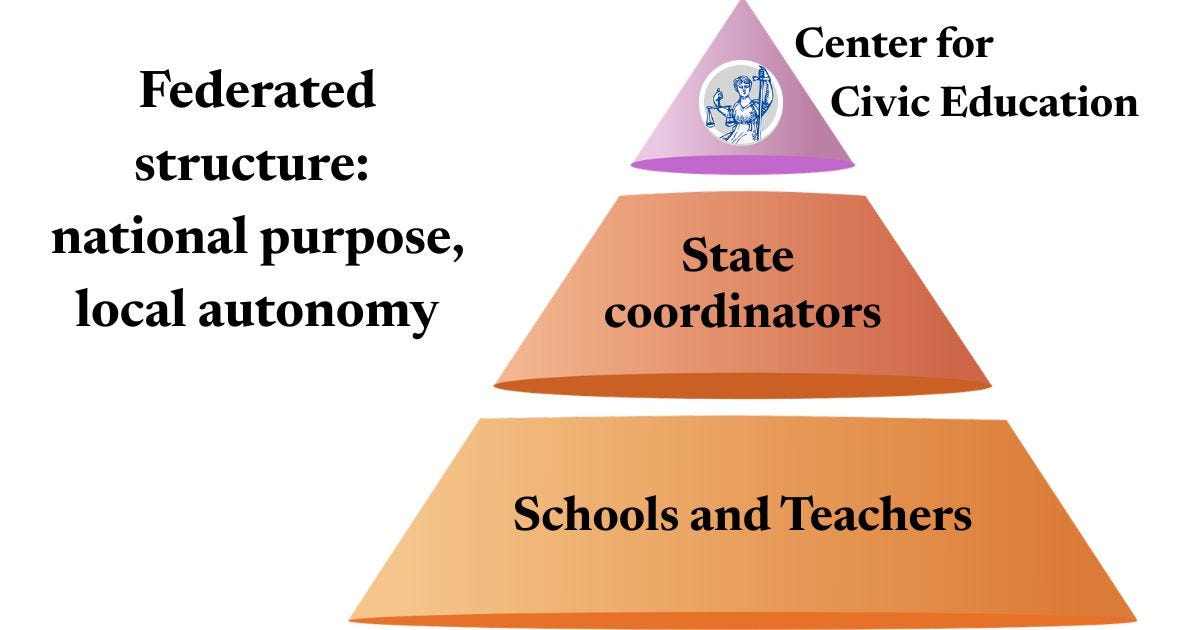
What propelled the early success of the programming was its federated model. As a national nonpartisan nonprofit, the Center provided intellectual coherence and curricular materials delivered through a network of state coordinators embedded in all 50 states and territories. Those state coordinators worked with districts and teachers to align lessons with state standards and local culture. Through this federated model, the Center cultivated trust across political lines because the model mirrored the American constitutional design itself—national purpose, local autonomy.
In 1986, this architecture finally bloomed into a complete civic learning system. The Center’s founder, Charles N. Quigley, and Dr. Margaret Branson developed We the People: The Citizen and the Constitution under the Commission on the Bicentennial of the U.S. Constitution, chaired by Chief Justice Warren Burger. Justice Burger would later call the program the “living legacy of the Bicentennial Commission.”
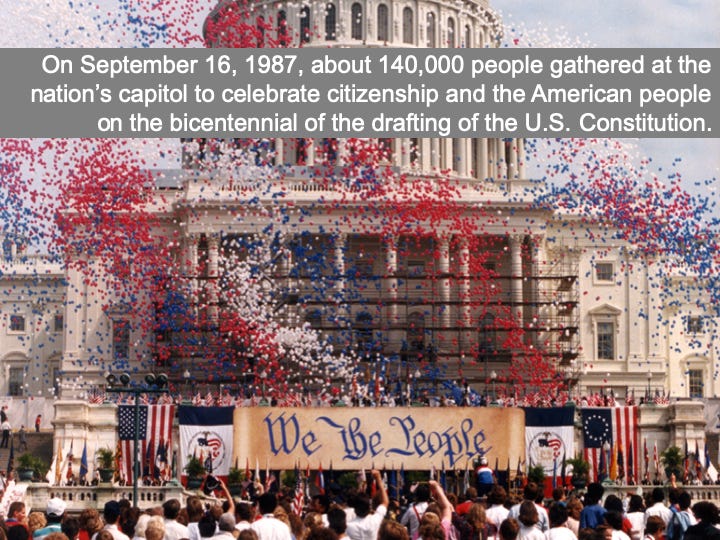
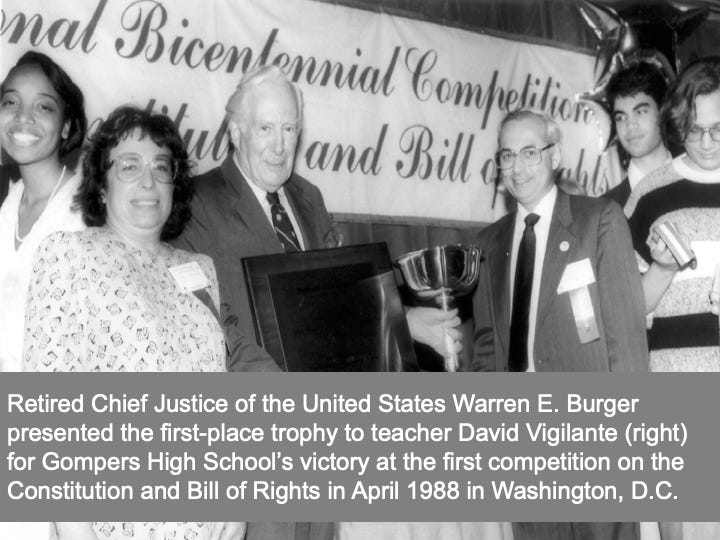
Under the auspices of the commission, the Center developed a textbook and also trained teachers to use the curriculum. The curriculum included experiential learning opportunities, including simulated congressional hearings, to support deeper learning and the development of civic skills. The Center funded events at the local, state, and national levels where students put their knowledge of the Constitution and Bill of Rights to the test, testifying on constitutional questions before panels of judges. That national culminating event — the Bicentennial Competition on the Constitution and Bill of Rights — still convenes every spring near Washington, D.C., and is known today as the We the People National Finals: the largest civic education competition in the United States.
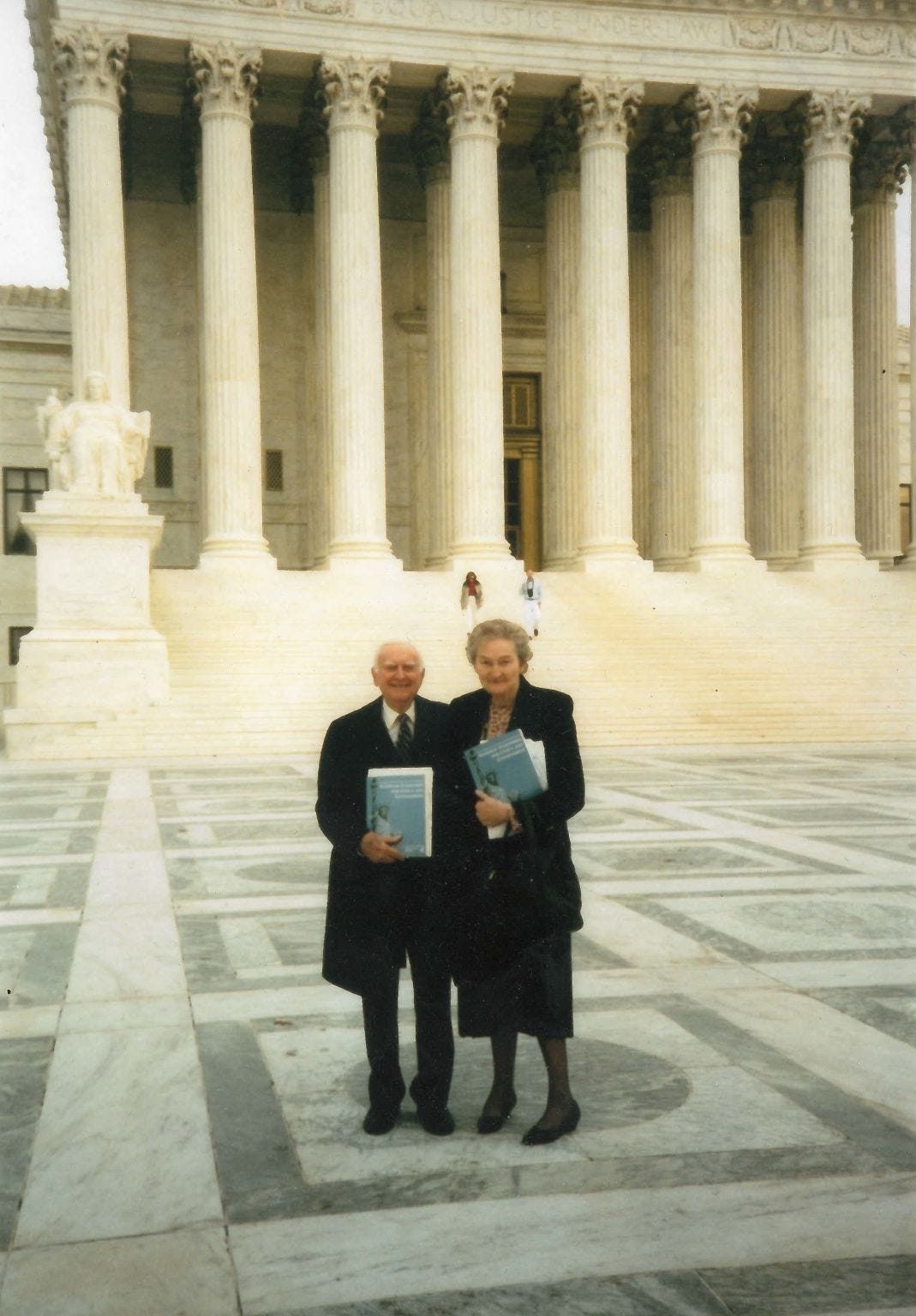
The We the People program empowered schools in every corner of the country not just to memorize constitutional knowledge but also to apply it. We the People expanded into Project Citizen, a sister program in which students identify real problems in their own communities, research them, and propose public policy solutions to public officials. These homegrown projects reflected the political culture of their communities, from Honolulu, Hawaii, to Easthampton, Massachusetts, and from Miami, Florida, to Fairbanks, Alaska.
What Success Looked Like
When the Bicentennial Commission expired in 1992, Mark Molli and the Center convinced Congress to authorize both programs in the Elementary and Secondary Education Act under what became known as the Education for Democracy Act. Over the next two decades, the annual appropriation grew incrementally, with sustained bipartisan support of $26.5 million for its domestic programs. What that investment sustained was genuine national infrastructure: free textbooks and teacher’s guides to classrooms in every state; a network of state coordinators; mentor teachers and professional development pipelines; student competitions creating civic associations across geography; dedicated programs for high-need schools, rural districts, and Native American communities. At its peak, the Center employed 98 staff with program coordinators in nearly every congressional district.
Because the programs served schools in every congressional district, the bipartisan coalition was real. Annual “Dear Colleague” letters supporting the appropriation gathered between 96 and 137 House signatures and 33 to 50 Senate signatures—co-led by figures like Kevin McCarthy and John Lewis; Richard Lugar and Debbie Stabenow; Dale Kildee and Henry Hyde. Red states and blue. Urban districts and rural ones. The programs earned that trust because they were genuinely nonpartisan—grounded in constitutional principles. As a result, the programs reached over 50 million students. What’s more, congressional funding established international infrastructure too, through the Civitas International Programs, thus extending similar initiatives to millions of additional individuals in 84 developing democracies worldwide.
As We the People spread through the state coordinator network, it built something beyond programs: a community of practitioners who laid the intellectual foundations of the civic education field itself.
In 1994, Dr. Margaret Branson and that network authored the National Standards for Civics and Government—the first voluntary national standards for civic education, developed by this network of practitioners and partners. They became the anchor document for most voluntary state civic education standards across the country.
Shortly afterwards, Center staff and practitioners from this same community developed the Civics Framework for the National Assessment of Educational Progress (NAEP)—the assessment that produces what is known as “The Nation’s Report Card.” This framework has defined what civic knowledge looks like, what gets measured, and what counts as civic literacy in American education policy.
But the unsung rise of these intellectual foundations and associations of this civic infrastructure nearly came crashing down.
Accidental Destruction
In 2007, an amendment quietly passed Congress that redefined “earmarks” to include any “directed funding” to nongovernmental entities. Earmark elimination was a national political movement for accountability and transparency, and against cronyism. Despite these good intentions, the Education for Democracy Act was caught in the undertow. No one voted against the national civic education infrastructure. Organizations like the Center for Civic Education, Street Law, the Constitutional Rights Foundation, Teach for America, and more were collateral damage in a procedural war about congressional spending rules.
In 2010, a full earmark ban eliminated directed funding entirely. Soon, the Center went from 98 staff and paid coordinators in congressional districts across the country to under a dozen. Schools lost access to free curricula covered by congressional funding. Professional development for teachers disappeared. And the same ban similarly impacted other civic education organizations.
When federal funding collapsed, the national organization contracted dramatically. But the federated architecture—the state coordinators, the partner entities, the mentor teachers—adapted. They ran programs on nothing but civic spirit. They kept networks and student events alive with volunteerism when the stipends and free materials were gone. Entities like the Indiana Bar Foundation, the King Kamehameha Judiciary History Center, the Nevada Center for Civic Engagement, Humanities North Dakota, the Civics Learning Project of Oregon, the Massachusetts Center for Civic Education, and many more all maintained civic associations and sustained statewide programming on shoestring budgets through years of feast and famine. Alongside them and many more state partners, a generation of We the People and Project Citizen teachers who had become beloved in their communities kept reaching more and more students.
Every state has a version of this story. The civic education field should know the names of some of these civic heroes, whose sheer wit and will kept the torch of civic education lit when the nation lost focus. Names like Dee Runaas (IL), Tom Vontz (KS), Glenn Manns (KY), Roger Desrosiers (MA), Marcie Taylor-Thoma (MD), Kathleen Dickinson (NV), Janis Kyser (TN), Kathy Hand (WA), Rebecca Tinder (WV), Matt Strannigan and Dick Kean (WY), and so many more.
The survival of this state-based infrastructure is not just inspiring. It is a structural argument. At a moment when some in Washington are arguing to send education back to the states, the history of this network offers a working example of how that can be done effectively: a federated model in which national investment strengthens local sovereignty, and local civic institutions prove durable enough to carry the work forward on their own.
What Comes Next
Because of what was built and what has survived, the field of civic education once again has the ripe opportunity to rebuild and improve as we look beyond the 250th. In fact, the network of civic organizations may never have been more united to do so than right now.
At the state level, coalitions have formed to reassemble the strength of universities, bar associations, and civic education organizations working together. CivXNow has striven to connect practitioners, policymakers, and partners across the country to make the case for civic learning in the statehouses, where curriculum, standards, and funding decisions are increasingly being made. And there is reason for optimism that the Center’s civic education infrastructure is being revived and improved as the Andrew Carnegie Foundation has made a significant investment aimed at strengthening and expanding the access that students and teachers once had to We the People and Project Citizen. It is a signal that the philanthropic community understands what is at stake and is willing to act.
The Center’s history indicates that this state-based focus is a powerful methodology for making durable impact since it mirrors the federated logic that made the original infrastructure work in the first place.
There is new breath in the potential for federal policy as well. Two bipartisan legislative vehicles represent the most serious proposed investments in civic education in years. Rep. Mary Gay Scanlon’s office is working to reintroduce the Teaching Engaged Citizenship Act, and the Civic Secures Democracy Act is also rebuilding support. Both offer great potential for restoring federal investment in the experiential, practitioner-led civic learning that four decades of evidence have validated. Both deserve support.
Memory as Obligation
Tolkien’s tragedy in The Fellowship of Ring was that things that should have been remembered were forgotten. That’s a threat to America’s civic education story too.
We have built an infrastructure before, grounded in constitutional knowledge and practice, to advance the promise of our nation. The question is whether we remember it well enough to build the civic education infrastructure we need for the next 250 years.