

25 States Want Congress to Act on Campaign Spending
Inside American Promise’s Effort to Pass a Constitutional Amendment.

Few issues unite Americans like money in politics.
For the second straight year, Pew Research’s annual survey found Americans rank the role of money in politics as the biggest problem facing the nation — well above inflation, the deficit, gun violence, and immigration.
Who can blame us? In the 2024 election, 300 billionaire families accounted for 19% of all federal campaign contributions, and 100 donors provided 67% of all Super PAC money. The 2026 Midterms are projected to be the most expensive political ad cycle in American history (presidential years included), with Elon Musk planning to spend at least $100 million to help Republicans.
It wasn’t always this way. In 1976, Jimmy Carter and Gerald Ford financed their presidential campaigns almost entirely through public grants. That same year, the Supreme Court’s Buckley v. Valeo ruling declared individual political spending protected speech. Outside spending climbed steadily for decades until 2010, when Citizens United extended that same protection to corporations, ushering in the Super PAC era. Today, dark money in federal elections tops $1.9 billion.
Since Citizens United, lawmakers of both parties have introduced dozens of bills to curb money in politics. Some target corporate spending, others foreign donations, dark money, or disclosure requirements. None have become law.
Cities and states have experimented with public financing of elections to help level the playing field. Seattle pioneered a democracy voucher program in 2017, which Oakland adopted in 2022. Denver, Montgomery County, Maryland and Los Angeles are among several cities running public matching-fund programs, while more than a dozen states run similar statewide systems.
But direct restrictions on spending have had a rockier path. Fourteen states have tried and failed to enact laws curbing outside election spending. In May, Hawaii broke through, becoming the first to bar corporations from spending on statewide elections outright. The law already faces a federal lawsuit, and Hawaii’s own attorney general warns it will be difficult to defend in court.
There’s the rub: so long as Citizens United stands, any state or city trying to cap outside spending faces the threat of legal action. That recognition moved Jeff Clements in 2016 to found American Promise, a nonprofit whose sole mission is ratifying the nation’s 28th Amendment, the For Our Freedom Amendment, which would empower state and federal lawmakers to regulate campaign spending.
Of course, passing a constitutional amendment is no small feat. You need three-fourths of state legislatures (38) to ratify the amendment, and two-thirds of both the House (290 members) and Senate (67 senators) to approve it.
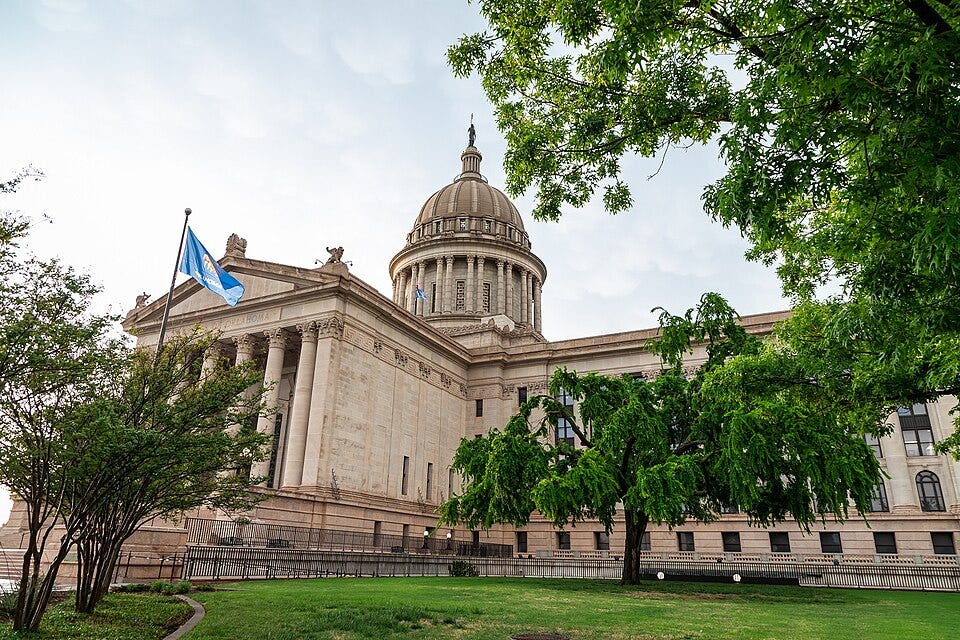
But American Promise is chipping away. This spring, the group’s efforts helped make Oklahoma and Idaho the 24th and 25th states to pass resolutions supporting the For Our Freedom Amendment.

While they devote most of their resources to state-level campaigns, American Promise maintains an active presence on Capitol Hill. In June, Rep. Tom Barrett (R-Mich.) introduced a version of their amendment in the House.
Brian Boyle, American Promise’s Chief Program Officer and General Counsel, spoke to me from the Hill last week about the recent wins in Idaho and Oklahoma, how American Promise has won over skeptical lawmakers, and the single biggest obstacle standing between the For Our Freedom Amendment and ratification.
This interview has been edited for length and clarity.
ZK: What does American Promise’s role actually look like on the ground in a state like Idaho or Oklahoma? Are you recruiting sponsors, building coalitions, doing direct advocacy — what’s the playbook?
BB: When American Promise thinks about how we engage in a state, a lot of it flows directly back to what it actually takes to amend the Constitution. We need two-thirds of Congress in both chambers to propose an amendment, and then 38 states to ratify it. One of the things we’ve found effective in demonstrating to Congress that there’s real appetite for a constitutional amendment is when state legislatures go on record calling on Congress to propose one.
We don’t swoop into a state and say, “here’s what you need to do, here’s what the resolution should say.” Instead, we try to pay attention to what’s already happening on the ground — what’s making the issue of money in politics salient for people in that state — and try to be responsive and good listeners. That’s step one: being good listeners to folks in the state, and to state legislators, about their own concerns around money in politics. We’re not there to prescribe a solution.
In Idaho, there’d been a real rise in out-of-state dark money pouring into what used to be low-dollar, sleepy state legislative races. You see the same dynamic in Oklahoma. Once we explain that their ability to address this has been constrained — essentially handcuffed — by the Supreme Court taking over this area of policy, it actually becomes not a hard sell to say: one very clear thing you can do is call on Congress to start working on an amendment.
What happens next is really driven by who the legislative champions end up being. If a legislator feels passionate and wants to be a sponsor or co-lead sponsor, we follow their lead on what would be helpful — in-person meetings to talk through how the amendment would work, answering questions, sometimes sending an expert to testify at a committee hearing if that’s useful. It’s not one-size-fits-all. It really depends on the climate in a given statehouse and what the legislators leading it need from us.
ZK: The Oklahoma and Idaho resolutions passed with near unanimous support. But I imagine it wasn’t a straight line — what obstacles came up along the way?
BB: Sometimes the obstacle is purely timing. In Oklahoma, the House passed the resolution one year, and we simply ran out of time in the Senate — it had to get picked back up the following year. A lot of states have legislative sessions that only run a few months, say January to April, so if you don’t get your business done in that window, you get timed out. In Idaho, by contrast, money in politics had become top of mind for legislators well before the session even opened — leadership was already talking about it in November and December — so we were part of that conversation early enough that the calendar wasn’t as much of an obstacle.
In terms of actual arguments, most of what we deal with is explaining how our proposed amendment differs from other versions lawmakers may have heard about. There have been proposed constitutional amendments addressing money in politics going back to the 1980s, and some of them get very prescriptive — actually trying to write specific campaign finance policy into the Constitution, or overturn a specific Supreme Court holding, like saying corporations have no constitutional rights, full stop. We make sure lawmakers understand our version isn’t prescriptive in that way. It focuses purely on the structural question: who should be deciding campaign finance policy — elected lawmakers, or judges? When we frame it as “we just want it to be you, the elected lawmakers,” that tends to land.
ZK: When there’s still pushback, is it usually First Amendment concerns, or something else?
BB: Actually, lawmakers pretty quickly understand that we’re not saying “you can’t decide, in your own judgment, to give money the same kind of protection you’d give pure speech.” Our point is: you as the policymaker may have very good reasons to want spending by people or entities to be unencumbered, and there’s probably a rich First Amendment argument to be made for that. We’re just saying you’re just as capable of working through that as judges are — so why let the courts do all of that work and take that tool out of your hands?
So the free speech argument isn’t the pushback we encounter most. What comes up more is in states with very strong one-party dominance — the minority party will sometimes ask whether, if this authority goes back to elected policymakers as the main decision-makers, they’d be at a disadvantage. So we do get those kinds of questions.
ZK: A constitutional amendment requires both two-thirds of Congress and 38 states to ratify. How does American Promise think about those two tracks — are you pursuing them in parallel?
BB: Let me back up for a second, because there are actually two steps, and each step has two possible pathways. Step one is proposal of the amendment’s language — that can happen through two-thirds of Congress, which is how all 27 amendments to date have been proposed, or through a convention of states, which has never actually happened. Our strategy is proposal by Congress. Step two is ratification, which can happen either through three-quarters of state legislatures, or through ratifying conventions in three-quarters of the states — that’s only happened once, for the 21st Amendment. Our strategy is ratification by state legislatures, since that’s the method that’s actually been used successfully.
In terms of how that feeds into our strategy: when states take action showing their appetite for an amendment, that demonstrates constituent pressure and state lawmaker support, which genuinely informs the conversations happening on Capitol Hill. But there’s also a separate, practical need — you need 38 states to actually be in a position of awareness and readiness to ratify once an amendment comes back to them. So the work at the state level serves both purposes: building pressure on Congress now, and preparing states for the ratification process later.
ZK: What states are next on American Promise’s radar? Idaho’s press materials mentioned over a dozen states actively considering similar resolutions.
BB: For 2027, we’re still figuring out where it makes sense to re-up efforts, but I can share a few states where at least one chamber has already voted in favor:
Wyoming — the Senate voted in favor; we ran out of time to get it taken up in the House.
Indiana — the Senate voted in favor overwhelmingly; we’d look to pursue something in the House next.
Arizona — the Senate voted in favor overwhelmingly, same situation.
Missouri — the House passed it unanimously, but the legislative session wrapped up in early May before the Senate could take it up.
None of these were voted down in the other chamber — they just didn’t get taken up in time. So we’re optimistic there’s broad support to build on in a new session.
ZK: If you could wave a magic wand and remove any obstacle, recruit any ally — what’s the one thing standing between where American Promise is today and getting this across the finish line nationally?
BB: This might be a surprising answer. I think there’s a real skepticism, especially among what you might call “the thinking class,” about whether the Constitution is even amendable anymore. If we could normalize the idea that the amendment process is actually viable, that would help more than almost anything else.
If you have a suggestion for someone else to invite, please contact us!
Join us for the next Renovator Assembly, a conversation for paid subscribers on Thursday, August 6, at 7 p.m. ET, with Lisa Rice. Lisa founded Make All Votes Count DC and led the campaign that passed semi-open primaries and ranked-choice voting with nearly 73 percent of the vote in November 2024. Then she kept going — building Grow Democracy DC to fight the litigation and the recalcitrant City Council through implementation, winning the Council’s reversal on semi-open primaries just last month. She’ll talk with us about how her organization pulled off major change against entrenched opposition, where she found the resilience to sustain it, and what comes next.
Paid subscribers can find the Zoom registration link below.