

Lisa Rice: Washington D.C.'s Democracy Renovation Hero
Join Renovators and Lisa Rice live at the next Renovator Assembly

Lisa Rice: Washington D.C.’s Democracy Renovation Hero
Join Renovators and Lisa Rice live at the next Renovator Assembly, Thursday, Aug. 6, at 7pm ET. Zoom registration link available to paid subscribers.
All over the country people are wondering: What’s the vision for a healthy democracy that can respond to people’s frustrations? Often people seem to want a single, telegenic, media-savvy figure to deliver THE ANSWER—Donald Trump, Bernie Sanders, AOC, Zohran Mamdani, Graham Platner. I was at two conferences last week focused on democratic backsliding and the future of liberal democracy. So many people seemed to be reaching. “Where is that next vision?” they ask urgently.
At The Renovator, we believe the answer will come from ordinary citizen-leaders who are already driving fundamental, transformative democracy renovation all over the country. People like Juli Lucky in Alaska, whom we met at the last Renovator Assembly, and Lisa Rice, in Washington, D.C., whom we will meet at our next one.
In Alaska, where Juli Lucky led a renovation coalition, a new Top 4 election system has enabled a bipartisan governing coalition to tackle pressing problems in the state legislature: increasing funding to the education system; passing a budget on time; reforming insurance to drive down costs for commercial fishermen; reforming digital corporate taxation; and addressing access to affordable child care. Procedural transformation changes the agenda and re-aligns incentives so legislators can get things done for the people.
In Washington, D.C., the democracy renovation hero is Lisa Rice.
After the 2016 national election, Lisa was fed up with partisan politics. She disenrolled from the Democratic Party, stepping away from a membership shared by 77 percent of registered voters in the District, a genuinely one-party city. Independents make up about 16 percent of Washington’s voters, and Republicans only 6 percent. But politics was just one of her problems. A marketing professional, with personal superpowers in arts and civic engagement, Lisa soon found herself in 2017 facing a breast cancer diagnosis. This was a family inheritance. Her mother had also had a serious battle with breast cancer.
When the next election rolled around, even though Lisa was engaged in an intense personal trial, she took note when her ballot didn’t arrive in the mail.
Washington, D.C., generally mails ballots out to voters. Her husband, still registered with a party, received his. Lisa is powerfully attached to her right to vote, so she called up the election administrators and asked about hers. She was told that since she had disenrolled from a party, she would no longer be getting a ballot for D.C.’s party primaries. Because D.C. is such a one-party city, general elections are a foregone conclusion; the primary is the only election that matters. Lisa had been disenfranchised from the only consequential election available to her.
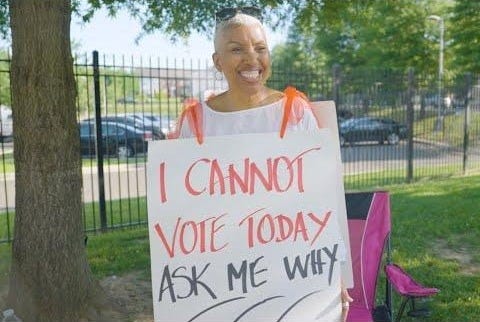
Lisa was furious and—a few swear words later—started learning more. Taxpayers fund primary elections in D.C., but to participate in them, if you are an independent, you have to go through what people call “the kabuki dance.” Twenty days before the election, you enroll in a party. Then you vote. Then you disenroll again. Compelled association—arguably a violation of First Amendment rights—was the only way you could get access to the vote.
Lisa looked around to figure out who was doing something about the problem. There was no one. During treatment for breast cancer, she had quickly learned that she was her own best advocate. Now, in the election context, too, she realized that if she wanted to get her right to vote back while also preserving her ideological independence, she would have to take matters into her own hands.
In 2023, she made it to survivor status in her breast cancer journey. But she didn’t rest. She had already founded Make All Votes Count DC, and in mid-2023 the organization proposed a ballot initiative to bring the Alaska model to Washington, with some tweaks. Alaska has an all-party primary, where the top four vote-getters go on to a general election with ranked-choice voting. The advocates in D.C. couldn’t get all of the way to an all-party primary, for various place-specific reasons, so they sought to combine a semi-open primary, where independents can participate and pick whichever party ballot they want on Election Day, with ranked-choice voting in the general election. The goal was to re-enfranchise the independent voters with no way to vote in the city’s only consequential elections. As Lisa liked to say, one in eight people in D.C. had or would get breast cancer. One in six couldn’t vote.
The reform effort was dogged by waves of litigation throughout. The Democratic Party jumped out in opposition immediately, bringing a suit. But in November 2024, the measure passed with nearly 73 percent of the vote.
Did the renovation work end then, though? Far from it. The litigation from the Democratic Party continued, but so did opposition from the D.C. Council, itself dominated by the party. Implementation was going to require resources. The Council decided to implement the shift to RCV for primaries but not to fund the semi-open primary. As a result, in June 2026 D.C. used RCV for the first time, for a primary election and special election, but Lisa still couldn’t vote in it. The election was still open only to people formally registered in parties.
But Lisa was still on the case. After winning the ballot measure, she had set up another organization, a nonpartisan nonprofit called Grow Democracy DC, to support the implementation work. Partnering with another group called the Campaign Legal Center, Grow Democracy DC fought the Democratic Party’s lawsuits and fought the recalcitrant city council.
Last month, faced with rising frustration from voters, actively organized by Grow Democracy, the City Council changed direction and agreed to implement semi-open primaries. Washington, D.C., is now on the starting line of a new election system that lets voters in.
Now we will have to track what responsiveness follows. Can this reform hit the target? Will this procedural change shift the agenda and re-align incentives so legislators can get something done for the people? A vision of a world where elected officials both listen to the people and get something done is coming into being in places like Alaska and D.C. We can build off the vision of what’s next from these real, on-the-ground victories.
Lisa will join us at the next Renovator Assembly, Thursday, Aug. 6, at 7 p.m. ET, to talk about how her organization pulled off major change against entrenched opposition, how she personally found the resilience to do this work, and what comes next.
Our future country is already visible in Lisa’s story, just as it was in Juli’s. All we have to do is listen, learn, and join in.