

Join us on Wednesday at noon Eastern Time as we go live for Headstrong Club, to hear about how community colleges are working to save democracy! Julie White is the president of Pierce College Fort Steilacoom, a community college in Washington State. She’s been working at community colleges and celebrating them for over 25 years, and as a testament to her success in building civic engagement across the institution, this year she was the winner of Campus Compact’s Eduardo J. Padrón Award for Presidential Leadership.
Just after July 4th, a bus rolled through Pennsylvania, Ohio, and Michigan carrying an unusual array of passengers: sitting and retired judges on their way to talk with ordinary Americans about the Constitution.
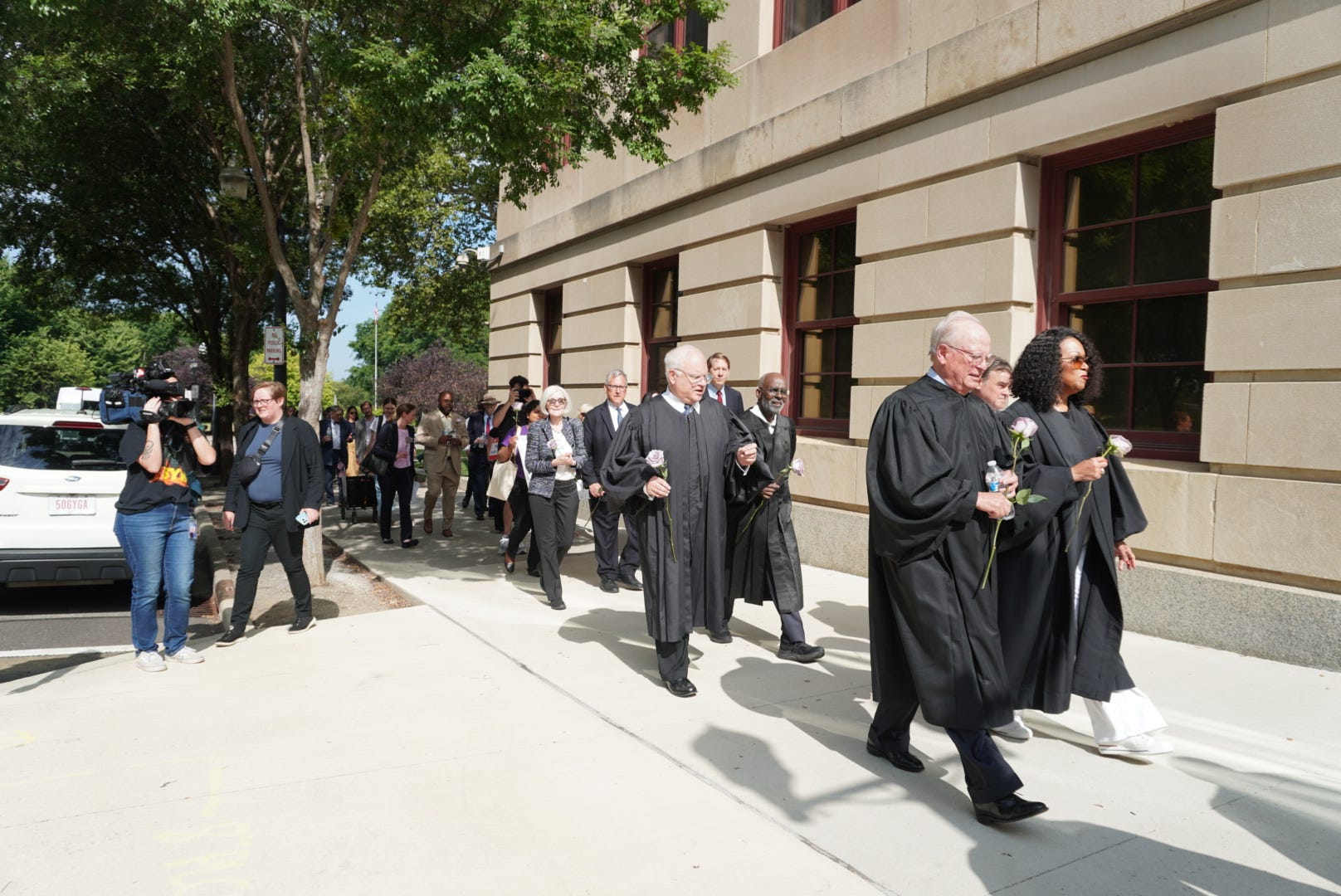
The tour, called Justice in Motion, is easy to describe and a little surreal to picture. Over four days, judges and civic leaders held press conferences, community panels, and meet-and-greets in small towns and big cities. There was a “March of the Robes” from the federal courthouse in Columbus to the Ohio Supreme Court that emulated the iconic March of a Thousand Robes in Warsaw in 2020. There was a fireside conversation with the Chief Justice of the Michigan Supreme Court at the Grosse Pointe Public Library. There was a BBQ lunch at Cleveland’s ThirdSpace Action Lab where community members ate chicken from Pearl’s Kitchen and talked with jurists about why courts matter. In Cleveland, retired Ohio Supreme Court Justice Michael Donnelly told a crowd gathered outside the Carl B. Stokes U.S. Courthouse — law students, Girl Scouts, Stokes Scholars, and students from the Law and Leadership Institute — that every generation inherits the same question about the Constitution: will they leave it stronger than they found it, or weaker?
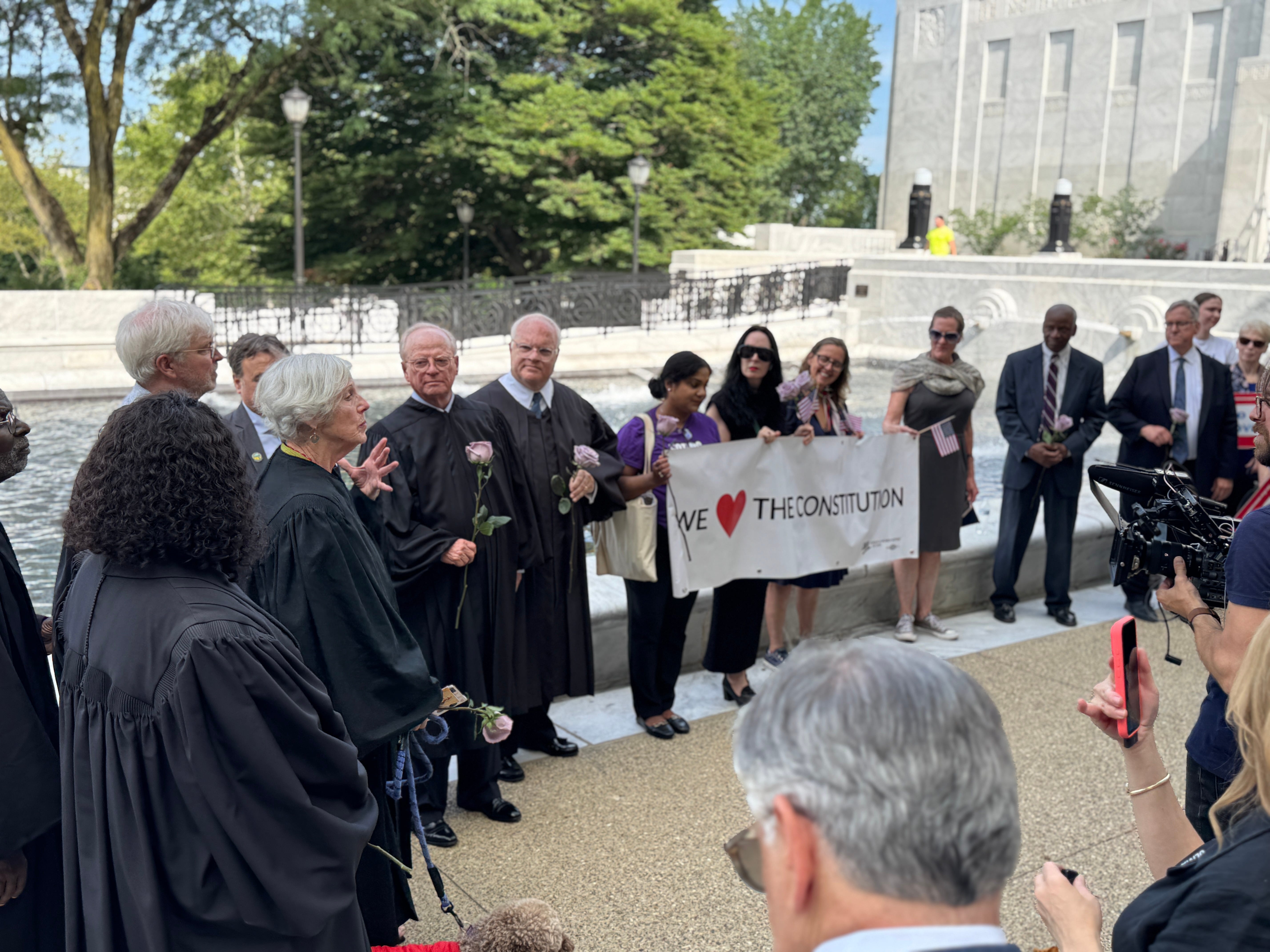
Justice in Motion — the first tour of its kind in the United States, with more planned to follow — was organized by our organization, Democracy Rising Collaborative, and our partner Keep Our Republic.
The idea didn’t start with a bus, though. Last October, The Carter Center’s Rule of Law Program brought a delegation of U.S. lawyers and civic leaders to Warsaw for a study tour, to sit down directly with the Polish judges and lawyers who had spent years defending their courts. They were joined by democracy leaders from Georgia, Slovakia, Hungary, and Romania, as well as from the Hungarian Helsinki Committee. Steve was part of that trip. It’s where we first heard, in detail, how they’d done it. As we launched Democracy Rising Collaborative last November, the idea of a bus trip as a kind of listening tour began to take hold. We drafted a concept paper and shared it with a few trusted colleagues in the pro-democracy space, including colleagues who had been on the Warsaw trip. The feedback was universally positive. Before long, we were talking with Keep Our Republic about actually doing a judges’ bus tour.
That sentence about what every generation owes the next — the one Justice Donnelly offered a crowd in Cleveland — is doing more work than it might seem. Judges don’t normally stand outside courthouses asking crowds to think about what they owe the next generation. They write opinions. They preside. They stay, by design and by professional norm, above the fray, deciding cases rather than making speeches about how they do their work and why deciding cases matters. Justice in Motion breaks with that. It puts judges in front of communities not to rule on anything, but to engage in face-face dialogue, answer questions, and explain, plainly and personally, what the rule of law and independent judiciary are for and why threats to judges, their families, and staff are never OK.

That’s a real departure, and it’s worth sitting with why it’s happening now.
The short-term case is obvious. American courts have been under sustained attack for years — not the ordinary friction of appeals and dissents, but a campaign to delegitimize judges themselves: to paint rulings political actors dislike as illegitimate by definition, to threaten and intimidate jurists, to treat “independent judiciary” as a euphemism for “obstacle.”
And that is just the rhetoric. Physical threats, doxxing, and other forms of intimidation have only become increasingly prevalent. On July 14th, Supreme Court Justices Amy Coney Barrett and Elena Kagan testified before Congress about threats to the safety of members of the Court. Barrett said that the threat level is “really high.” Kagan attested that the Supreme Court Police anticipated a “very substantial” 38% annual increase in threats. No matter how you feel about the Court’s decisions, threats of violence against public servants or their families are never compatible with democracy or justice.
Judges have rarely responded to this kind of pressure and these threats, on the theory that silence protects impartiality and that others will respond on their behalf.
But silence has a cost too. If the only voices explaining what courts do are the ones trying to discredit them, the public absorbs a distorted picture by default. A tour like this is, in part, triage: judges showing up in person, in communities that rarely see them outside a courthouse, to say plainly that the rule of law and an independent judiciary are not partisan weapons; they’re the things that let a democracy settle its disputes without violence. It is one of the concepts that make the United States what it is.
What the rule of law and an independent judiciary actually mean
None of this was abstract in Columbus, Grosse Pointe, or Cleveland — it’s what the judges on that bus were trying to explain, town by town: not a legal abstraction, but something people experience in their everyday lives.
The rule of law is a simple idea, even if the phrase sounds abstract: the same rules apply to everyone, including the people in charge, and everyone can count on that in advance. It’s why, when you deposit money in the bank, you don’t have to wonder whether it’ll still be there tomorrow. It’s why, when a police officer pulls you over, there are actual limits on what happens next — you have rights in that encounter, and both of you are subject to the same rulebook. It’s why a small business owner can sign a contract with a much bigger company and trust that if the bigger company breaks it, a court will enforce the deal anyway, size and power aside. It’s why a family can buy a house and know the deed means what it says, ten or twenty years later, no matter who’s in office. These are the same ideas that many of the judges on our tour spent days talking about with their fellow citizens.
None of that happens automatically. It happens because courts exist that will enforce those rules on your behalf, even against someone powerful — and that only works if judges are actually free to rule that way without getting threatened, fired, demoted, or squeezed for it. That’s what judicial independence is: judges who are free to decide a case on the law and the facts, rather than on a shifting political climate, because they can’t be removed or punished for a ruling those in power dislike; and courts whose decisions can’t simply be ignored once made.
If the courts are delegitimized, the rule of law stops being real, even if the words stay on the books. The bank account is only as safe as whoever has the power to seize it. The traffic stop only goes well if you’re the right person, or you know the right person. The contract only holds if the other side doesn’t have more leverage than you. Laws still exist, but they’ve stopped being a shield — they’re a tool, available to whoever’s currently in charge, aimed at whoever they want it aimed at.
An independent judiciary does more than referee everyday disputes fairly, though. It’s also the place a person can go to argue that a law itself is unconstitutional — even a popular law, passed by a large majority, that no legislature has any incentive to revisit. Take away that neutral forum, and there’s nothing left to stop the majority’s preference from simply becoming the rule for everyone it leaves out.
It’s also why the judiciary exists as its own separate branch, rather than an arm of whichever branch currently holds the most seats or the loudest microphone. Congress writes the laws, the executive enforces them, and courts decide what the laws mean and whether they were followed — three different jobs, held by different people, precisely so that no single branch can do all three at once. An independent judiciary is what keeps that arrangement from collapsing into one: without it, whichever branch is willing to lean on the courts hardest ends up holding all the power, not just its own share of it. Our Founders designed our Constitution to avoid any one branch becoming too powerful.
That’s the actual stake in impeachment threats over a controversial ruling, or a refusal to comply with a court order: not a procedural skirmish, but whether disputes in this country get settled by law, or by whoever has the power to disregard a result they don’t like. Even when we disagree with a decision, it’s in our interest to uphold the independence of the judiciary that made it, because the alternative weakens the rule of law in general.
Justice in Motion drew packed rooms and extensive local and national press in three states over four days — evidence of an appetite for more tours like it elsewhere. That appetite is the useful signal here. The tour worked as a bold response to a moment of extraordinary pressure on the judiciary. It could also work as the seed of something sustained and durable: a standing corps of jurists treating public explanation of judicial independence as part of the job description rather than an occasional exercise.
Defending judicial independence right now is necessary, but it’s not sufficient — the underlying vulnerability isn’t this attack or that one; it’s that most Americans never learned, in any durable way, what the judiciary is or why it’s built to be independent. You can’t defend an institution you were never taught to understand. And civic education in this country has been in slow collapse for decades, squeezed out by testing regimes, budget cuts, and the assumption that democratic literacy would just happen by osmosis.
Long-term, what we’re proposing is something closer to infrastructure — one more piece of the civic architecture a democracy needs so that the next attack on the rule of law meets a public that already understands what’s actually at risk. Authoritarian drift doesn’t get stopped in a single news cycle. It gets stopped, over time, by citizens who understand what they’re at risk of losing. That’s a slower fight than a bus tour, but the bus tour is a good place to shine a light on this foundational institution of our Republic.
Danny Miller and Steve Silverman are attorneys and the co-founders and co-directors of Democracy Rising Collaborative, an organization that mobilizes lawyers, retired judges, and civic leaders across the country to stand up for the rule of law.
Join us for the next Renovator Assembly, a conversation for paid subscribers on Thursday, August 6, at 7 p.m. ET, with Lisa Rice. After being told she could no longer receive a ballot in Washington, D.C.’s only consequential elections, Lisa founded Make All Votes Count DC and led the campaign that passed semi-open primaries and ranked-choice voting with nearly 73 percent of the vote in November 2024. Then she kept going — building Grow Democracy DC to fight the litigation and the recalcitrant City Council through implementation, winning the Council’s reversal on semi-open primaries just last month. She’ll talk with us about how her organization pulled off major change against entrenched opposition, where she found the resilience to sustain it, and what comes next.
Paid subscribers can find the Zoom registration link below.