

Why the United States Needs a Nationwide Journalist Shield Law
Trump Administration's Latest Subpoenas to Reporters Attack Press Freedom.

On July 10, the Trump Administration fired the latest salvo in its ongoing attack on the freedom of the press. It issued subpoenas to four New York Times reporters who had authored a story about inadequate security measures on the president’s new Air Force One.
Their story appeared just two days earlier. “President Trump,” they said, “flew out of Turkey on Wednesday night on the old Air Force One instead of his new Qatari-donated Boeing 747-8 as a security precaution related to the resumption of hostilities with Iran… The swap deepens questions about whether the new plane, which the president had pressed to be ready as soon as possible, was retrofitted with sufficient security measures over the last year.”
The subpoenas, some of which were served on the reporters at their homes, ordered the Times journalists to testify in a federal grand jury proceeding on Wednesday. It is likely that they will be asked to reveal the sources who provided them with information about the new Air Force One’s inadequate security measures.
Such a bold assault on press freedom and attempt to discourage people from providing information to journalists should not have come as a surprise. In April 2025, Attorney General Pam Bondi repealed a policy of the Biden Justice Department that prevented it “from seeking records and compelling testimony from members of the news media.”
She accused the Biden Administration of using that policy to protect “media allies [who engaged] in selective leaks in support of failed lawfare campaigns.” Bondi added, “The leaks have not abated since President Trump’s second inauguration, including leaks of classified information.” And she announced that “This Justice Department will not tolerate unauthorized disclosures that undermine President Trump’s policies, victimize government agencies, and cause harm to the American people.”
Trump’s attacks on journalists are too numerous to count, but threats of criminal prosecution represent an escalation. In April of this year, the president threatened to jail reporters who published a story about a plane the Iranians had shot down and the administration’s efforts to rescue one of its pilots. Referring to confidential sources, President Trump’s policy is “‘Give it up or go to jail.’”
That is why it is time for Congress to enact a national journalist shield law. Such a law would “protect journalist-source confidentiality,” except in “cases involving terrorism, other serious emergencies, or journalists suspected of crimes.”
Two and a half years ago, the House of Representatives passed such a bill, the so-called Press Act, but it died in the Senate. It was sponsored by Democratic Representative Jamie Raskin and Republican Kevin Kiley in the House.
As the subpoenas issued to the New York Times reporters suggest, it is more important than ever that reporters be provided protection. Without it, the current administration and any future one can harass and threaten journalists and choke off the information they need to tell stories that the government does not want told – or create a hostile environment that dissuades them from pursuing those stories at all.
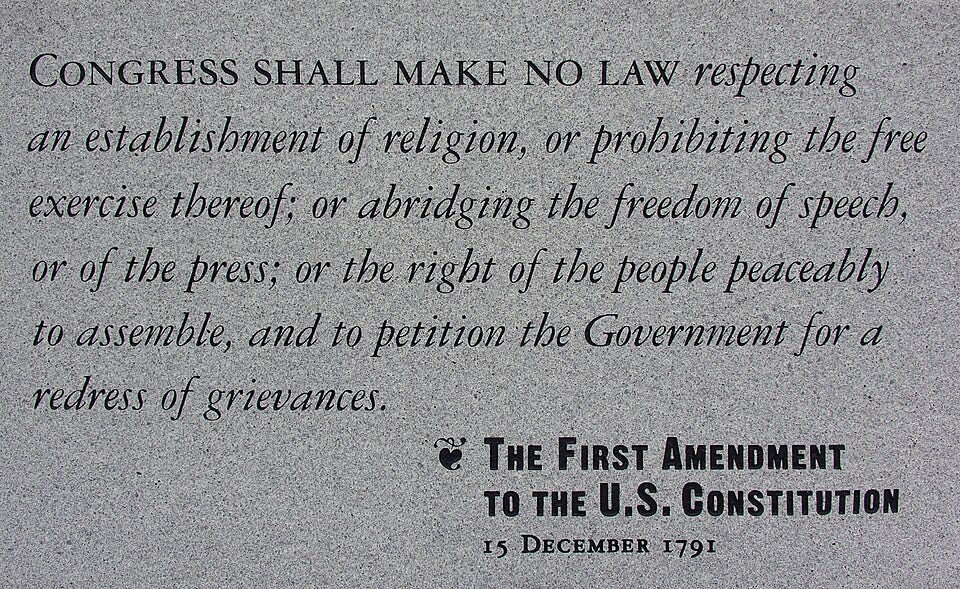
More than fifty years ago, in 1971, Supreme Court Justice Hugo Black described the press’s essential role this way in his opinion in New York Times Co. v. United States: “In the First Amendment, the Founding Fathers gave the free press the protection it must have to fulfill its essential role in our democracy. The press,” he wrote, “was to serve the governed, not the governors.“
As Black put it, “The Government’s power to censor the press was abolished so that the press would remain forever free to censure the Government. The press was protected so that it could bare the secrets of government and inform the people. Only a free and unrestrained press can effectively expose deception in government.”
In Black’s view, the First Amendment only prevents the government from stopping the press from publishing something. That’s it. He said nothing about providing reporters with protection so they can get the information they need from sources who will provide it only if they are confident their identities will not be revealed. His opinion established a precedent that seriously undermined the freedom of the press and laid the groundwork for Bondi’s DOJ today.

One year later, in Branzburg v. Hayes, the Court considered the case of a reporter who “declined to testify before a state grand jury about information that he had obtained for a newspaper in an investigation of drug activities.” It refused to go beyond what Black had written and held that “there is no testimonial privilege for reporters that goes beyond protections for ordinary citizens.”
The Court downplayed the chilling effect that being forced to choose between revealing sources or going to jail might have on press freedom. As Justice Byron White observed in his majority opinion, “There is a stronger public interest in deterring crime than in preserving the flow of news.”
That is exactly the position articulated in Bondi’s 2025 decision to have the Justice Department get back into the business of compelling reporters to reveal their sources.
Looking back on those Supreme Court decisions, the New York Times editorial board was right to say in 2024 that doing the job Black assigned to the press, i.e. censuring the government, “depends…not just on journalists but also on brave officials willing to sound the alarm about government misconduct. Even when their disclosures are clearly in the public interest, these whistle-blowers — or sources, in the journalistic parlance — often hide their identities to avoid punishment or retaliation.”
“In this way,” it continues, “bringing essential information to the public often depends on protecting the identity of the person sharing it.” That is why the editorial board wrote that “A Reporter’s Shield Law Is Vital to Prevent Abuses of Power.”
Fortunately, state governments recognized the danger of the Branzburg precedent. They responded by enacting journalist shield laws to cover reporters within their own jurisdictions. The Reporters Committee on a Free Press suggests that “a national consensus has emerged among the states, establishing protections for journalist-source communications.”
In forty-nine states and the District of Columbia, either the state legislature or courts have recognized a privilege for reporters to withhold information about their sources. Wyoming is the only outlier.
Many other countries have also passed laws recognizing a reporter-source privilege. They include Austria, Norway, Belgium, France, and the United Kingdom. Spain, Sweden, Portugal, and Germany go further and protect this privilege in their constitutions.
It is time for the federal government to join them, by legislation if not a constitutional amendment.
As the Times put it in 2024, ”the need [for federal action] is arguably greatest, in part because of the rapid evolution of electronic snooping and the fallout of sharply polarized politics.” It is also important because the reach of the administration in Washington, D.C. is much greater than that of any state.
At present, neither legislation nor constitutional change can come in time to help the reporters who uncovered the truth about the new Air Force One. But without such change, the project of protecting press freedom in this country will remain radically incomplete.
 | A guest post by
|
Thanks Austin. I couldn’t agree more. Most Presidents and administrations have gone after the press at points in their terms. But, at the risk of cliche, we seem to be operating now in a perfect storm that risks obliterating what’s left of serious accountability journalism in the US: the massive decline in independent, in-depth, hard reporting journalism; the constant law breaking and corruption of the Trump Administration that cries out for press coverage and review; the increasing subservience of business leaders as they consolidate media control; and the unprecedented level of attacks on the remaining sources of accountability focused reporting.
In a time when rightwing influencers and their sort promulgate all kinds of nonsense, that the Justice Department would now go after NYT reporters makes clear how this admin fears the freedom of the legitimate press, i.e., with long established, tried and proven, policies, source-checking and cross referencing, practiced by trained and experienced journalists and editors ... the NYT is not some run-of-the-mill rag/podcast/substack outta Alabama. I suspect nothing will come of this, but it'll be a costly process (financially and emotionally) for these reporters, their families, and the NYT.
Thank you for this post.