

Why Should I Care About the Semiquincentennial?
A User-Centered U.S. 250th – and Beyond – for the Youth Wave.
In our last post, we shared that institutions commemorating America’s 250th, the semiquincentennial, will get a lot more Gen Z-ers engaged if they involve them in designing activities from the start, with civic opportunities that meet them where they are. But this argument presupposes that our institutions’ leaders care about reaching young people. Why should they care about connecting to young people during the nation’s birthday, with so much else going on?
Of course, the 250th presents an opportunity to cultivate an informed, prepared citizenry – valuable in its own right. But here are three more big reasons to brainstorm ways to engage young people now.
Riding the Youth Wave
First, there’s an incredible collision taking place: The nation turns 250 just as the biggest American generation ever crosses the threshold to adulthood.
The largest birth year in U.S. history was 2007, with a new baby boom of 4.3 million children born. Those 2007 babies are now the high school class of 2026. The sheer size of this cohort is already shaping politics, culture, the workplace and consumer trends.
Today’s young people are in fact part of a global youth wave. More than 40 percent of the world’s population is under 25. Youth political movements have taken hold in Nepal, New Zealand, Madagascar and Morocco. Institutional leaders can’t ignore this impact – and if they’re smart, they’ll embrace it, recognizing that we can either change with this generation or be changed by them.
Beginning the “commemorative decade” on the right foot
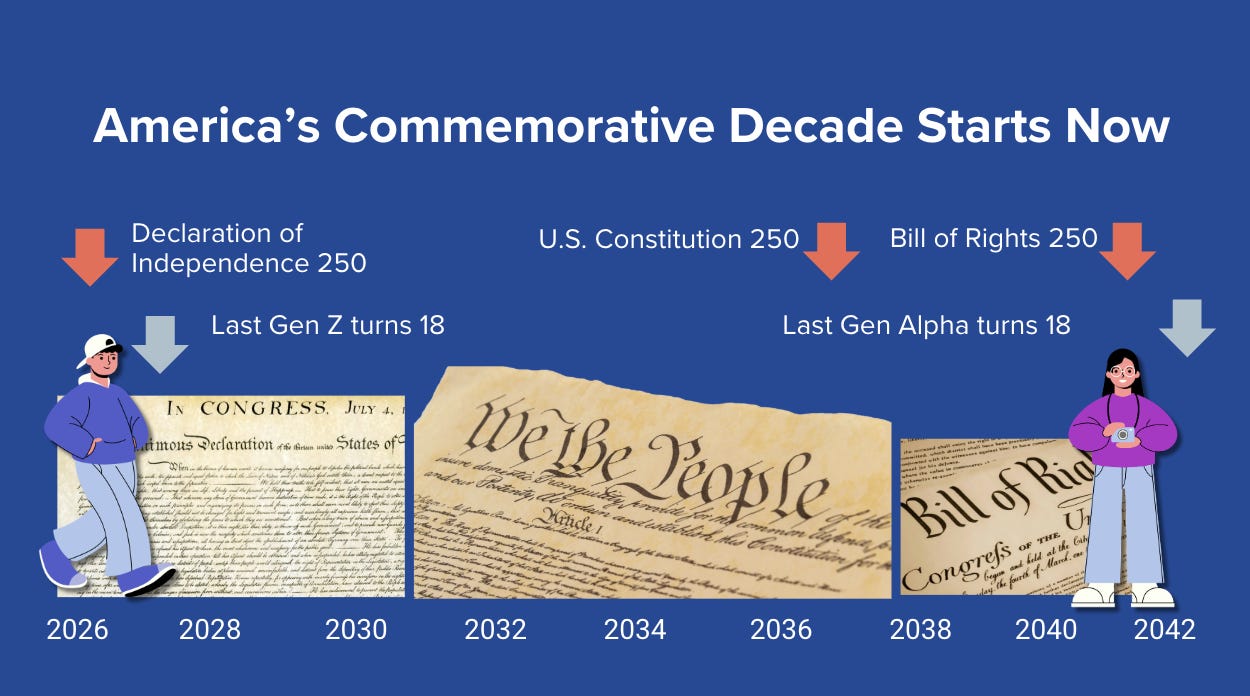
Second, all those young people are pouring into our systems every year — voter rolls, the workforce, the stock market — and driving a wave of change that will span America’s “commemorative decade.” The 250th is just the start of that decade. All our founding documents will cross the quarter-millennium milestone between 2026 and 2040, as all of Gen Z and Gen Alpha step into adulthood. If we want these founding documents, and the ideas and inspiration they contain, to inspire a new generation to understand, sustain and improve our democracy, we’ll need to build the institutional muscle to connect with youth – not just for the 250th, but for the next 15 years.
Closing the trust gap
The decade ahead presents an opportunity to close the gap between young people and our institutions, and rebuild some level of trust, currently threadbare. On the other hand, a commemoration that’s disorganized, out of touch, or simply a snoozefest only furthers disinterest and disengagement, diminishing trust in institutions. It opens the door for alternate celebrations with partisan or exclusionary motives to take root.
The disparity between the demographic shape of the country and of power-holders is palpably felt among Gen Z. They are quite aware that institutional leadership in America is far away — demographically, culturally, socially, economically — from young people’s everyday world. The laws that get passed, issues that get attention, and systems that seem intractable drive this home.
Twenty-four members of Congress are over 80, and half of those are running for re-election this year. Meanwhile, more than half of Gen Z identifies as politically independent, and only 16 percent thinks democracy is working well. Many civics events trot out current and former Supreme Court justices as speakers meant to inspire youth, but only 17 percent of Gen Z thinks the Supreme Court can be trusted. The median age of cable TV news viewers is 70. The old guard has come and gone, but they’re still on TV. This is the ecosystem young people are experiencing during this commemoration.
Of course, Gen Z is not the first to encounter an “out of touch” ruling class. That’s practically a rite of passage. But young people today are using a myriad of new tech tools and media to express ourselves and to connect with each other in everyday life, a constantly evolving landscape that is disconnected from our institutions. Actually, I’ve come to see Gen Z as a “canary in the coal mine” for how many Americans of all ages are feeling: unheard, unconvinced and unsure who to trust.
So how do we get young people’s help to write the next chapter for our institutions?
Design thinking rests on this liberating principle: You can’t get people to do anything. You can only design for their underlying need.
Four key questions
Across our work with museums and cultural and civic organizations trying to reach youth audiences, we’ve found that young people – actually people of all ages – are asking four key questions before participating in civic life:
Is this for me?
Who else will be there?
Do I know enough?
Why should I care?
We’ve seen the most success from initiatives that address these questions up front, and lead with information that’s important to the user, not the institution.
When it comes to the U.S. 250th commemoration, have we addressed these four questions? Some recent views from our youth community at Made by Us reveal a blunt reality; young people do not think the celebration is for anyone other than institutional power-holders, and they certainly don’t think it’s for them, as our December 2025 polls showed:
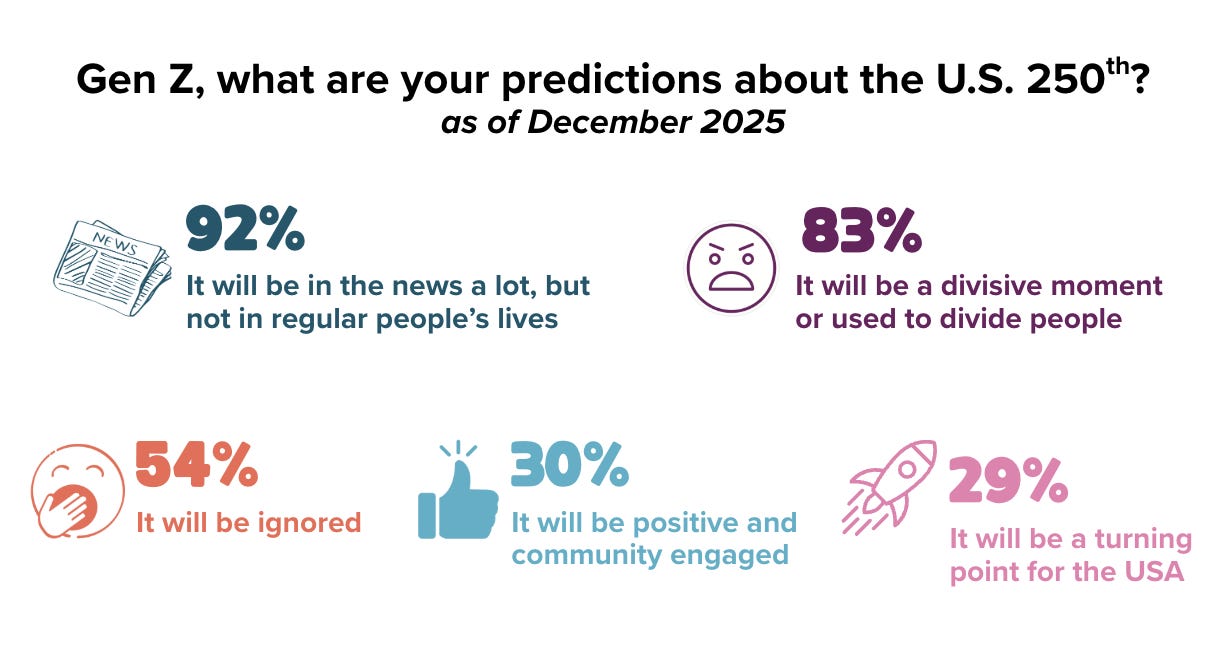
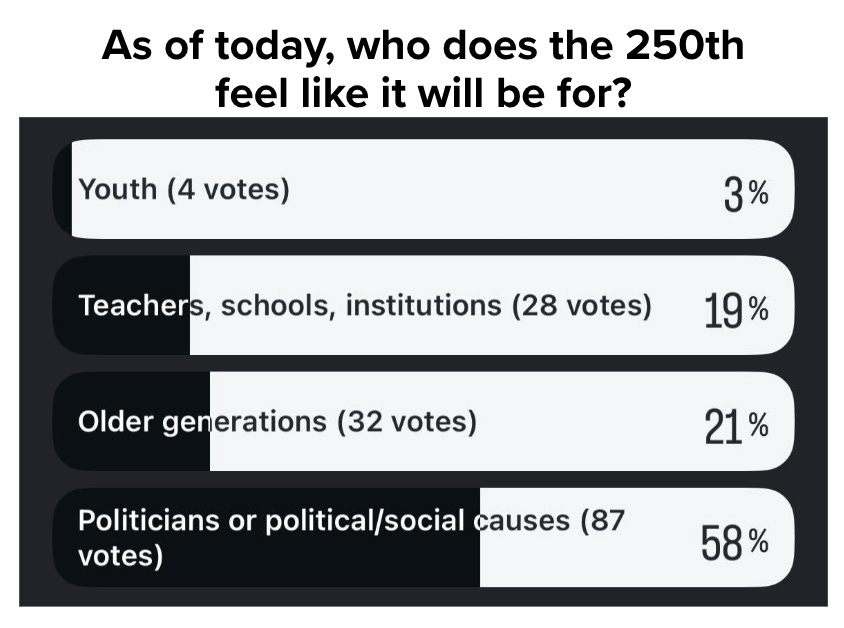
These data points suggest we’re headed toward a missed opportunity to seize upon a generation’s emerging and keen — if unsteady and uncertain — interest in contributing to American life and a better future.
Gen Z wants to participate. They want to be heard and improve things and volunteer and make their own meaning out of this complicated and changing nation. They would rather not be on their phones all the time, pay a gazillion dollars for a college degree, or have to make new friends in the most polarized, sensitive and always-recording social climate to date. They are voting with their wallets, their time and their votes (or non-votes). They are wondering how they can make it any clearer to the rest of us that the future is not abstract, but in fact arriving daily.
The 250th is an incredible, once-in-a-generation moment to usher in a better future. Commemoration is one of the few avenues average Americans have to shape our national story, from monuments to street names. This moment will be defined by both the past that we honor and the future that we imagine and build toward. If done well, it’s a great test kitchen for how we might reconfigure other aspects of civic life to better appeal to and engage young people — and people of all ages. So how can we turn the youth-excluding dynamics around?
Building Better On-Ramps
When we take the time to measure civic opportunities, we learn there is a glut of supply for civics resources and ways to take part in civic life. We also know Gen Z has an immense demand for credible information and ways to be heard. But currently there is no connective tissue between supply and demand. Institutional leaders and Gen Z are often operating in different universes.
It’s been eight years since New Power was published, arguing that networked participation is replacing top-down authority in politics, culture, and business. Yet most institutions still define themselves by boards, VIPs, prestige brands, and credentials – sources of legitimacy that increasingly fail to translate externally. Young people do not recognize most board names. They are unmoved by logo soup. They also know you can call yourself anything you want online.
I’m not suggesting that to connect with youth audiences, institutions must switch power grids entirely. It’s hard to satisfy both an institutional funder and a 19-year-old gamer. Perhaps gravitas doesn’t easily coexist with coolness. The goal is to supplement institutional power, not abandon it. Institutions that are seeing traction with youth audiences are those willing to operate, at least some of the time, on a parallel axis measured by resonance, usefulness, and reach. When organizations look closely at what’s happening in group chats, feeds, cultural moments, and peer networks and then tap into those conversations, their work becomes more effective and legible. For example: If your organization is talking about the midterm elections while college students are talking about their midterm exams, start with the reality that their pressing concern is tomorrow’s chemistry test, and find ways to help with that – mental health breaks, study tips, stories of life beyond college. Trust moves at the speed of connection.
This doesn’t mean dumbing anything down; in fact, when it comes to sharing history, Gen Z wants the raw data, the thoughtful critique. But cultural institutions that want to reach young people must include on-ramps that answer those four core questions:
Is this for me?
Who else will be there?
Do I know enough?
Why should I care?
Modeling is one powerful on-ramp. The Civic Alliance, a network of more than 1,200 companies activated to support civic engagement, worked with ViacomCBS to integrate voting into the fabric of popular streaming shows, complete with a how-to toolkit for Hollywood. A character might have “Election Day” circled on their calendar — subtle, participatory and effective.
Influencers provide on-ramps for individuals to connect with brands, news, music and more. Quizzes, polls, prompts and other interactive questions can do this too. We have a whole list of tactics you can try in the Gen Z Engagement Scorecard.
The fastest track to delivering programs, content and curriculum that appeal to youth is to ask a young person to design them. After hearing from many cultural institutions that they lacked a way to simply ask a young person their opinion — “we don’t know any!” — we took a big bet and launched the Youth250 Bureau, a first-of-its-kind national youth advisory board, our “Gen Z Hotline.” We had so much interest that we had to create subsequent programs for more waves of young people that wanted to contribute to the 250th, which validated our assumption that the appetite for civic participation is there – but not always the opportunities.
On the institutional side, we need to make it standard to include youth in the design process. There are bright spots: Edelman launched an internal Gen Z Lab of 250 young people, and in Sydney, Australia, it’s now required to have a youth member on every cultural institution board. It’s smart business strategy to design with, not for people, but there’s a longstanding attachment to “how we’ve always done it” that slows down progress.
For the 250th, this requires a mindset shift toward asking what kinds of moments, tools, and invitations might naturally intersect with people’s lives in 2026 and beyond. The anniversary is competing with everything else vying for our attention, energy, and optimism, from the World Cup to the daily headlines to summer vacations. Happily, this is an opportunity — and the best possible moment — to build up this relevance muscle for all that’s to come.
We know we can do it. Back in 2020, Gen Z’s skepticism and lack of connection to July 4th led to the development of Civic Season, three weeks of learning and action from Juneteenth to July 4th. We worked with a group of young leaders from Civics Unplugged who brought up the idea that Independence Day could be so much more than hot dogs and fireworks, or just a day off — if re-imagined, it could drive real patriotic participation in community and country. Civic Season has served as a proving ground for collective experimentation around how we could coordinate and deliver a meaningful 250th
Since its launch, Civic Season has grown to a beloved tradition, reaching 85 million people annually. Civic Season is a coordinated campaign, but adapts to local environments, like Utah adding in Pioneer Day, or the historic farm Conner Prairie hosting outdoor events while the e-book app Libby shares reading lists. The pluralism is the point; it has a resonant, sticky through-line but is elastic enough to hold all of our stories and evolve over time. Crucially, Civic Season created a space where institutions could innovate and experiment within the safety of a large, collective campaign.
A practice decade
It is harder than ever to deliver all that institutions are expected to deliver, for a changing American people, in changing times. We aren’t going to get it right all the time, and incremental change is far more feasible than any kind of overhaul of our systems.
This is why the 250th should be viewed as the kickoff to an incredible practice decade for institutions to transform into the places we will need for tomorrow. We must make time and permission to test, adapt, and learn in public — to pilot small changes, assess what resonates, and build confidence over time rather than striving for instant transformation.
And we ought to show our work. Gen Z is an audience that’s okay with you trying new things, changing your mind, evolving your approach and showing that you’re learning, too. This is the generation of hybrid school and work, blurred race and gender lines, and multiple identifiers (artist/Doordasher/paralegal/health girlie). They resist an either/or, binary simplification, and this fluidity extends across their lives. They want major institutions to bring the expected seriousness and credibility to the work, but if you dabble in a rogue meme, they won’t be mad. If you share an amateur video of yourself rather than a highly produced one, well, that’s the realness they’re looking for.
With this serious, fluid generation at the helm, a richly pluralist view appeals. The 250th anniversary can embrace a both/and approach — we can retain some of the pomp and circumstance from tradition, while giving equal weight to the joy, the fun, the promise, and the plurality. When it comes to teaching civics, engaging people with our institutions, or how our democracy is operating, we need the strengths of both institutions and youth.
Let’s enter the next 250 years together, with generations connected, starting with this decade of incredible milestones and youth power at scale. Ask the young people in your life or your organization:
What do you want the United States to be like in 50 years, at our 300th anniversary? What needs to change to get there? Who do you think will determine that?
Where is your time and attention going right now? What do you talk about with your friends?
What do you think older generations aren’t understanding about this moment?
You may be surprised at how these questions can cast our world in a new light. Let us know what they say!