

War Crimes Don’t Win Wars
A Call for Accountability

Amid the morass of the Iran war, the shifting explanations for why the U.S. and Israel unleashed their attacks, the daily miasma of dis- and misinformation, one simple and universal truth emerges: Killing thousands of civilians, directly or indirectly, deliberately or recklessly, is morally wrong and strategically stupid.
The moral prohibition against killing civilians is self-evident. Strategically, it can rapidly alienate actual or potential supporters. People who support you in the abstract, and loathe their government enough that they are willing to accept outside help to fight against their fellow citizens, often change their minds while watching the deaths of family members, friends, and neighbors, the destruction of their property and livelihoods, and the befouling of the air they breathe and the water they drink. These horrors are intensified when they explode randomly and anonymously from the sky.
Bombing stiffens the will and determination to resist the bombers. That is a lesson the British taught the world during the Blitz. The Germans did not give up after the Allied firebombing of Hamburg and Dresden; the Japanese didn’t capitulate after the firebombing of Tokyo. Only the nuclear obliteration of two cities succeeded in convincing them that resistance was futile.
Yet we need not look so far back. 9/11 was a bombing with airplanes — a modern kamikaze attack. The United States deployed hundreds of thousands of soldiers in Afghanistan and later Iraq, giving rise to the “forever wars” that the current president was elected in part to end and avoid. Moreover, the George W. Bush administration’s invasion of Iraq was motivated in part by an alleged Iraqi plot to assassinate President George H.W. Bush in 1993.
Think tanks and the Pentagon itself have concluded that civilian deaths from drone strikes can be strategically counterproductive, “promulgating a sense of terror among the broader populace within which targets are embedded” and increasing support for the Taliban, ISIS, or whatever other enemy the drones are being used against.
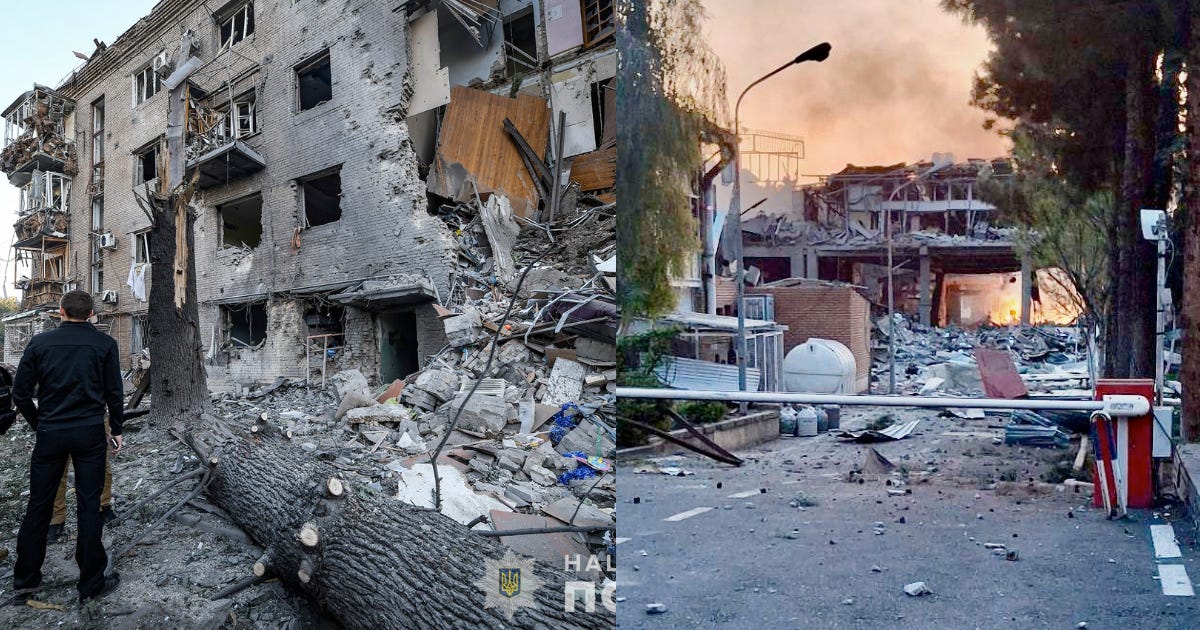
One of the biggest arguments for using drones is their relative precision compared with bombs and even guided missiles, but precision is only as good as the intelligence it relies on, which can be woefully inaccurate. The U.S. killed over 100 children in an Iranian school on the first day of the current war, the last day of February. Did they die due to intelligence about a nearby Iranian Revolutionary Guards Navy command post that was fed into an AI targeting system? Whatever the explanation — the Pentagon has a duty to provide one — it won’t provide much comfort for their grieving families. Their desire for vengeance or at least some kind of recompense will burn hot and long.
The pain that the U.S. and Israel are inflicting from the skies extends beyond shattered bodies. Although we condemned Russian strikes on Ukrainian power plants and electrical grids, we are ourselves now plunging people into darkness and cold, destroying the generators and incubators that keep their loved ones alive. Iran’s retaliation on the energy infrastructure of Persian Gulf powers does the same, but Iran did not ask for this war. On the contrary, the Iranian leaders were willing to negotiate away almost everything but their own destruction.
.jpg)

I hold no brief for the mullahs and the horrors they have inflicted on their own people for decades. Their Middle Eastern proxies have deliberately kept many countries fragmented, fragile, and insecure. Yet my country is committing war crimes, and aiding a government that is willing to obliterate entire territories to keep itself in power. Public opinion has not rallied around the flag; over 60 percent of Americans disapprove of the Trump Iran War. What we are doing is horrific. We will pay morally and strategically for more decades to come.
Can we renovate the international order to ensure that Article 2(4) of the U.N. Charter, which bars the use or threat of force except in self-defense, actually means what it says?
Canadian Prime Minister Mark Carney has argued that this is a job for middle powers. Imagine if such an order enforced rules against aggressive war through coordinated economic action, supported by citizens. The countries of the European Union, plus Britain, Norway, Switzerland, Canada, Japan, South Korea and Australia control 42 percent of the world’s GDP. Now add Saudi Arabia, India, Indonesia, Brazil, South Africa, Egypt, Nigeria, and Mexico, just to take one possible grouping. A refusal to buy or sell from a nation using aggressive force against another, or to admit that nation’s citizens for any purpose, would effectively bypass and replace the U.N. Security Council.
Suppose, further, that in addition to jus ad bellum — the international law governing the right to go to war — these powers sought to enforce jus in bello, which is the law governing right conduct in waging war. All nations would have the first right and obligations to try their own fighters for war crimes, under domestic military law incorporating the international law set forth in the Geneva Conventions of 1949, governing the treatment of killed, wounded, and imprisoned soldiers and the protection of civilians in wartime. At the same time, victims of grave and systematic war crimes would have the right to appeal adverse judgments to regional and global tribunals. And as with Nuremberg, commanders would be tried first.
At this bloody, horrific moment, even imagining alternative futures can seem frivolous and quixotic. Yet if we do not, we will be unprepared to seize the moments that will arise. The first Geneva Convention arose from the efforts of a Swiss businessman, Henry Dunant, who witnessed the aftermath of the Battle of Solferino in northern Italy, a clash between Napoleon and the Sardinian king against the Habsburg Empire in which over 40,000 soldiers died or lay suffering on the field. Dunant mobilized the Swiss government, which in turn worked with France, Italy, and other European governments to conclude a treaty that required wounded and ill soldiers to be cared for, and protected them and the medical personnel tending them from attack by combatants. It also created the Red Cross. World powers updated this convention in 1906 after another round of European wars, and then again in 1929 following the staggering toll of World War I, adding a convention setting forth rules governing the treatment of prisoners of war.
As with the U.N. Charter itself, renovating an existing order and building new spaces and structure requires the intersection of ideas, opportunity, and political will. We cannot know which of the present crises or those that we can see on the horizon will create that intersection; we can only get ready, by circulating ideas, co-creating designs, building networks, and mapping mobilization strategies. We can also do our best to engage national parliaments, including Congress, to ensure that the actual representatives of the people around the world will have a say.