

To Build Support for Democracy, Teach What Democracy Means.
From Doug Addison at CFFAD: Many Americans just want more power for leaders who agree with them, but can be persuaded to see the benefits of democracy in the big picture.

In 2018, my colleagues and I founded the Center for Free, Fair, and Accountable Democracy (CFFAD). Our small team provides civic education to American adults via materials reviewed by at least one conservative expert and at least one progressive expert. We are among the millions of Americans who have turned their energies toward civic renewal over the course of the past decade. We’re not in it for the book learning. Like so many others, we want to secure government of, by, and for the people.
We power our work with research, and our research has turned up a fascinating puzzle. In theory, a person who supports government of, by, and for the people should not also support autocracy. Yet substantial and rising shares of American adults believe both approaches to governance are equally good. (See Table 1.) How can that be?
Table 1: Some Americans like both autocracy and democracy.
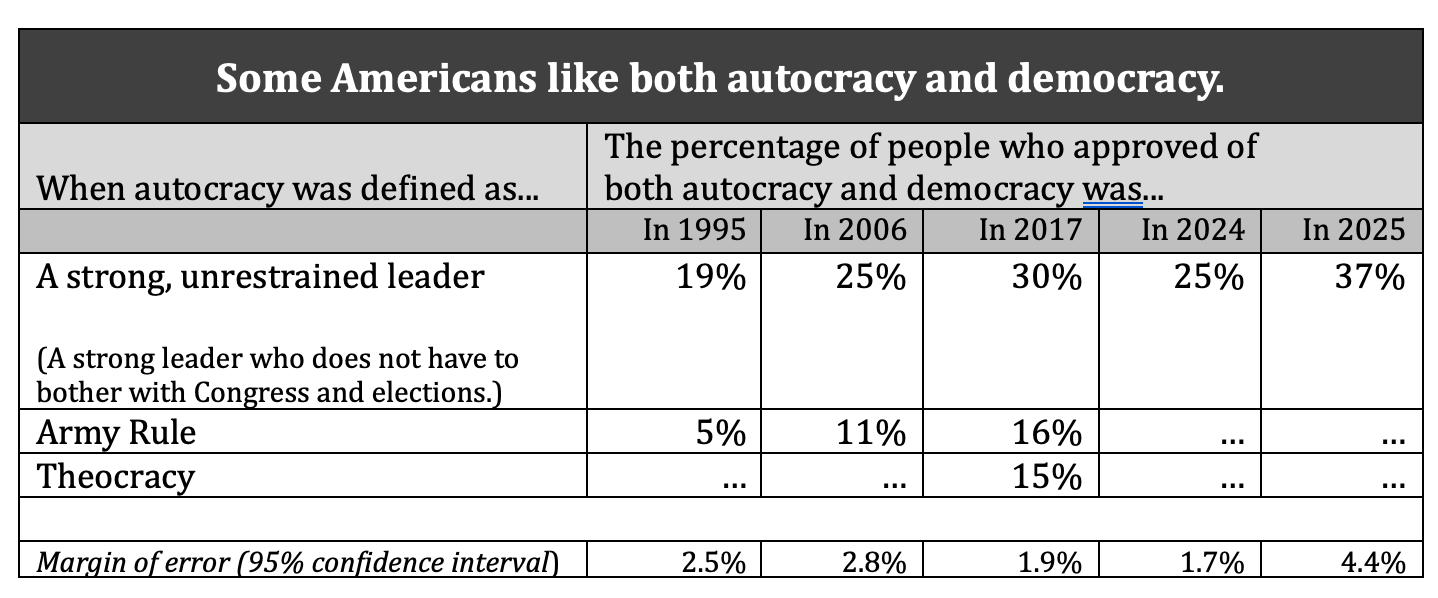
Imagine how things might change if even half of those people could be inspired to reject the temptations of autocratization!
While most of these people are less active politically, many are open to becoming more so. These ambivalent Americans are a consequential audience worthy of attention. They represent a large pool of potential new support for democracy.
Inspired by that idea, we began researching this puzzle with the ultimate goal of developing a theory of change for converting ambivalent Americans from the temptations of autocracy to active support for American democracy.
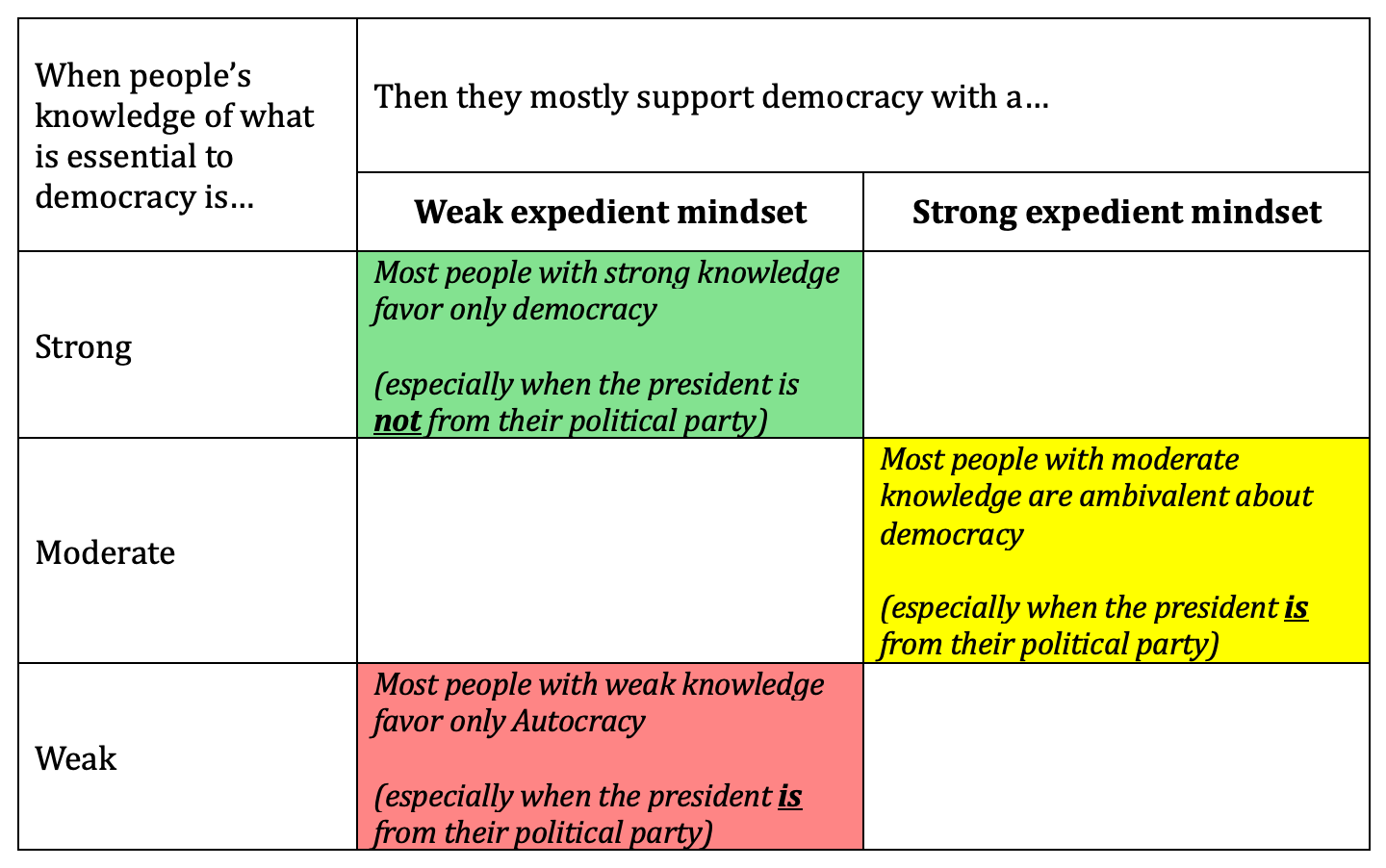
Our initial findings are fascinating and point to a path forward. In a nutshell, we find that a combination of knowledge, mindset, and partisanship goes a long way towards explaining whether a person might support representative democracy over autocracy or why they might instead be ambivalent between the two options or even reject both. People with a strong base of specific knowledge of what is essential to democracy tend to favor democracy, while those with weak specific knowledge tend to favor autocracy. Yet, people with what we call an expedient mindset, and who have only a moderate store of specific knowledge, tend to be ambivalent. People also tend to be ambivalent about democracy when the President is from their party. (See Figure 1.) We explain more below.
1. Support for democracy is more associated with specific knowledge of what is essential to democracy than with having a university education.
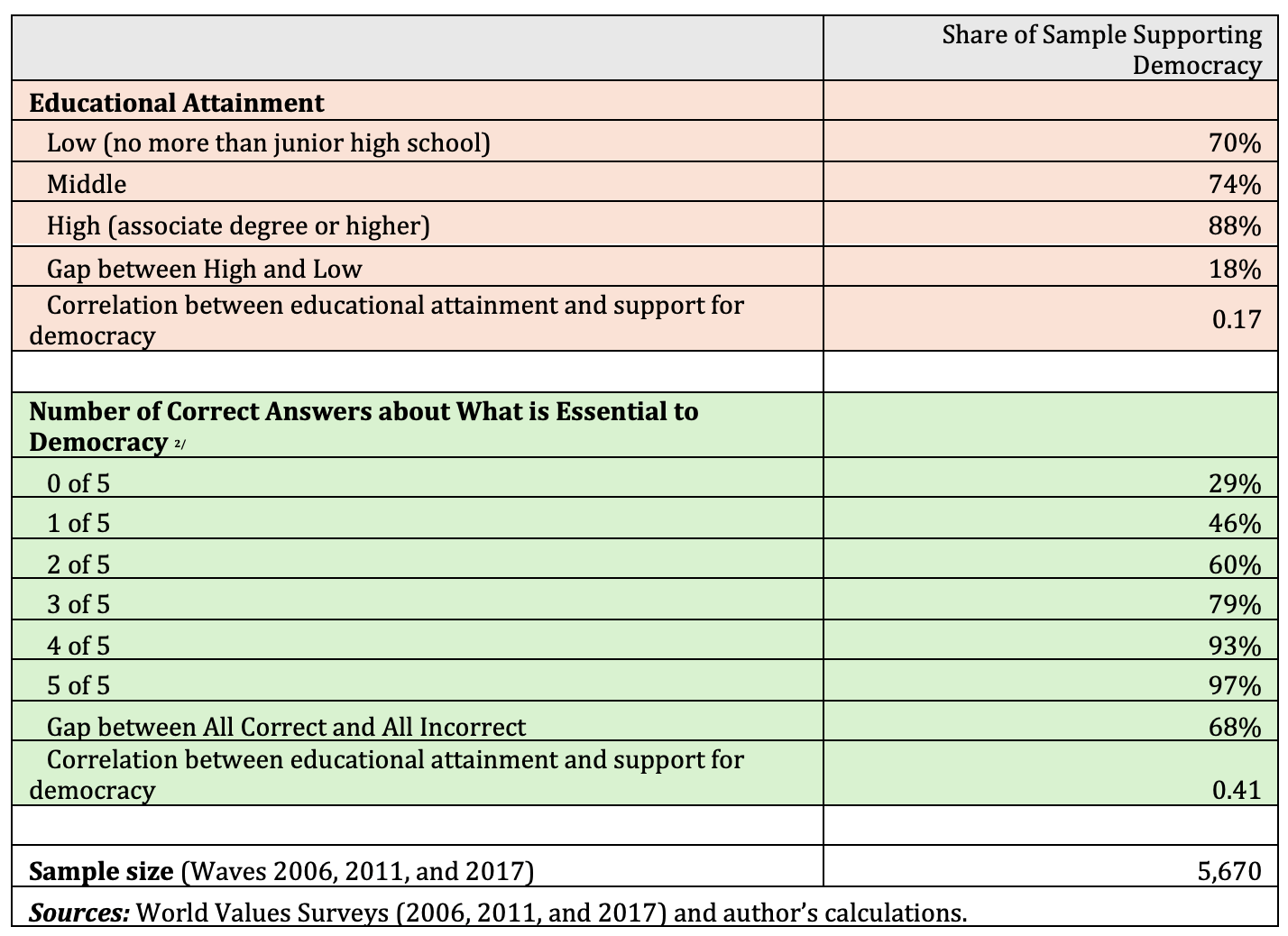
We compared the level of general educational attainment (low, medium, and high) with an index of specific knowledge about what is necessary for democracy. The index is a simple count of how many of five questions a respondent answered correctly. The five questions are part of the World Values Survey:
Religious authorities interpret the laws (Not essential)
The people elect their leaders through free elections (Essential)
The army takes over when the government is incompetent (Not essential)
Civil rights protect people’s liberty against oppression (Essential)
Women have the same rights as men (Essential)
Both level of educational attainment and specific knowledge measures are positively correlated with whether a person values democracy as a good or bad way for the country to be governed, but specific knowledge is more potent. For example, as shown in Table 2, there is a 68 percentage-point gap in support for democracy between those who answer all five questions correctly and those who answer all incorrectly. By comparison, the gap between those with high and low educational attainment is only 18 percentage points. The correlation between support for democracy and knowledge of what is essential for democracy, 0.41, is much stronger than the correlation with educational attainment, 0.17.
Table 2. Share of Respondents Who Support Democracy
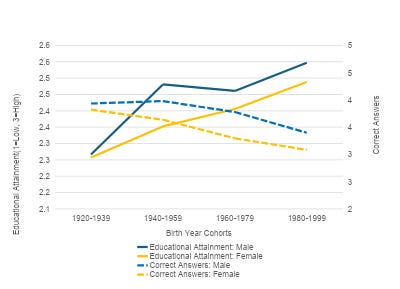
2. Unhappily, we also find that the pool of specific knowledge of what is essential to democracy has been draining, even though educational attainment has improved.
It remains true that people with more education tend to have more accurate knowledge about what is essential to democracy. The problem is that this tendency has been weakening with each new birth-year cohort. On the one hand, younger cohorts have enjoyed a higher level of educational attainment than the older cohorts. On the other hand, on average, they know less about what is essential to democracy than their elders. (See Figure 2.)
Figure 2. Education versus Knowledge of What is Essential to Democracy
This decline is evident within each of the three educational attainment groups. (See Table 3.)
Table 3. Specific Knowledge Holding Education Constant, by Birth-Year Cohorts
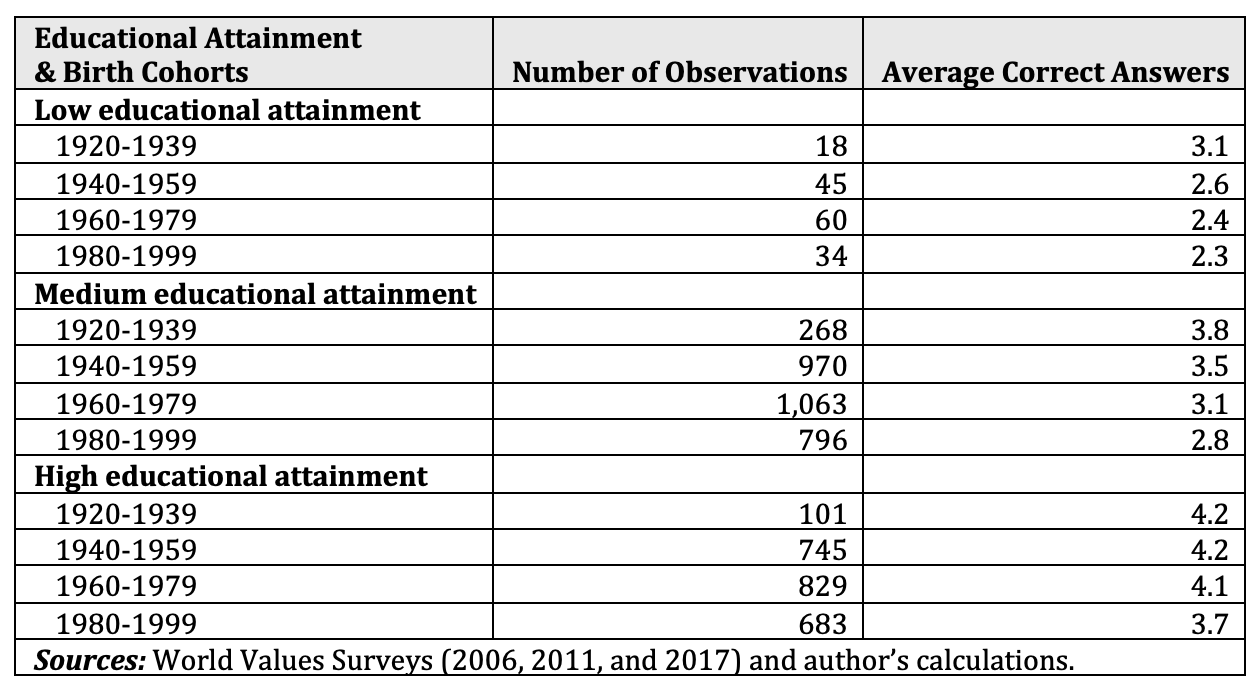
Education still matters, though: the decline is slower for those with more education. Yet, in an ideal world, there would be gains rather than declines. Civic education needs to be made more effective and more widely available, and it also needs to target what is essential to democracy and why. (For example, it is more important to know why the framers required a separation and sharing of powers than to name all three branches of government.) Higher education also needs to up its game, ensuring that civics knowledge from K-12 is both retained and deepened.
3. An expedient mindset combined with middling knowledge of what is essential to democracy correlates with ambivalence between democracy and autocracy.
One of the more prominent explorations of this mindset was conducted by two political scientists, John Hibbing and Elizabeth Theiss-Morse. They found a large share of Americans who (1) don’t care about politics, (2) believe the political process is often unfair and ugly, (3) prefer to delegate the process to unelected experts or successful business leaders who they believe will be more likely to make wise and selfless decisions than politicians would, but (4) want to retain a democratic option to remove corrupt or harmful decision makers. Hibbing & Theiss-Morse (2002) refer to this mindset as a desire for “stealth democracy” after the military aircraft that are designed to be difficult to detect on radar. They find that most people who feel this way would happily place their trust in an imaginary form of government led by unelected experts who know and respect our common needs. In this light, we follow Bloeser et al. (2024) who characterize this mindset as expedient.
The third criterion, unelected experts or business leaders, surely overlaps with autocratic governance, while the fourth overlaps with democratic governance – nicely illustrating the ambivalent attitude. However, to avoid having a tautological measure of ambivalence, we constructed an index of the expedient mindset using eight questions in the WVS:
How interested are you in politics? (Not very)
When you get together with your friends, [how often] would you say you discuss political matters? (Occasionally or never)
How often in elections [are] opposition candidates prevented from running? (Often)
How often in elections [are] are voters bribed? (Often)
How often in elections [do] rich people buy elections? (Often)
How much confidence do you have in universities? (A lot)
How much confidence do you have in major companies? (A lot)
How much confidence do you have in elections (A lot)
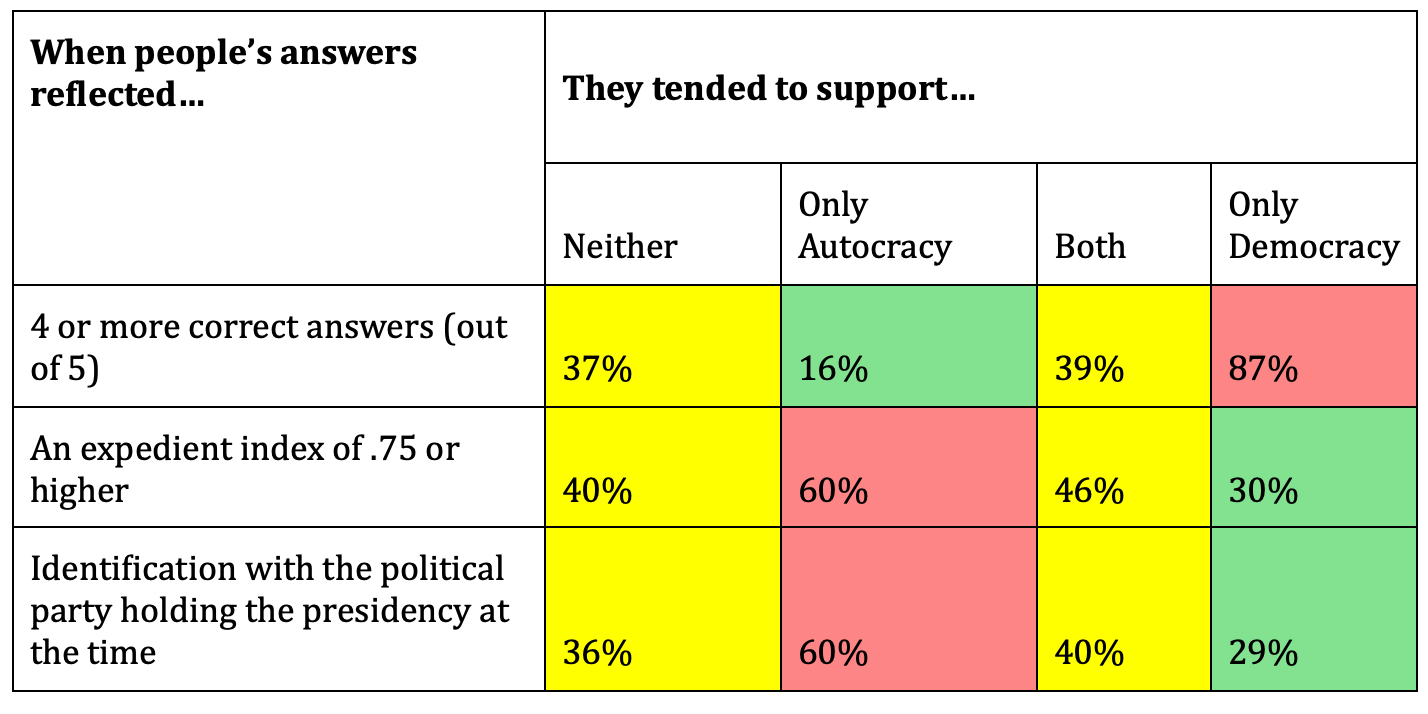
We found that this measure of the expedient mindset was prevalent among those who favored autocracy (60%), followed by those who were ambivalent (46%). (See Table 4.) Only 16% of those who favored autocracy could correctly answer at least four questions about what is essential to democracy, compared to 39% of the ambivalent group. By contrast, only 30% of the people who favored only democracy harbored an expedient attitude, and 87% answered at least four of five key questions correctly about democracy.
Table 4: Summary of Three Influences on Ambivalence
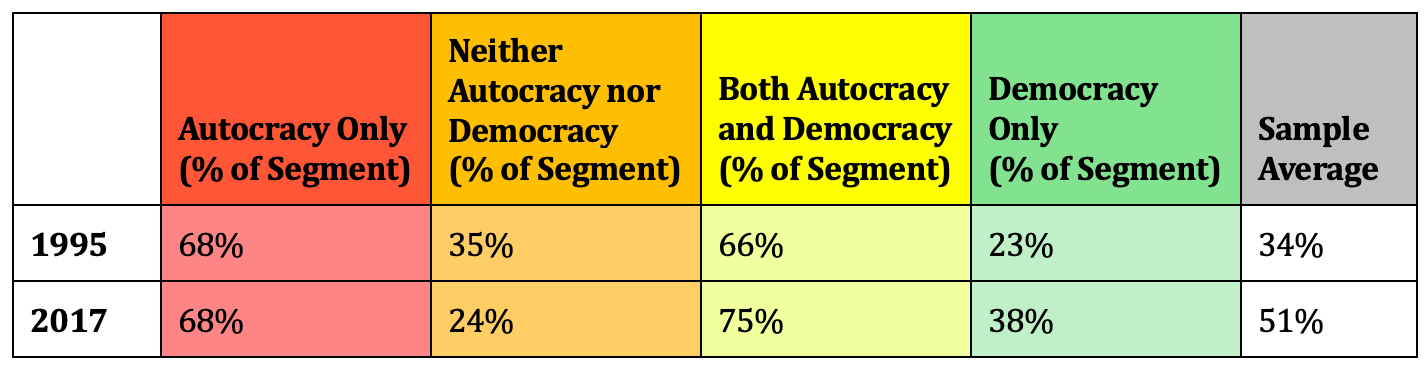
The index for the expedient mindset is only available for 2017 but between 1995 and 2017, among ambivalent Americans, the percentage of people who believed having unelected experts is a good way to be governed rose from 66% to 75%; it also grew among those who support democracy (from 23% to 38%). At the same time, it stayed steady among those who support autocracy.
Table 4. Agreement That Rule by Unelected Experts is a Good Way to Be Governed
4. The problem of ambivalence is not confined to one party.
People in both major parties are susceptible to autocracy’s temptations. The contest between autocracy and democracy is timeless and non-ideological. It will continue so long as people who disagree seek advantage over one another by altering how we are governed.
In 2011, when Barack Obama was President, the share of Democrats who equally favored democracy and a strong leader, unrestrained by Congress or elections, was 32%. In 2017, when Donald Trump was President, the Republican share reached that same level.
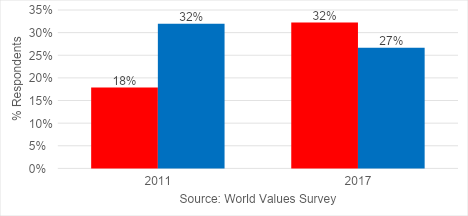
The changes over time shown above are consistent with findings by other researchers. People in one party will be open to weakening democracy when the President represents their party, hoping to advance their agenda more easily. They will want stronger institutions of democracy when the President is not from their party, hoping to slow down the other side. This expedient attitude, especially when widely held, allows ambitious politicians to try to weaken democracy to their advantage.
These findings must be acknowledged to be preliminary. We had only a few apples-to-apples surveys to support comparison across time. And while we can rule out potential drivers of ambivalence related to rural residency, the highest educational degree, income, and ideological polarization, the data did not permit exploration of affective polarization.
Nonetheless, the findings are suggestive enough to justify further research into the dissemination of essential knowledge about democracy and into the expedient mindset and how to change it. We have shared these findings in the hopes that other democracy practitioners might find them valuable and invite those who are interested to join in our research process and pursuit of a theory of change. Come join us in this work! Your ideas and feedback in this regard are most welcome. Write to us at team@cffad.org.
Thank you for this, it is very enlightening and I will forward it to many people, especially high school teachers, I know. Education is powerful and essential.