

The Union of Power and Love
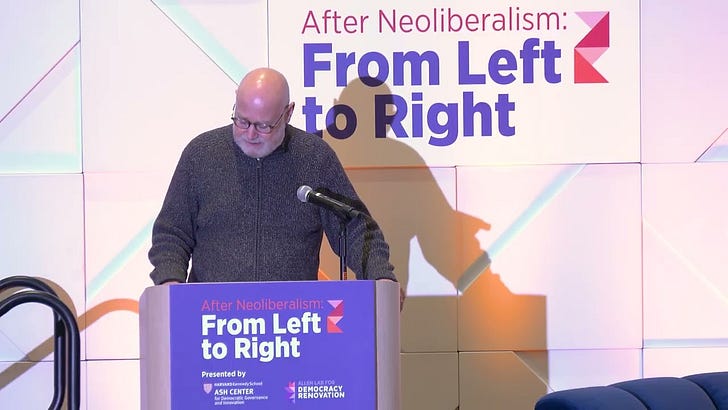
Harvard Prof. Rebecca Henderson’s keynote speech at the "After Neoliberalism: From Left to Right" conference
Video and transcript from Harvard University Professor Rebecca Henderson’s keynote speech at the “After Neoliberalism: From Left to Right” conference.
Good morning. I have ten minutes, and I’m going to talk about love.
Let’s start at the beginning. Yesterday, we talked about content. We talked about what a new paradigm might look like, what the policies would look like, how would we organize. And Yochai did a brilliant job of summarizing a whole range of fantastic ideas about how we could imagine building a just and inclusive society that respects particularly those who work and those who are less fortunate. Super exciting, really important.
But what we didn’t talk about so much is how we get there.
Suppose we came up with the new paradigm and everyone — left and right, all our allies — were like, “Yeah, let’s do it!” And in fact, we know that if you give a mixed group a list of reasonable policy proposals, about eighty percent of the people in this country will sign on to them. But if you label them Republican or Democrat, support drops dramatically.
We are in a hugely difficult political environment where it can seem almost fantastical to think about implementing well-designed policies that speak across party lines. I mean, that’s not where we are. We’re in the middle of deep identity politics, a governing elite that is fostering fear and hate, and the emergence of tools on social media and in AI that make it increasingly likely that it will be possible to manipulate public opinion in ways that we’ve never seen before.
What are we going to do? How do we think about this moment?
And that’s what leads me to this crazy idea that we should talk about love. And compassion, and connection, and values, and what the deepest purpose of being a human being is. I have been an academic for nearly forty years and I have never said the word “love” in an academic gathering before. But I am desperate. We need to do things differently.
It’s going to be rough going forward. I’ve spent many years of my life working in climate change, and what’s coming at us is not good. It’s going to interact with everything else to cause untold suffering. So what do we need? We need to organize at the community level.
It is a travesty of democracy that in many parts of this country we run one-party states — and I talk about this state, too. Not to give people a real choice is a serious problem. It’s not good for democracy and it’s terrible for local civic infrastructure, for engaging people in the deep ideas about how they want their community to run, about the things that bring them together as opposed to what drives them apart. So in every community, I think we need skilled leaders of all kinds, from all kinds of backgrounds, leading deep conversations about what we value as a community, where we want to go — and who are you as a person? What do you love? Why do you care about this locality? These leaders will need to be able to think strategically, as well, to support everyone in learning to think that way — but without building the deep relationships on the ground, without real listening, without supporting those who have been marginalized to discover their own agency, all our strategizing will go nowhere.
I know this can sound like pie in the sky, but there are thousands of people right now, all over the world and all over this country, doing this work. We don’t talk about it much in academia because we are — forgive me, those of you who are not like this — rather stuck in our heads. We’re a bit cognitive. We’re a bit analytic. All those other sides of being human, all that vulnerability, all those emotions, all that dysregulation—we don’t talk about that. But we need to talk about it, because facing these parts of ourselves — healing, loving — that’s what connects people.
As Kadeem Noray said yesterday, we can come up with the best policies in the world, and if we can’t translate them in ways that people find useful, it won’t go anywhere. And worse than that — if they don’t come up with these policies themselves, we won’t go anywhere.
So I think we need to spend time understanding what this looks like. The psychologists are all over this. The leadership consultants are all over this. The people of faith, at their best, are all over this. What does it mean to be human? What are we called to do? It used to be that education was called moral education, and we would help the students think through what they wanted from life, what their deepest goals and values were. Could it be that living only for your own good and only for the accumulation of stuff is deeply unskillful? Humans have been saying this for thousands of years. This is not a new idea. What’s new is that we stopped deeply teaching it to our children. Now, of course, I have no brief for rigid dogma or particular sets of existential beliefs — but I do have a brief for activating those parts of ourselves that are more than cognitive, that are about connection.
Now, of course, as Dr. King said famously — and I want to get this right for obvious reasons — love without power is sentimental and anemic. So I don’t want you to think I’m sentimental and anemic, and I don’t think anyone in this room is that. And of course power without love is reckless and abusive, tyrannical and cruel. We’re seeing that right now.
So we need the union of power and love. To focus on connection, to focus on a different way of being human, is not to leave our brains or our analytic capacities at the door. It is to seek to integrate them. To build a society that continually reinforces our capacity for connection and, yes, our capacity for power. Power gets a bad name—power over. We say “power with,” but I’m a fan of power, too. We need power to take care of those we love, to build the societies we dream of, to grow, to build.
Many people feel powerless right now. I would like to close by suggesting that one of our roles might be to help support, in any way we can, the rediscovery of power in conjunction with love — to build communities that the people who live in them can be proud of and delighted to be part of.
Thank you very much.
Check out The Renovator’s other pieces in the “After Neoliberalism” series —
After Neoliberalism: From Left to Right

Two weeks ago I ran a conference at Harvard called After Neoliberalism: From Left to Right, sponsored by my Harvard Kennedy School Lab for Democracy Renovation and the Ash Center for Democratic Governance. Across the political spectrum, a contest is underway over the future of political economy. From “inclusive abundance” and “power-sharing liberalism” …
After Neoliberalism
An excerpt from Professor Yochai Benkler’s closing remarks during the “After Neoliberalism: From Right to Left” conference at Harvard in December, hosted by the Allen Lab for Democracy Renovation. Benkler is the Berkman Professor of Entrepreneurial Legal Studies at Harvard Law School, where he is faculty director of the Program on Law and Political Econ…
I especially like the mention about local civic infrastructure (and its atrophy). Money doesn’t build trust, it’s transactional. Love can build trust, and it can allow for greater connection and understanding. This must become our political currency if we seek a healthy, lasting union of Americans.
Love is not adorable and mushy. It's what allows for deep listening, for giving the benefit of the doubt, and for looking beyond our own certainties