

The Pope vs. Marc Andreessen: The Future of Tech & Democracy
Morality, technology, and symbolic Twitter beef in your Tech & Democracy Roundup

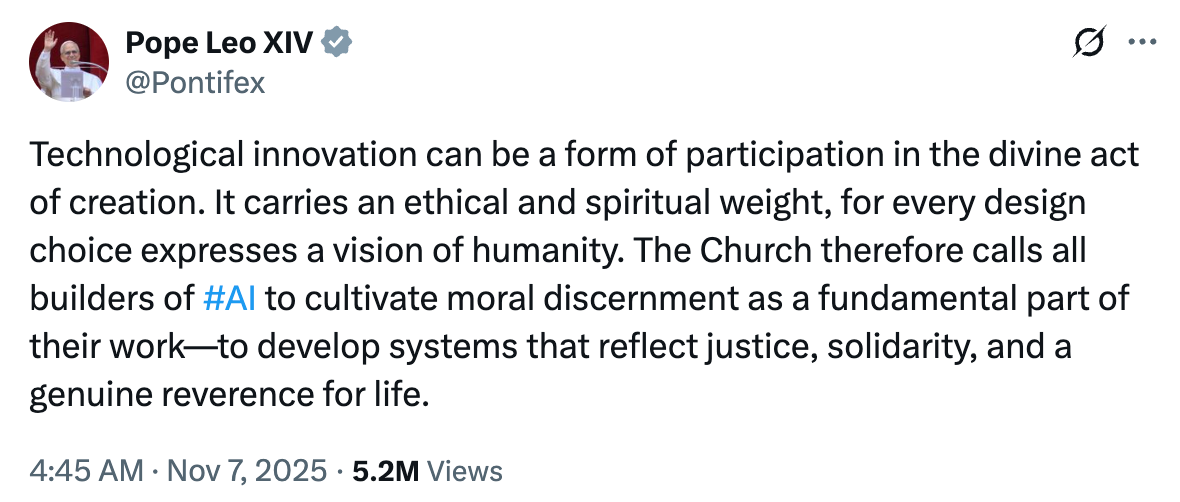
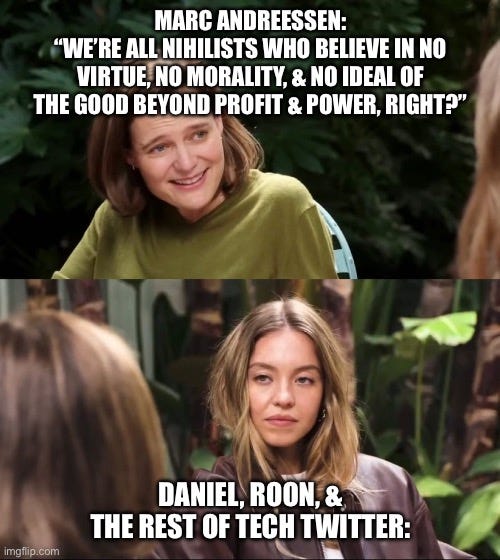
His Holiness Pope Leo XIV tweeted this weekend that AI builders should include moral considerations in their vision of the future. This is a pretty simple, yet powerful message that resonates with a majority of people— creators of society-transforming technologies should care about morality, virtue, and humanity. Yet somehow, Marc Andreessen, one of Silicon Valley’s most influential and notorious venture capitalists, took this statement personally:
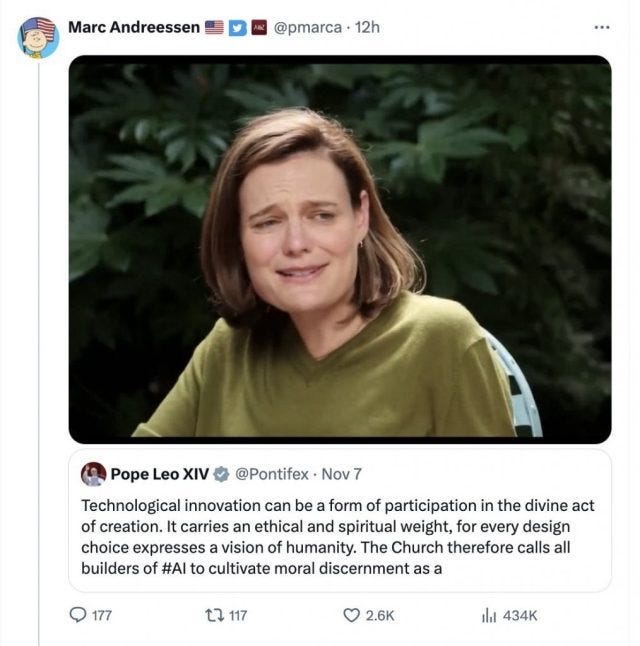
The reaction image is a meme that’s been popular lately on Elon Musk’s X platform; it refers to a moment in a recent interview between Sydney Sweeney and journalist Katherine Stouffel, when Stouffel nudged Sweeney to make a statement disavowing racist readings of her “great jeans” American Eagle ad campaign, and Sweeney stoically rejected the premise of the question. The meme has been used to represent moments when ‘woke’ people expect a de facto, orthodox liberal expression, only to have their premise rejected by a ‘based’ right-winger refusing to engage in the ideological ritual. Sometimes the meme could also imply an age element (in which the woke Millennial is countered by the more reactionary Zoomer) or a gender element (in which Stouffel is the feminized HR scold and Sweeney is the masculine ‘chad’). This meme quite succinctly captures the 2025 zeitgeist on Musk’s right-leaning X platform; in this culture, Sweeney is the protagonist, whereas Stouffel is the protagonist on Bluesky.
For Marc Andreessen to quote-tweet the Pope with this image was to mock the divine head of the Catholic Church, and to mock the very idea that considerations of ‘the Good’ should have any relevance for technologists beyond pure profit-seeking. In this way, Andreessen represents the worst fringe of the new tech-right, a nihilistic worldview in which obtaining profit and power by any means necessary is the only guiding value. Luckily, this does not represent Silicon Valley as a whole; in fact, the backlash against Andreessen’s tweet from the broader tech scene was swift and brutal.
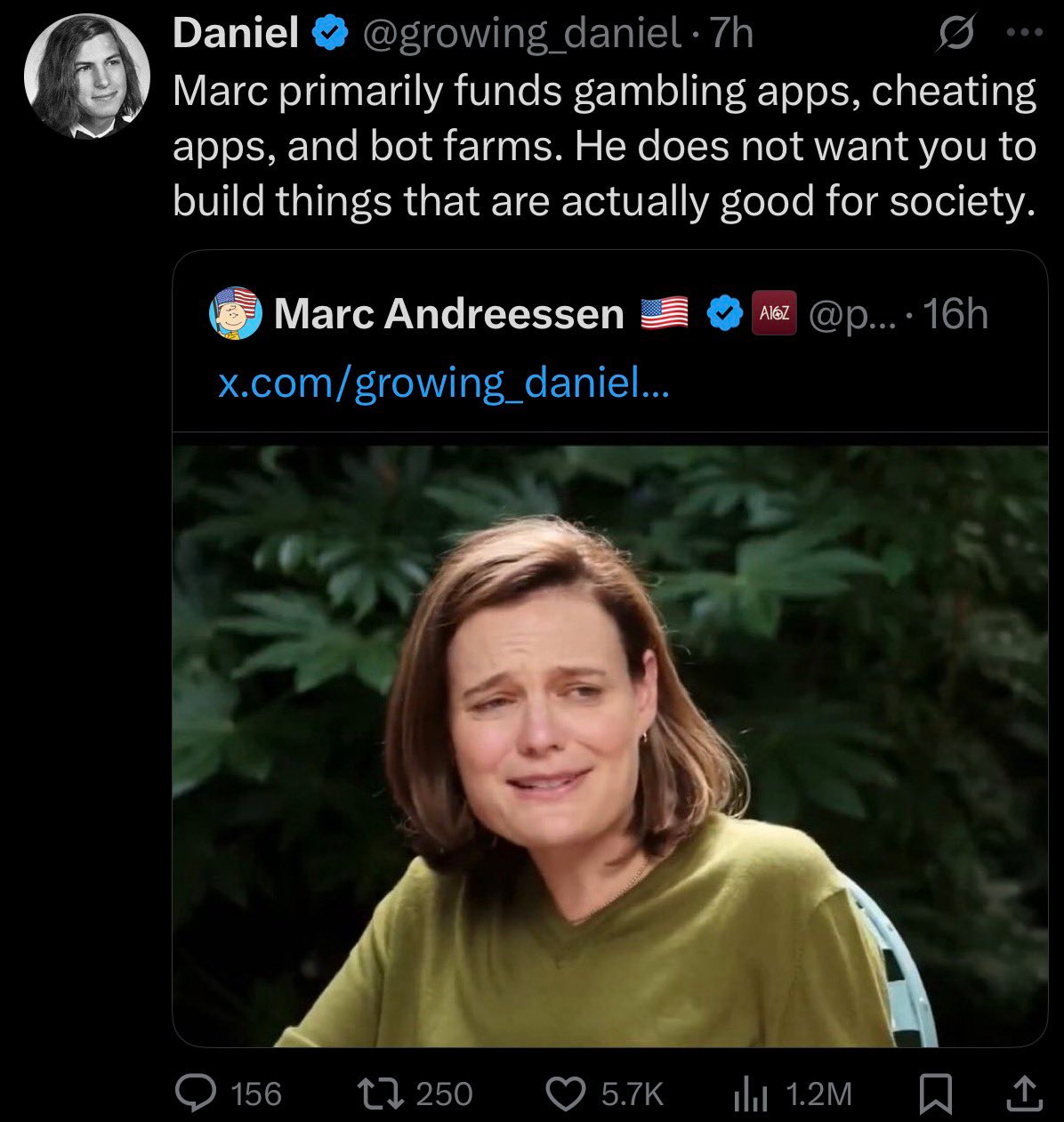
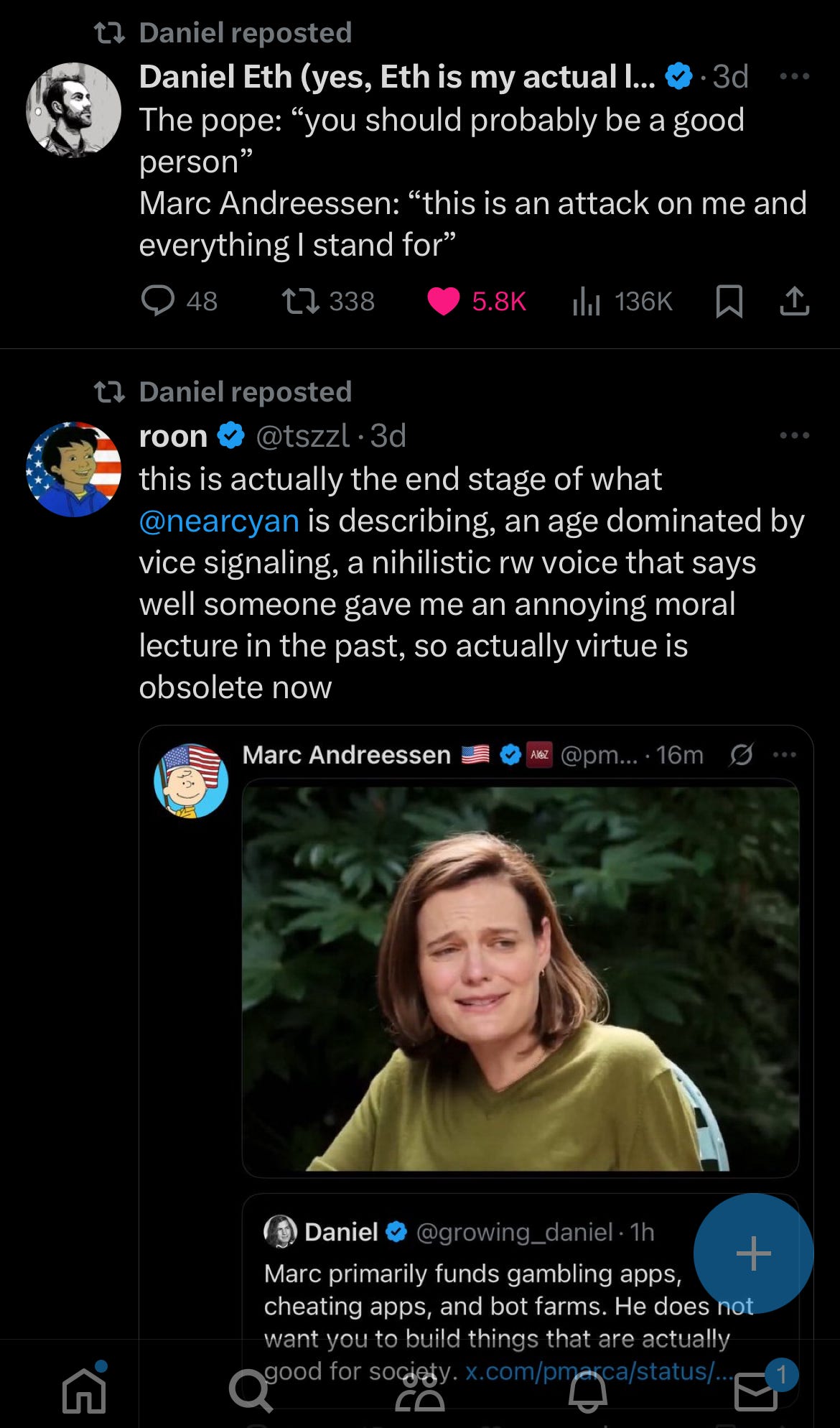
Andreessen ended up deleting all his tweets in an embarrassing retreat. This highly influential sphere on X/Twitter— centered around San Francisco / TPOT / the ‘gray tribe’ / and generally smart posters adjacent to tech— pushed back on this nihilistic, extreme version of certain Silicon Valley philosophies. Growing Daniel and roon are some of the most influential voices on a part of Twitter that frequently shapes the decisions of powerful tech players. Growing Daniel is certainly not ‘woke’; most of these influential X posters deeply appreciate the power of capitalism and free markets. In essence, the ‘tech center’ rejected the worst vice-signalling fringe of the ‘tech right’.
The sad irony for Marc Andreessen is that, in the end, he became Stouffel, while the tech tweeters who mocked him were Sweeney. Andreessen assumed that everyone else was as immoral and self-interested as he is; bad people tend to imagine that the world is full of bad people. Andreessen became the smug representative of a falsely assumed orthodoxy, and the chads on tech Twitter resoundingly rejected the premise.
This is a hopeful sign that a majority of influential minds in the tech world still do agree with the Pope that technology ought to be developed by people with a basic sense of moral responsibility and vision of human goodness. Beneficence is still popular.
We here at The Renovator speak to that silent majority of technologists who believe that technology should serve humanity, serve a moral vision, serve worthy ideals of the Good. Our ideals are liberty and democracy. Some in Silicon Valley, including most famously Peter Thiel, believe that liberty and democracy are incompatible; we Renovators would like to convince the tech center that, at their best, liberty and democracy are actually symbiotic, reciprocal, mutually generative ideals, because freedom and creativity emerge from interaction and communication. If you want the individual liberty to build something new, your power to do so is actually best served in the long run by pursuing a higher ideal of democratic interconnectedness— liberty by means of democracy.
As more and more technologists re-embrace clear ideals of liberty and democracy, we can begin to more effectively tackle the ‘engineering problems’ of actually building a society that can approach our ideals. The future of liberty and democracy depends deeply on how we design new technologies, and the human values we consider while building them.
That’s why Pope Leo’s cultural impact matters so much. It is no accident that he chose the name ‘Leo’; the last Pope Leo, Leo XIII, led the church during the last Gilded Age in the 1890s; he used his moral authority in order to positively influence culture during an era of runaway capitalism and the social upheavals that arose from industrialization. What his predecessor did to help us morally adapt to the Industrial Age, our American-born Pope Leo wants to do as we adapt to the era of artificial intelligence. It is no small task, but this episode with Marc Andreessen shows that culture work and moral ambition can still make real impacts on how new technologies will shape the future of democracy.
For more on this story, check out this essay: Tech Billionaire Mocks Pope Leo’s AI Warning — and Reveals Silicon Valley’s Original Sin.
The Pope also recently chimed in on the relationship between AI and humanity in healthcare.
~
Further Tech & Democracy news links of interest:
Who Will Be The First American Candidate to Harness AI? by Bruce Schneier
A 365 page transcript from a deposition in the OpenAI case was released, which details the Sam Altman/leadership fiasco and includes explosive testimony from former OpenAI co-founder and Chief Scientist Ilya Sutskever
Report: Mapping LLM Tools for Public Discourse, Pluralism & Social Cohesion
Character.AI to Ban Children Under 18 From Using Its Chatbots - The New York Times
NVIDIA becomes the world’s first $5 trillion company - now worth more than the aggregated stock markets of all countries, apart from the US, China, and Japan
Elon Musk Challenges Wikipedia With His Own AI Encyclopedia - Grokipedia
And lastly, join the ongoing series ‘Reboot Democracy: Designing Democratic Engagement for the AI Era’, free online workshops sponsored in collaboration with the Allen Lab. Danielle Allen is featured in some of the upcoming talks.
AI reminds me of one of Voltaire's ideas about religion. He expressed it more than once in more than one way. "In the beginning God created man in His own image, and man has been trying to repay the favor ever since." "If God created us in his own image, we have more than reciprocated." Religion and AI mirror our own minds.
AI LLMs write by mimicking the writing of people. AI can write a lot about "democracy" because people like to write about "democracy." People like to write about democracy, in part, because people have been writing about democracy for a long time. Artificial Intelligence can tell us a lot about democracy. Real intelligence is required to speak the truth about our Constitution.
Despite our affinity for "democracy," "democracy" in America is dangerous. I don't mean that democracy is dangerous in the sense that Madison and Montesquieu emphasized (the potential for oppression by any person or group of people with too much power, or as Tocqueville and John Stuart Mill put it, a "tyranny of the majority"). I mean that excessive emphasis on "democracy" in America is dangerous to our most democratic institutions. Don't take my word for that; take the word of U.S. Supreme Court justices.
In Rucho v. Common Cause in 2019, a majority of SCOTUS justices sought to mislead us to believe that partisan gerrymandering does not violate our Constitution. They did the same in 2024 in Alexander v. South Carolina State Conference of the NAACP. In Alexander, six SCOTUS justices led by Justice Alito even publicly admitted they knew that their own decision (and the conduct of state legislators) “bears an uncomfortable resemblance to political apartheid.”
Six SCOTUS justices approving of a system that they know (and even publicly admit) “bears an uncomfortable resemblance to political apartheid" should shock us into consciousness that we have a serious problem. Americans desperately need real, substantive discussions about what our Constitution says and means. It doesn't say or mean that we have "democracy." "Democracy" is the cotton candy of political discussion. It looks cool and tastes great, but it's definitely not serious sustenance. Thinking and speaking about "democracy" may inspire people politically, but it won't teach people how to defend our democratic institutions.
SCOTUS Justices Kagan, Ginsburg, Breyer and Sotomayor (and James Madison) tried to show us the truth. In a powerful dissenting opinion in Rucho, they emphasized vital principles of our Constitution (our constitution as one people of one nation). “The people are sovereign.” “The “power,” as Madison emphasized, “is in the people over the Government, and not in the Government over the people.” As Madison also emphasized, “[R]epublican liberty” demands “not only, that all power should be derived from the people; but that” our public servants “should be kept in dependence on the people.” “Free and fair and periodic elections are the key to that vision. The people get to choose their representatives.” Election day emphasizes politicians’ dependence on the people. “Election day” emphatically “links the people to their representatives, and” emphasizes to “the people their sovereign power. That day is the foundation of democratic governance.” But “partisan gerrymandering can make it meaningless.” Partisan gerrymandering “amounts” to “rigging elections.”
Democracy and popular invocations of "democracy" make partisan gerrymandering politically possible. Our Constitution makes partisan gerrymandering legally impossible. If we don't use real intelligence to think about our Constitution, we will be depriving ourselves of the power to defend our democratic institutions against people who have usurped the power to undermine our Constitution and our democratic institutions.
I'm puzzled when intelligent, well-informed people say things like "at their best, liberty and democracy are actually symbiotic, reciprocal, mutually generative ideals." Of course, at their best, many things are "symbiotic, reciprocal, mutually generative." The sun at its best is all those things. It also can burn a person or even kill a person or crops or regions. The sun contributes mightily to the massive wildfires scorching vast tracts of land every year. So why should we pretend that democracy or anything else will always be at its best?
The people who wrote and ratified our Constitution were not foolish, naive or inexperienced. They saw and foresaw abuses or usurpations of power by anybody with power. They did not pretend that the People (or public officials) always would be at their best. In fact, The Federalist Papers repeatedly warned about the fatal attraction between the People and their most dangerous favorites.
In the very first (The Federalist No. 1), Hamilton emphasized this very point:
"a dangerous ambition [even] more often lurks behind the specious mask of zeal for the rights of the people than under the forbidden appearance of zeal for the firmness and efficiency of government. History will teach us that the former has been found a much more certain road to the introduction of despotism than the latter, and that of those men who have overturned the liberties of republics, the greatest number have begun their career by paying an obsequious court to the people; commencing demagogues, and ending tyrants."
James Madison emphasized a similar warning and explanation in The Federalist No. 10: Our Constitution was designed "to break and control the violence of faction. The friend of popular governments never finds himself so much alarmed for their character and fate, as when he contemplates their propensity to this dangerous vice. He will not fail, therefore, to set a due value on any plan [constitution] which, without violating the principles to which he is attached, provides a proper cure for it. The instability, injustice, and confusion introduced into the public councils, have, in truth, been the mortal diseases under which popular governments have everywhere perished."
In The Federalist No. 15, Madison re-emphasized the danger of "[a] spirit of faction, which is apt to mingle its poison in the deliberations of all bodies of men[. It] will often hurry the persons of whom they are composed into improprieties and excesses, for which they would blush in a private capacity." This problem "has its origin in the love of power."
Madison in The Federalist No. 51 emphasized that "Justice is the end of government. It is the end of civil society. It ever has been and ever will be pursued until it be obtained, or until liberty be lost in the pursuit. In a society under the forms of which the stronger faction can readily unite and oppress the weaker, anarchy may as truly be said to reign as in a state of nature, where the weaker individual is not secured against the violence of the stronger." In fact, our Constitution was designed specifically to oppose the "reiterated oppressions of factious majorities."
Madison in The Federalist No. 47 emphasized that our Constitution was designed, not to secure democracy, but to secure our liberty by the division and re-division of powers. First, powers were deliberately divided between the sovereign people and all our public servants. Second, powers were divided between our state and federal representatives. Third, powers were divided among our legislative, executive and judicial representatives. The reasons for the need for such restraints on power were well known and widely believed.
"The accumulation of all powers, legislative, executive, and judiciary, in the same hands, whether of one, a few, or many" is "the very definition of tyranny." Tyranny (via an excessive accumulation of power) is dangerous and detrimental regardless of whether one (e.g., the president), a few (including any faction in Congress or on SCOTUS (including in combination with the president)) or many (any political or religious faction among the people) possess the power of tyrants to oppress others. As Madison emphasized, under our Constitution there is great danger of oppression and tyranny by any faction or political or religious majority (or even a minority).
"In order to form correct ideas on this important subject, it will be proper to investigate the sense in which the preservation of liberty requires that the three great departments of power should be separate and distinct. The oracle who is always consulted and cited on this subject is the celebrated Montesquieu." "Montesquieu" emphasized (and the people who wrote and ratified our Constitution believed) "There can be no liberty where the legislative and executive powers are united in the same person, or body of magistrates," or, "if the power of judging be not separated from the legislative and executive powers."
Hamilton in The Federalist No. 78 emphasized, "I agree" (with Madison and Montesquieu) that "there is no liberty, if the power of judging be not separated from the legislative and executive powers." Maybe "liberty can have nothing to fear from the judiciary alone, but would have every thing to fear from its union with either of the other departments."
Our Constitution was designed to cut both ways: to enable us to be our best and to be represented by our best and also to protect us when we are at our worst or when we choose the worst among us to lead us.