

The Past Waits for the Future in Gettysburg
272 words at Gettysburg changed the meaning of what the dead had done. I walked those fields with Navy SEALs to learn what the ground still had to teach.

Michael Gibson is the co-founder of 1517 Fund. This guest piece commemorates the anniversary of Abraham Lincoln’s Gettysburg Address, delivered on November 19th, 1863.
“Lincoln reminds us we owe the dead a country that remembers how to build, how to explore, how to learn from our great inheritance, how to believe in the wild, improbable promise of itself.”
~
The Past Waits for the Future in Gettysburg
Some presences can be felt only across time. Not in time, but across it, like a melody. In a melody, we can’t understand the full meaning of the first note until the last note has been played. The end must reach back to the beginning to tell us what it meant. Each part, every note, occurs in time, in sequence, but the end sends a retrograde wave back to the beginning and recasts it as something new that says, you were never what you seemed all alone. You were only the first note waiting for the last.
Or consider a human life. It may be that someone’s childhood was marred by neglect or cruelty. But that person may yet have a wonderful adult life that changes her understanding of where she began. The beginning, once terrible, is now the foundation of something good, quite possibly something great. We have it in us to infuse the past with something present that was not yet known at the beginning.
So too with a nation. November 19th marked the 162nd anniversary of Lincoln’s Gettysburg Address. Earlier this year, I traveled to Gettysburg, as it turns out, on the eve of the 250th anniversary of the signing of the Declaration of Independence. I was there to tour the legendary battlefield with a group of Navy SEALs to see what lessons we could distill from the Civil War’s pivotal battle, the bloodiest three days of our nation’s defining conflict.
Jocko Willink served in the SEAL teams for 20 years. His unit, Task Unit Bruiser, is the Iraq War’s most highly decorated Special Operations unit. Together with the “Ready First” Brigade of the U.S. Army’s First Armored Division, Willink commanded operations against insurgents and al-Qaeda in Iraq that helped win the Battle of Ramadi in 2006. Now, once every Spring, Willink and his group of SEALs lead a three day tour of Gettysburg.
There is an old tradition in the U.S. military, going back to the aftermath of the Civil War, where younger commanders were teamed with Civil War veterans to tour a battlefield. It was called a staff ride because they would ride horses, get off at significant locations, stand around, and have debates over what took place and why certain leaders may have made the decisions that they made. They discussed “What if?” questions to understand how they might improve their performance on the field. The past, it was understood, could be a guide to the future. We did the same.
The three days of Gettysburg July 1-3, 1863 marked a turning point in the Civil War, the beginning of the end of the Confederacy, and with it, slavery in the United States. The two armies had 57,000 casualties total, with 9,600 dead and the rest wounded or missing. No other Civil War battle approached this scale. It was a pivotal, defining moment in American history.
The significance of Gettysburg was not clear right away, not even to President Lincoln. He was distraught that General Lee had gathered his broken Confederate forces and escaped back to Virginia. Gettysburg was Lee’s Waterloo, Lincoln thought, and his commanding general, General Meade, had foolishly let Napoleon go. Lincoln felt the victory should have meant the end of the entire war. He wrote a letter to Meade saying as much, excoriating him, but in the end, decided not to send it. Instead, he left the letter in his desk drawer for history to discover. The larger meaning of the event would take time to flower.
A man who was considered the greatest public speaker of the time, Edward Everett, the former president of Harvard University, was invited to provide an “oration” for the burial-ground ceremony. Originally, the event was to take place in October, before the frost set in and made it too difficult to inter the bodies, but Everett objected that it would not be enough time for him to compose a speech worthy of such an important occasion. So the event was pushed to November 19th.
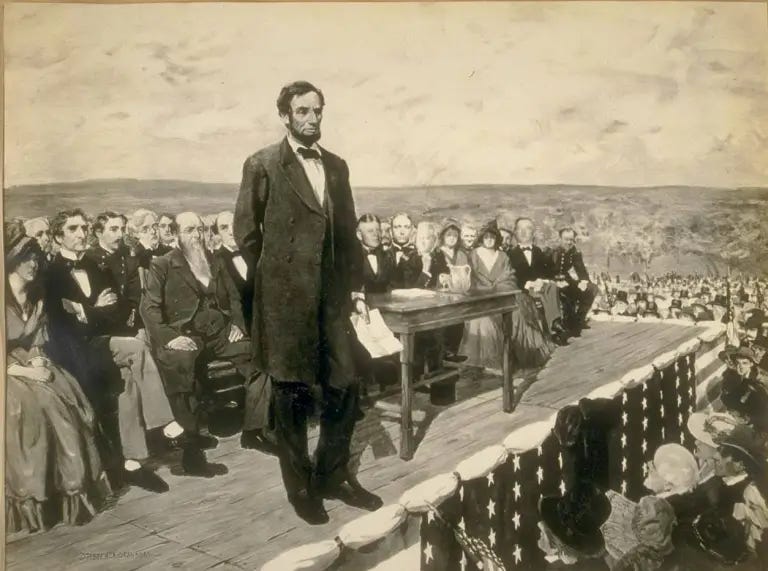
Everett ended up composing a flowery speech that was two hours long, an epic which he recited from memory. One Gettysburg resident said she thought Everett’s speech would never end. In the words of Garry Wills, a historian and scholar of rhetoric, Everett’s speech, as ornate and polished as it was, “was made obsolete within a half-hour of the time it was spoken.” When Everett had finished, music played, and then Lincoln stood up and spoke 272 words in less than three minutes. He had just finished writing and revising them the night before.
It is the nature of poetry to endure in the mind. Joseph Gilbert, a journalist for the Associated Press, was there to report on Lincoln’s speech. Lincoln stepped to the front of the platform, his hands clasped, and began to speak. Gilbert was taking notes, but as he listened to the words, he became mesmerized, and his pen came to a full stop. He had to see what he was hearing. “Fascinated by his intense earnestness and depth of feeling, I unconsciously stopped taking notes and looked up at him,” he wrote.
Plato says that the two aims of a funeral speech are to extol the dead and to exhort the living. “Laud the dead and lead the survivors.” Lincoln amends that. He doesn’t tell us only to strive forward. He tells us that the past is not finished until we have answered it with our living. “It is rather for us to be here dedicated to the great task remaining before us,” Lincoln says. What great task? To continue forward with the cause for which these men gave their lives, so that these dead shall not have died in vain. And how might they not die in vain? If we ensure freedom does not perish from this earth.
As with most challenges, there is a right way of responding. The future will judge whether we responded well. Like the last note in a melody yet to be finished, Lincoln was telling us the end could reach back to this beginning. We have received the benefits of a sacrifice, but only time will tell if we deserve what we have received.
Every new generation of Americans faces this great task: to render justice to the achievements we hold but have not yet earned. All we possess—our freedom, our nation’s wealth, our long lives, our ease—was passed on to us, not earned. They come at the end of a long line of sacrifices. Yet we may still do justice to these gifts. Only time will tell if we deserve them. That is the sum of all we can do.
A retired Marine who was part of the SEAL group walked us through the Gettysburg National Cemetery, to the exact location where Lincoln gave his speech. It was not where you would think it was. Not at the main monument, or even the section of the park dedicated to the Gettysburg Address. It turns out the spot Lincoln gave his speech is behind a fence in a different private cemetery.
“Some people say these monuments are over the top, in your face, we won the war monuments,” the Marine told us at one point. “But that’s not what these are at all. These monuments are here to heal the veterans. Gettysburg truly is a place of healing. Come out here someday and be quiet and just pay attention, and you’ll see old guys coming up and touching the monuments. Because our veterans today, we don’t have these monuments. Our veterans today, a lot of them will come here to remember the people that they lost.”
For the end of our three day tour of the battlefield, Willink and his SEAL team led us to a hill just outside the ground of the cemetery. “We get to walk around out here, we get to talk about these leadership decisions, and learn those lessons, and then you walk through that graveyard. And that graveyard represents a fraction–a fraction–of the people who sacrificed their lives for the Union,” Willink said.
He pulled out a piece of paper and read aloud an entry from an unknown soldier’s journal depicting the horrors of the Gettysburg battlefield. It describes rotting bodies, “some with faces bloated and blackened beyond recognition, some with glassy eyes staring up at the summer sun and others with faces downward and clenched hands filled with grass or earth which told of the agony of their last moments.”
Willink reflected on what it feels like to see this horror in war and then to return to your home. “If a human being can do this to another human being, then we must be doomed. It’s so easy to go down that path. But if we can detach, if we can take a step back, something else reveals itself on the battlefield. The will to live. The will to fight for freedom. The will to fight for something bigger than ourselves.”
Every new generation of Americans faces this great task: to render justice to the achievements we hold but have not yet earned. All we possess—our freedom, our nation’s wealth, our long lives, our ease—was passed on to us, not earned. They come at the end of a long line of sacrifices. Yet we may still do justice to these gifts. Only time will tell if we deserve them. That is the sum of all we can do.
Willink then recited the Gettysburg Address. There wasn’t a dry eye in our group.
Here we stand, America in 2025, a nation teetering on the edge. Stumbling along a path of deferred reckonings, America teeters toward insolvency. Our politics are deeply polarized, even deranged at times, with hatred of the opposing party intensifying from a scream to assassination. Talk of a new Civil War or impeachment is not uncommon as a response to the crisis of the week, whatever that happens to be. To live as an American now is to navigate a landscape of squandered opportunity. Meanwhile, across the Pacific, China casts a long shadow. On any given week, it’s anyone’s guess what dark projects may erupt in the Middle East. And in the theaters of combat in Ukraine, drones hum and menace and kill in an awful foreshadowing of a future of war we are not prepared for.
Lincoln reminds us we owe the dead a country that remembers how to build, how to explore, how to learn from our great inheritance, how to believe in the wild, improbable promise of itself. Then, when that last note is played, we will let our achievements hang in the balance of the stars.
~
 | A guest post by
|
Michael, kudos to you for thinking deeply about the significance of President Lincoln's words, going out and walking the ground of the site of great sacrifices, and doing so with people who know the significance and sacrifices of service in the Armed Forces. You likely grasp better than the vast majority how President Lincoln linked the words of--and sacrifices made for--our 1776 Declaration regarding equality and liberty with the meaning of our Constitution.
"Four score and seven years" earlier, many men fought and sacrificed for "a new nation, conceived in Liberty, and dedicated to the proposition that all men are created equal." All those men then who "gave their lives that [this] nation might live" ratified with their service and their sacrifices their 1776 Declaration as a wartime constitution. Their service, sacrifices, ideas and ideals became the foundation of our Constitution. As a result of what they thought and did, our 1788 Constitution declared "this [new] nation" and "a new birth of freedom" and a "government of the people, by the people, for the people." "The brave men, living and dead, who struggled" to bring to life the words of our 1776 Declaration and our 1788 Constitution "have consecrated" them and ratified them "far above" anyone else's "poor power to add or detract."