

The Gen Z-ers Saving Democracy
Carnegie Young Leaders get to work addressing gerrymandering, polarization, government responsiveness, and more

When you sit down to talk with teenage civic fellows and learn that they’re developing mathematical formulae to curtail gerrymandering, or making their own AI to analyze local legislation, you have to wonder (or at least I did): How can they know how to do all this at their age? And when do they find time for their homework?!
The Institute for Citizens & Scholars is lucky to have some truly exceptional individuals in the inaugural cohort of the Carnegie Young Leaders for Civic Preparedness. Citizens & Scholars has been working with young civic leaders for a long time, as a part of its Civic Spring Fellowship. The support of the Carnegie Corporation of New York has now enabled it to expand its work considerably. Carnegie funding also allows Citizens & Scholars to compensate the fellows with a stipend and seed money for their projects, so the fellows won’t have to sacrifice earnings as they pursue their passions in the civic arena.
The real trouble, said Chief of Youth Civic Programs Audra Watson, was choosing only 100 fellowship teams from 300 impressive applications, each with a great idea for the kind of positive change our country so desperately needs. This was the result of a thoughtful and wide-ranging outreach effort, to reach students with great ideas wherever they were, even in “civic deserts” without a lot of existing resources or connections. Citizens & Scholars asked questions like: “Do you have an idea no one is listening to?” and “What’s important that no one has ever asked you about?” Some students have been working on their projects for years. Others are just digging in.
The selected teams include people ages 14 to 24 from 29 states – by next year, Citizens & Scholars hopes to have worked with teams representing all 50 as well as the District of Columbia. The fellows gathered at a convening over the summer, where the Citizens & Scholars team envisioned a pluralistic group from many different geographic and cultural backgrounds. Past fellows were on hand, giving notes and flagging the obstacles they faced and pivots they made. Also on hand were the coaches assigned to each team.
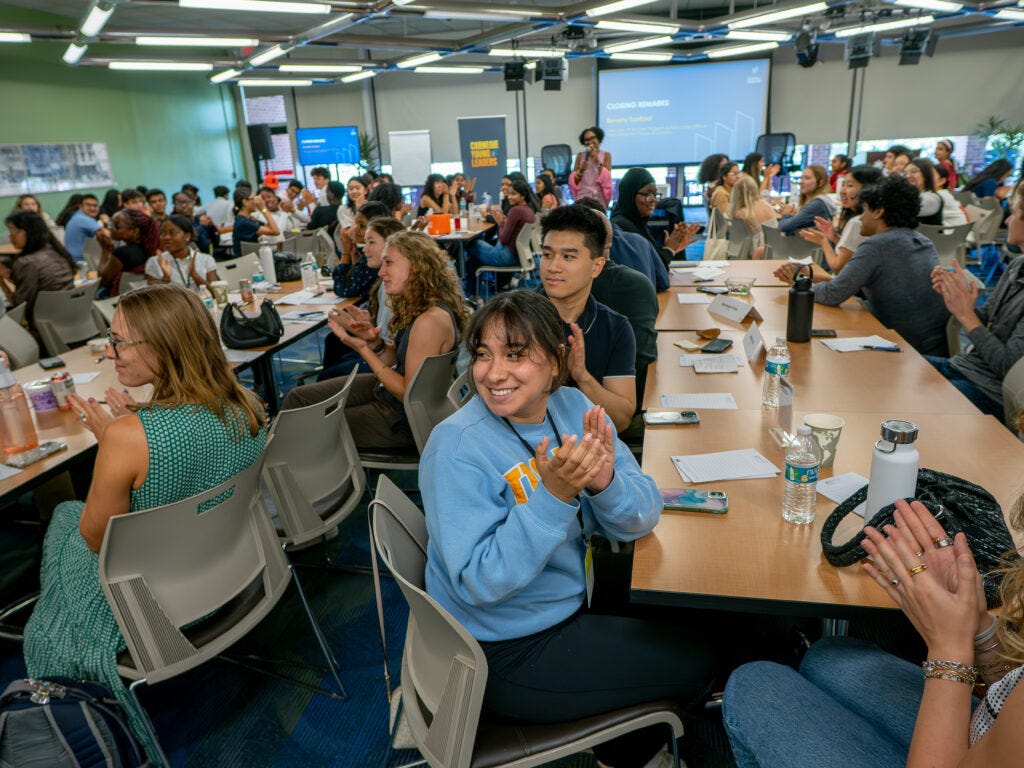
To get a better sense of the fellowship projects, I interviewed three team leaders.
First was Ryan Gans, a Florida State University student with an entrepreneurial, fast-talking style – if I see him in a campaign ad a few years from now, I won’t be surprised. He’s working with his team to run the annual FSU “Agree to Disagree” event. Participants will sit down in groups to discuss controversial issues and find common ground. “At the end of the day, we are all Americans, and we all want what is best for ourselves, our families and friends, and our country,” Ryan says earnestly. “While we may disagree on what that vision is, as long as we remind ourselves of that, the future becomes a little less bleak.” He’s hoping to make the event bigger and better – that is, more intergenerational and cross-ideological – by engaging students from different Tallahassee campuses, senior communities, elected officials, and others.
The most important thing, Ryan told me, was to move away from telling a group what you believe and why they should believe it too, and to move toward sharing why you believe what you believe – how your story and life experience shape your perspective. That’s the way to bridge differences and build understanding, by helping people to practice leading with curiosity and open-mindedness, he said.
Ryan credited his background in speech and debate in high school for his confidence in civil discourse. But he said that his magnet school emphasized civic engagement and community-engaged learning across the curriculum, too. As a member of the FSU College of Social Sciences & Public Policy (COSSPP) Student Leadership Council, he’s gotten the event planning and facilitation experience he’ll need to lead this project. He and his teammates met at FSU, and most of them serve together on COSSPP’s Civic Engagement Board.
In addition to this practical experience, Ryan brings a clear sense of purpose and mission as well as a healthy confidence to this difficult work: When the going gets tough, he draws on his dedication and experience. Not everyone brings that to the table, he thinks, and that makes him want to keep going. He shared: “I keep myself inspired by reminding myself that I am fighting for change and that those who support me, my friends, my family, my loved ones, and my colleagues are all doing the same and believe in me.”
I had my next conversation with Ananya Shah, a driven, quick-thinking high school student from the New York City suburbs. Ananya and her teammates come from several different states, having met at a summer program at Wellesley College’s Institute for Mathematics and Democracy. Ananya’s inspiration originated with a Covid-era online math group, where one member posed a practical problem: How can we use math to diagnose and perhaps correct partisan gerrymandering? She first connected with Citizens & Scholars by submitting her idea for a mathematical “GerryBuster” to their Youth Civic Solutions Competition (shared with her by a teacher), and then was invited to apply for the Carnegie Young Leaders fellowship. Her small high school’s emphasis on community and public service has encouraged her to keep using her voice to advocate for democracy.
You can tell that Ananya sees her work as a collaborative, highly social enterprise. After all, she says wisely, “No single group can tackle challenges alone, and no single person has all the answers or information. We can make real change when we put our heads together.” She’s reached out to academic experts in the field at institutions like Princeton and the University of Chicago for feedback and advice, and seemed surprised when I asked if they were receptive to outreach from a high school student. They were delighted, she said. Math aficionados of all ages evidently have a natural bond, especially when they’re working with a sense of civic purpose.
Casually tossing out a rapid stream of technical terms that I scrambled to write down for later research, Ananya explained to me that most takes on gerrymandering focus on weirdly shaped districts that defy geographical features (the origin of the term “gerrymandering,” as you can read in our post on the topic). She asked: What if we focused instead on voter data, not just from Congressional districts but down to the level of voting precincts, combining approaches from both math and political science? With that analysis, she said, we wouldn’t have to leave it up to political parties to cry “gerrymandering” or not; we (and by “we” I mean Ananya, and other experts in this field whom she admires) can use data to determine if voting districts fairly represent the voters, as well as to generate fair maps. We didn’t dig into the question of how to define fair in this context, but I’m sure Ananya would have a lot to say there too. You can read her paper on the subject at this link.
After working in this area for years, Ananya seemed frustrated but also excited that this topic is now front and center in the news. What we so often seem to forget, she said, is that members of Congress were sent to Washington to work for us. When we live in gerrymandered districts, however, it’s more a case of the politicians choosing their voters, instead of voters choosing their politicians. But examples like Michigan, where voters established an Independent Citizens Redistricting Commission by popular referendum in 2018 after a major grassroots campaign, show that voters’ voices really can matter. So public education about gerrymandering is a big focus of her project: analytical tools are most powerful in the hands of people who are using them to achieve a goal. Every state is a little different, and there’s never just one right way to draw voting districts, so Ananya approaches the work with a spirit of experimentation and open-minded curiosity: “I truly believe in the approach of consistently iterating upon and innovating within our democratic systems, and the approach of throwing everything at the wall and seeing what sticks.”
Finally, Imre Huss and his team from the Cleveland area are building an app, called Govvy, to improve communication between local officials and their constituents. This isn’t Imre’s first foray into civic work. He interned with More Like Us, an organization dedicated to civil dialogue and depolarization, and served on his Congressperson’s Youth Advisory Council, where he saw first-hand the communication barriers between elected officials and the community: endless phone logs and emails full of complaints coming in; dense, legalese-heavy bills going out. As if that weren’t enough, at the same time, he added almost sheepishly, he was also working on a local land conservation campaign, where their grassroots organizing work turned out to have less impact than a single ally with the ear of the city manager.
Imre, thoughtful and on the quieter side, described this trio of experiences as a reality check, a sort of perfect storm. “Many of our democratic processes are set up in a way that prevents the practice of informed and empowered democracy for a sizable percentage of Americans,” he said. “We need to see more accountability from lawmakers to their constituents.” He hopes that platforms like Govvy will improve communication and help to encourage people to work collaboratively on democracy renovation.
Imre attends a high school where the curriculum is centered around collaborative problem-solving, using real-world examples and consulting with community partners, and he sees this project as a great extension of that experience. This doesn’t leave as much time for traditional history and civics education, but Imre added conscientiously that he reads a lot of history in his spare time to try to come to grips with how our country traveled the path to where we are now, and to avoid reinventing the wheel. He and a friend at school started this project together, submitting first to the Youth Civic Solutions Competition, and recruited a college student with political campaign experience and a data analyst to round out their team’s skill set. They prudently decided to start by focusing on two greater Cleveland municipalities, which all function independently, so that they could pilot the app while building a network of relationships among elected officials and community organizers.
There’s no doubt that each of these projects will hit obstacles: They’re ambitious, and politics doesn’t care if your fellowship runs out after a year. But Citizens & Scholars’ Audra Watson is confident that the teams will find a way to keep moving forward, in consultation with their coach and community mentor and the other fellows.
All the fellows are members of the Generation Z, so they have some big things in common: They’ve grown up in a tumultuous political climate (as bears in traps being attacked by wolves with a wildfire on the horizon, as Danielle says), and they’ve grown up in the world of social media, which means rapid access to information and loud voices, for good and for bad.
But they’ve also had a lot of different life experiences. Meeting each other – other highly motivated, impressively skilled, and deeply principled young people – at last summer’s convening taught them that they can learn a lot from each other, and from other generations too, in their bimonthly convenings. As young leaders, they’ve got energy and vision, which means they can benefit from older people’s supportive guidance and stories. And connecting with other people is what helps them to recharge and keep going when burnout looms. The community surrounding the Carnegie Young Leaders might be the most impactful outcome of the fellowship, in the end, because I’m confident that their civic stories won’t end with this fellowship year or this fellowship project.
If you know young people ready to make a difference, share this reflection tool with them: Ten Questions for Young Changemakers. And encourage them to sign up for Citizens & Scholars fellowship application alerts HERE.