


After March came storming in like a proverbial lion, spring arrived suddenly in Philadelphia on March 7. I sowed some seeds for summer flowers and tomatoes, and then headed to the Civic Learning Week National Forum to celebrate the sowing and sprouting of metaphorical seeds.
Danielle Allen often talks about celebrating the green shoots of democracy renovation as one of our core missions here at The Renovator, and educators are as close to those green shoots as anyone.
Educators plant the seeds of knowledge, skills, values, dispositions, and informed action that we hope will grow into lifelong habits of civic participation and yield a healthier, fairer democracy. They nurture civic agency and a capacity for problem-solving that are strong enough to withstand the blight of disinformation, the invasive weeds of cynicism and extremism, and economic dry spells.
I can’t hope to recap everything that happened at the Forum – for one thing, I didn’t make it to every breakout session, and this post would go on much too long if I tried to summarize everything I did see! But I do want to report some of what I saw as the highlights, and I’ll leave it to you to add your highlights in the comments.
Stories from Educating for American Democracy teachers
The Forum began with a session on the Roadmap to Educating for American Democracy (EAD), now five years past its launch and enmeshed in curricula across the country.
Educators from Pennsylvania and Missouri spoke about anchoring their lesson planning in the EAD concept of reflective patriotism – clear-eyed civic honesty about America’s past, both the good and the bad, balanced with pride and faith in our founding principles that don’t stray into uncritical adulation. No matter how polarized their communities are, educators have found that reflective patriotism is a concept that brings people together and inspires curiosity rather than suspicion.
EAD teachers talked about their renewed sense of hope and joy, rediscovering American history alongside their students with an inquiry-based approach. In Arkansas, students are partnering with the Chamber of Commerce to plant trees and create informational brochures about local history for the town visitor center. A civics teacher in Montana was surprised when an outspoken libertarian student presented a research project on socialist Eugene Debs and enthusiastically praised Debs’ advocacy for working people, while remaining critical of his ideology. An AP U.S. history teacher’s students began the year by writing a dialogic debate between any two characters (from SpongeBob to Ayn Rand and even the moon?!) about writing a federal U.S. Constitution. Much to their teacher’s surprise and delight, they have regularly referred back to that project to help them understand later eras of U.S. history. The word is spreading: In Missouri, two more districts reached out to an EAD pilot school to work on their own implementation plan.
Across the country and across disciplines, students are tuning in to civic learning as a toolkit to translate their passion and frustration into action that helps their communities thrive. A science teacher studied solutions to the space junk cluttering our solar system with his students. A librarian guided students through research about the palm oil industry to help them understand how their spending affects global markets and communities, and a year later, students still meet her in the hall and sigh: “Palm oil!”
Preparation to participate
In her keynote address, historian Jill Lepore gave us all a powerful reminder of the possibilities these classroom experiences help create. America has – or at least had – a proud tradition of regular constitutional conventions held at the state or regional level to rewrite state constitutions as new technologies, demographic shifts, and conditions drove a need to adapt. Advocacy groups held these conventions too, to push legislators to acknowledge their concerns and serve the citizenry in a broader sense. There were Colored Conventions, conventions for women’s suffrage and Prohibition, conventions of indigenous nations, and of labor unions. Colleges and universities held town halls and open public debates. In the 20th century, that tradition waned. Maybe it’s time to bring it back.
When you picture a debate on a public issue – immigration, say, or a wealth tax, or military spending – hosted at a university, do you imagine civil discourse and respectful disagreement, or do you imagine shouting? Or worse? There was broad agreement at the Forum that if educators focus solely on transmitting civic knowledge, they aren’t doing enough.
If we expect students to be prepared to advocate respectfully for new policies or to participate in deliberation alongside people with diverging perspectives and positions in a pluralistic democracy, then we also need to build civic values, dispositions, and habits into our frameworks of civic learning.
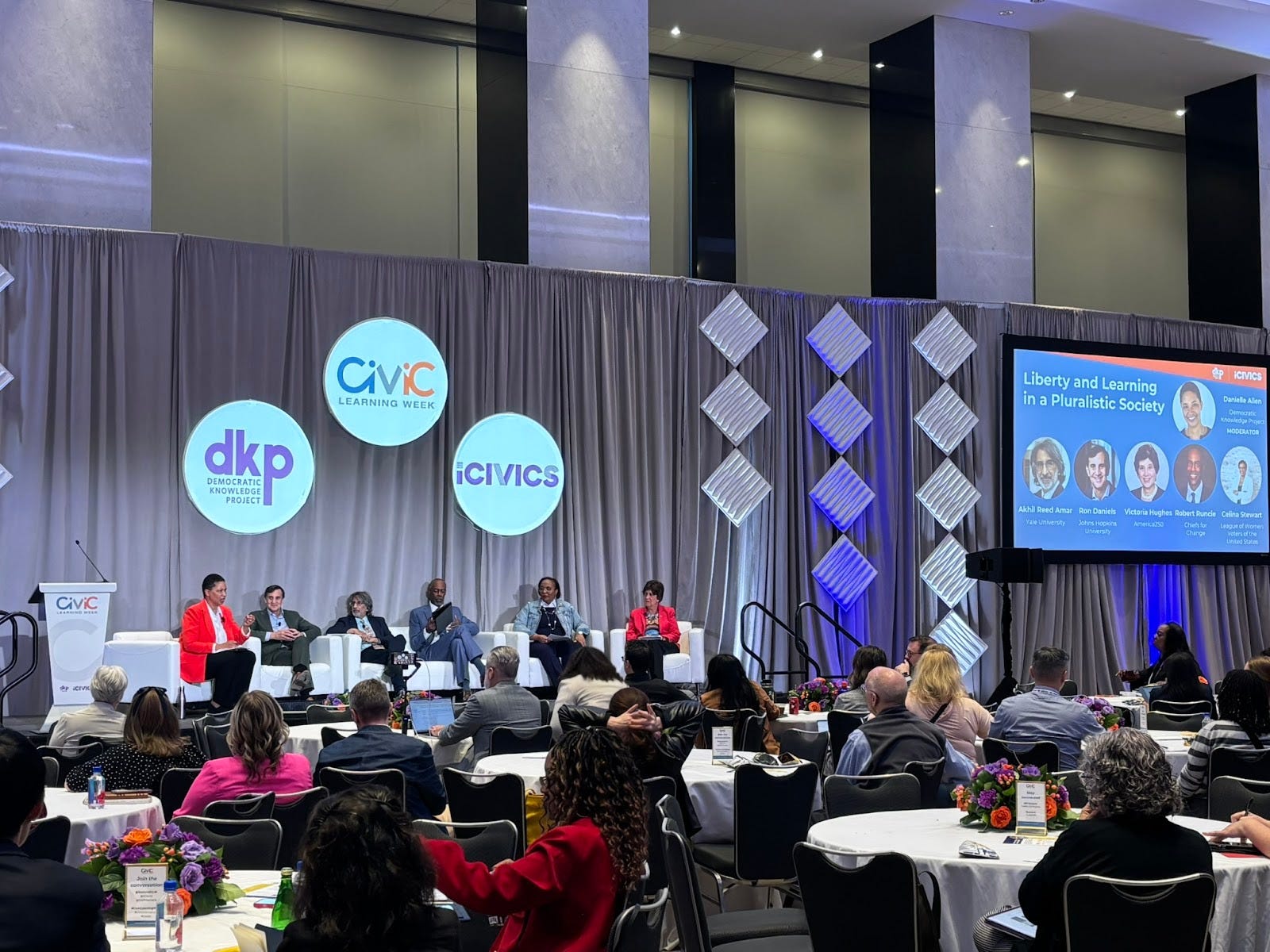
This idea came through clearly in the Forum’s closing plenary session. Celina Stewart, the CEO of the League of Women Voters, recalled her own childhood in a raucous household with six children. “It’s never easy to decide anything! But at least we listen to each other, and when we disagree, the world doesn’t end, and we’re still a family,” she reflected. “I worry that we think about pluralism as politeness, or as frictionless. That’s not what pluralism and democracy actually look like.” The mission of civic education in the 21st century must be to prepare students to disagree, to endure friction, to make their voices heard even in the face of pressure to be silent – without breaking the bonds of community or disrespecting their fellow citizens.
Student voices
I want to take a moment to appreciate the panel moderated by PBS’ “Civics Made Easy” host Ben Sheehan on Student Perspectives. Four extraordinary students (who all insisted that they weren’t actually all that extraordinary) spoke on the panel about their experience with civic leadership, and shared their perspective on what makes their generation tick.
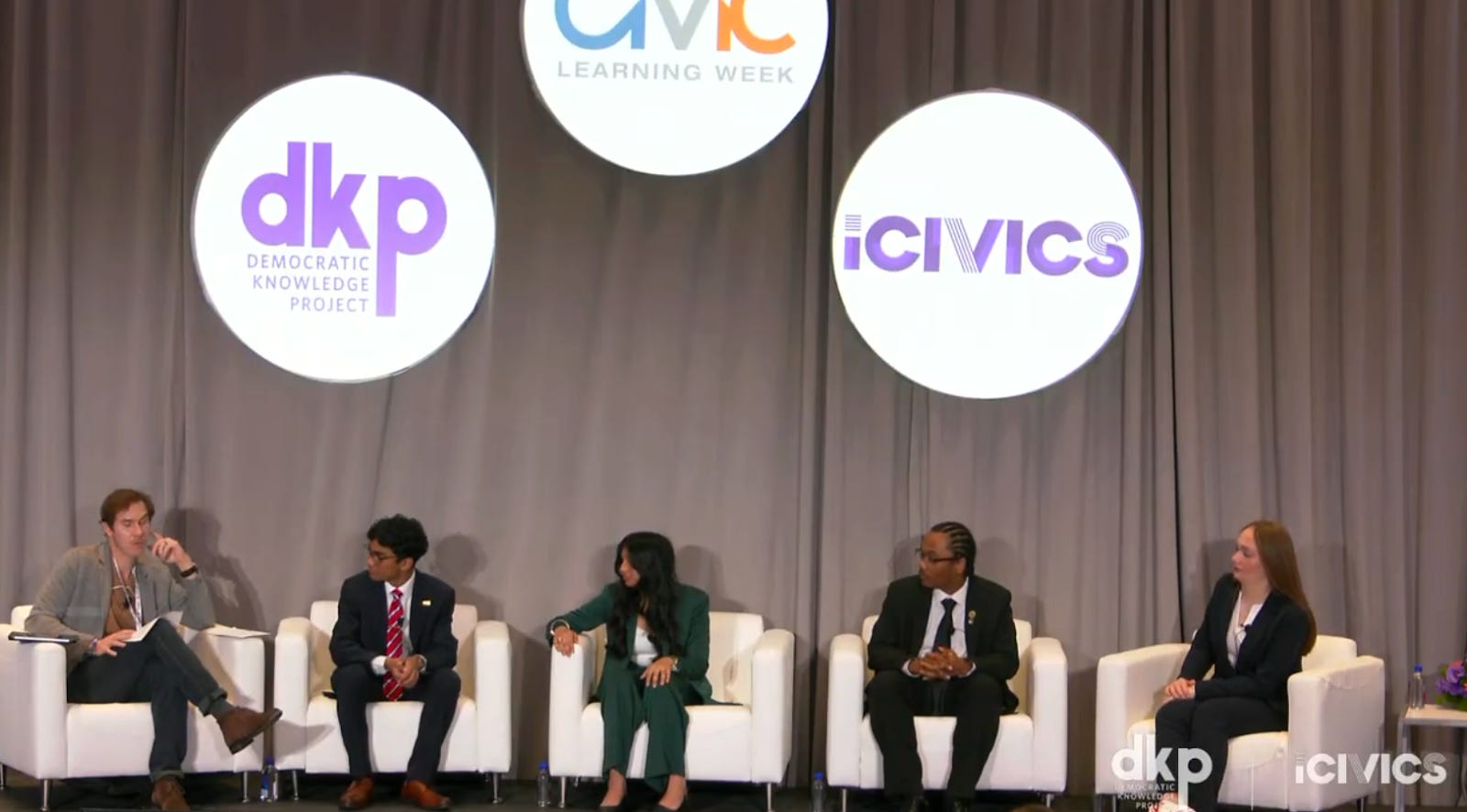
Ava June Tackett entered the Chamber of Commerce Civics Bee essay contest in middle school and reflected on her experience of civic education in rural Kentucky. Even in middle school, she wrote, she could tell she wasn’t getting the same learning opportunities as other students in other parts of the state or country – and she learned this was partly due to changes to the ACT and state standards. She could also tell that her teachers were afraid to talk about politics in class.
So could Shreya Raman, hailing from Arizona, who insisted: “Having a copy of the Constitution on your classroom wall isn’t political, it’s American. There’s a difference between brainwashing kids and telling them to support a specific ideology and making sure that they’re informed citizens.”
Ben Kurian, a documentary filmmaker and co-founder of Students for Patient Advocacy Nationwide from Ohio, recommended advocacy on specific issues, which often requires coalition-building with strange bedfellows and across party lines. But Shreya and Ava also pointed out that civic learning is not limited to politics or debating current events. If you’re improving the life of a community or working to understand other people better, you’re becoming a better citizen of a democracy, and that’s what civic learning is about.
Panelist Charles Rinker, a peer mediator trained in restorative justice, took aim at critics of Gen Z who see them as nihilistic or disengaged. “I think we’re the most patriotic generation, in the sense that being patriotic means critiquing where we are, realizing how much work we have to do, and being ready and willing to advocate for that.” The other panelists nodded vigorously as Charles called for civic learning opportunities in the humanities, because “humanities fuel our soul” (I felt a room full of teachers’ hearts leap in unison). Shreya jumped in to suggest that young people particularly want opportunities for creative, artistic expression of what they care about.
And in general, the panelists said, whether students want to invent new technologies or make art or write laws or plant trees, whatever their skills and interests are, and whatever their GPA might be, just encourage them: “What you’re good at matters – use that to make a difference.”
America at 250
It was a pleasure to spend time with hundreds of people dedicated to the mission of civic learning, a refreshing break from our day-to-day work that helped re-ground us. It also felt galvanizing in the moment of the semiquincentennial.
Danielle marked the occasion as a birthday party of sorts for the Declaration of Independence, one of many semiquincentennial celebrations set for Philadelphia and America’s 250th. 250 civics teachers and students attended the Forum to mark the occasion, along with hundreds more representing a network of organizations involved in curriculum, educational resources, professional development, and policy advocacy for civic learning.
Victoria Hughes, Co-Chair of the History, Civics, and America’s Future Advisory Council at America250, reminded us of anniversaries past: During the bicentennial in 1976, she recalled, we were a deeply divided country traumatized by political violence and assassinations, political corruption, a divisive fight for the Equal Rights Amendment, and economic decline. The bicentennial opened up an opportunity to recommit ourselves to our founding principles and to a more perfect union. The semiquincentennial offers the same opportunity, especially to educators, who can help to ensure that the reflections and recommitments actually stick for the rising generation of leaders.
Raising a Glass
In 1774, delegates to the First Continental Congress marked the end of their session in Philadelphia with a banquet at City Tavern, and raised 35 toasts to celebrate the occasion and their hard work. At the National Forum, we, too, raised a glass to celebrate in the historic Memorial Hall, built for Philadelphia’s Centennial Exhibition in 1876, and now home to the Please Touch Museum. I’ll leave you with those toasts, composed by participants.
To those whose words started a revolution, founded a country, and inspired the world.
To the Founders of our Republic: People of imperfect goals and an imperfect vision, yet possessed of the leadership to unite and the bravery to begin. We honor the drive that pushed them to look to the future and the humility to know their work was only a start. To the Architects!
To the unsung Americans who keep moving equality, liberty, and the American dream forward for the betterment of all.
To a future shaped by informed citizens, courageous learners, and a democracy that grows stronger when everyone belongs and participates.
To carrying the blessings and burdens of the past with the optimism that ‘we the people’ can shape our future
To those once excluded—may their descendants help perfect the promise.
To not letting independence stand in the way of interdependence
To our military children, who were born into service—not service by their choice—yet sacrifice greatly for our nation’s safety
To the educators, students, and community partners who bring civic learning to life—thank you for creating spaces where inquiry leads to understanding, where young people discover the power of their voices, and where collaboration strengthens our communities.
To our Teachers: Who plant the seeds of history and the power of the People. May the knowledge they sow today grow into a generation of citizens who are engaged, enthusiastic, and active in the arena. To the Planters!
To civic teachers—guardians of the “why” behind the “how.”
To our Students: The rising forest of our Republic. May the knowledge they’ve gathered grow a fire in their bellies—turning them into the loudest, proudest, and most active citizens this nation has ever seen. To the Future!
As we gather to celebrate our nation’s 250th, let us raise a glass to constitutional democracy not as a finished story, but as a shared responsibility we renew each day.
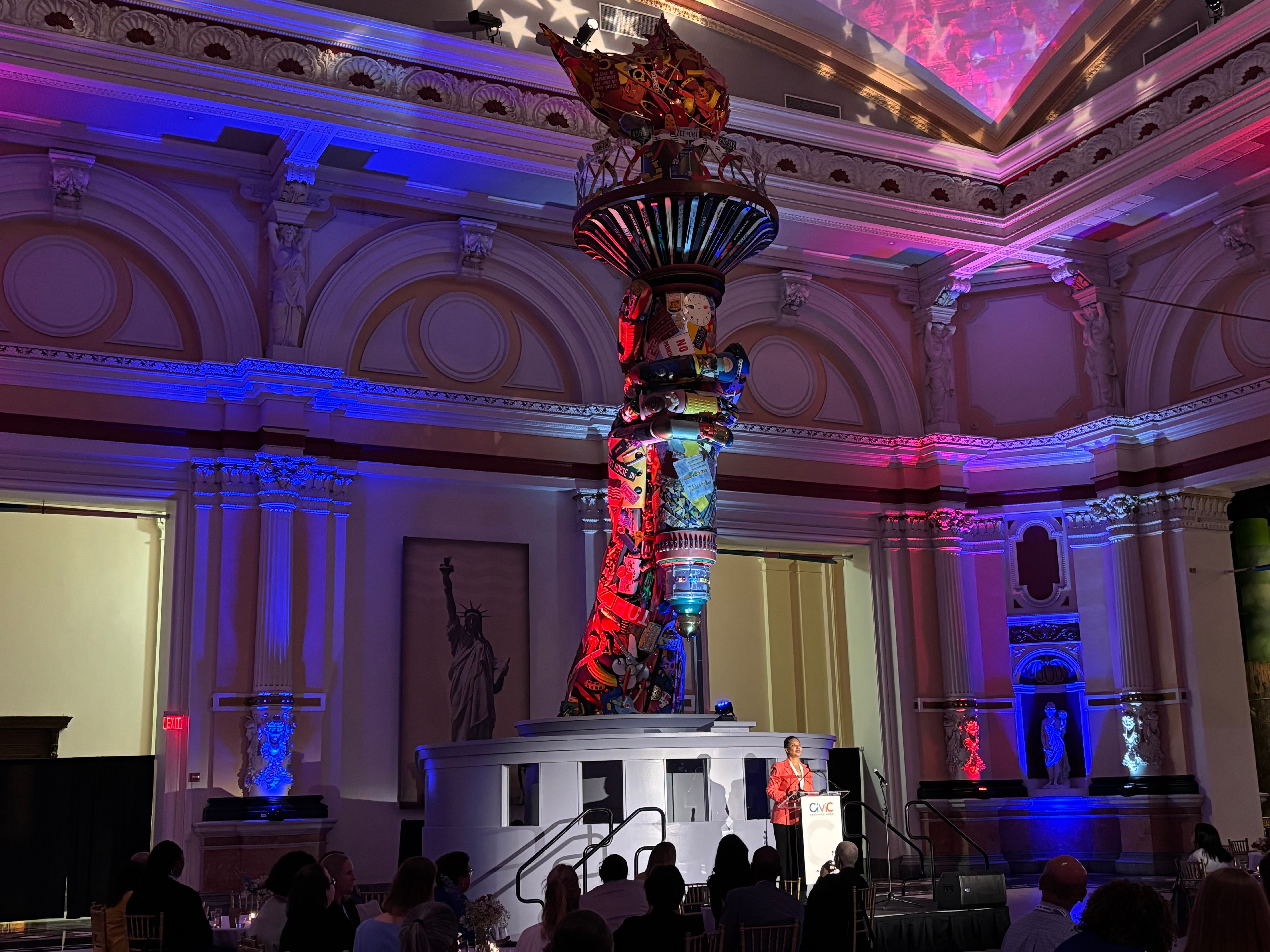
Raise a toast to Gen Z and planting seeds!