

Soft Bodies, Hard Cars
On hitchhiking, democracy, driving, and cuddle puddles

Imagine a democracy that feels a little like a cuddle puddle. Place yourself in a platonic pile of soft bodies, entangled on a king-size bed. You’re surrounded safely by friends, happy mammals, tribal love. The borders of your bodies and clothes meet gaplessly in the dark; the boundaries of the self are warm, and only loosely defined. You listen, lazily, to low whispers on your left, giggles on your right, all melted together into one.
Democracy requires a safe, open container for discourse. Discourse functions best between speakers who genuinely feel like they contribute to a shared tribe, a superorganism, a common good served by communication, coordination, and cooperation. Quality community creates quality communication, and vice versa.
A nation is a large tribe, and creating democratic trust on a national scale is harder than getting the vibe around a campfire right. It’s going to require cultural work to convince our monkey minds that we are safe and at home together. Perhaps the experience of the cuddle puddle has something to teach us about what it means to be a body in democracy.
I’m not suggesting 300 million Americans on ketamine and MDMA splay themselves across a mattress the size of Kansas, as sweet as that sounds. But if we’re serious about developing an American culture that can approach a higher ideal of democracy, and “crown thy good with brotherhood from sea to shining sea,” then I think we do need to examine how our bodies feel when interacting with fellow citizens.
Do we feel safe when we see our neighbor walking by the window, or does anxious fear of the HOA flutter in our hearts? Does eye contact at the grocery store send us into fight-or-flight, or do we smile? Are you scared of the stranger by the side of the road? Or does their journey overlap with yours?
Evolutionarily, other human beings are both our greatest resources and our fiercest predators — the most salient affordances to move toward, and the scariest threats to flee. When fellow citizens speak their mind, or vote, do we experience them as friends or foes? Soft, or sharp? Within the boundaries of the tribe, or beyond?
Now, consider this: The average American spends over an hour driving every day, and it influences how we relate to others. Cars, unlike bodies, are hard. When we’re driving, we experience our fellow travelers as threats. The “Other” is a heavy box of metal that could kill us, or at least cut us off before the exit. We navigate the so-called freeway as a zero-sum battle against enemies over limited space, not a positive-sum deepening of shared freedom. There are moments of grace, of course, when a country driver waves at us through the window, or a big blue bus lets you merge first. But road rage is more common than road love.
Driving teaches us that relating to other people requires strict distance; the ultimate rule of the public road is no touching. If your hard metal exoskeleton hits my hard metal exoskeleton, we’re both in for a world of hurt — not only physically, but also socially, legally; we’re subject to invisible forces as real as any weapon. Contact can only cost you.
When you drive a car, you become a car; you experience metal bumpers as the borders of your proprioception. Daily, we practice maintaining large gaps between hard-bound selves. Daily, the eyes of our neighbors are hidden behind anonymous windshields, their bodies abstracted and dehumanized.
The lived experience of driving a car practices a phenomenology of isolation. Cars habituate us to fundamentally anti-democratic ways of perceiving social life. We increasingly associate danger with our initial perceptions of other people. We learn to feel that safety means distance from other selves, not communion. This incipient habit grows, and comes to color our sense of association itself. Our fellow citizens become hard cars, foreign parties, enemies in the endless war of all against all in bumper-to-bumper traffic. Americans bowl alone, habitually, in part because we drive alone. Busy-highway democracy is the opposite of cuddle-puddle democracy.
Perhaps the experience of hitchhiking can help us resolve this tension. Put yourself on the shoulder of the road, watching the metal-and-glass cages go by as you seek connection. A good hitchhiker learns to look each driver directly in the eyes, right through the windshield.
Hitchhiking is a lot like fishing, and eye-contact is the line that connects us through glass. You smile when their eyes meet yours, and give your thumb an inviting wiggle. People might ignore you, or they might wave; someone always, eventually, pulls over. They see another body like their own through the glass, and they roll down the window; you chat, feeling each other out, and realize you’re going in the same direction.
The hitchhiker hops in the car, and the two bodies behind car doors become one tribe, temporarily united in the face of the world. As they drive on, they live or die together. They talk about the world they share, and learn that more connects them than they’d have ever discovered apart. They share a forward view through a single windshield, chasing a unified horizon.
Tribes are made of bodies, not cars. Voices, vibrating, carry discourse. Every ear is a hitchhiker; every soft mind a center, a moral equal, a valuable vote. The modern American is armored by invisible walls; as John Dewey knew, we are already a Great Society, but not yet a Great Community. Hitchhiking practices the art of extending the tribe — semipermeably, squishily, softly — around every border. When we think like a hitchhiker, we learn to see the soft bodies hidden in hard cars. Slowly, humanity links its hands through every crack in the world.
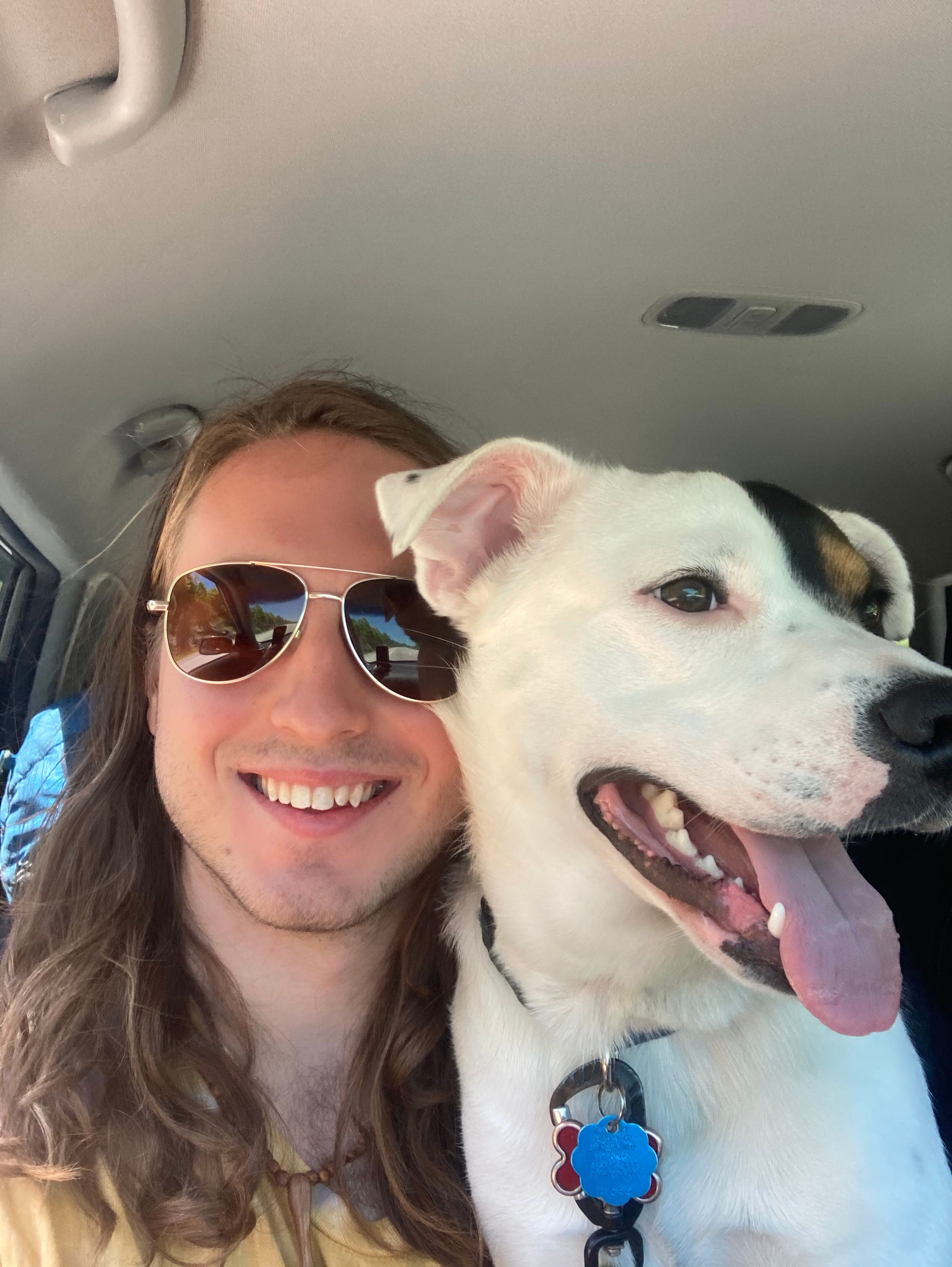
For more on hitchhiking and democracy, check out Beatin’ Paths.

@Aidan, you are too young to remember but in the 1990s was when "No Fear" became the (somewhat inexplicable) mantra of a generation. And it happened at the same time as mirrored sunglasses became popular beyond highway patrol officers. So young people would walk around hiding their eyes behind their shades and wearing T-shirts that denied the deep insecurity they really felt. Your experience today is what that evolved into. The eyes are the window to the soul, as they say. But we hide behind our windshields or our shades and pretend we are not afraid -- to meet people and be genuine with them.