

Why Business Leaders Must Step Up for Democracy and the Market Economy
In this collected series, Harvard Business School’s Malcolm Salter traces how U.S. democracy and markets are breaking down — and why business leaders can’t stay on the sidelines.

Editor’s Note
Malcolm Salter is a regular columnist for The Renovator and the James J. Hill Professor of Business Administration, Emeritus, at Harvard Business School. His scholarship focuses on issues of corporate strategy, organization, and governance.
The five essays collected here first ran in The Renovator between September 7 and November 1, 2025. Together, they map what Salter calls the “twin tailspin” of democratic capitalism: a system that has grown less democratic and less genuinely capitalist at the same time.
Across the series, Salter:
defines what “democratic capitalism” actually is and why it has been so successful when it works;
shows how pervasive cronyism and restricted suffrage now threaten both democracy and markets;
and makes the case that business leaders must become evangelists for renovating our political economy if they want it — and their enterprises — to endure.
These columns are adapted from his 2024 book, The Fading Light of Democratic Capitalism (Cambridge University Press), and are reprinted here as a single long read for easier reference and discussion.
You can read straight through, or use the table of contents below to jump to the questions that matter most to you.
Table of contents
The Twin Tailspin of Democratic Capitalism
How a system that once delivered shared prosperity and political freedom has drifted toward oligarchy, cronyism, and restricted suffrage, and why this combination endangers both democracy and markets.Are Democracy and Capitalism Compatible?
A clear definition of “democratic capitalism,” how its economic and political parts are meant to work together, how the American experience has so far proved Marx wrong, and what happens when the balance breaks down.Citizens United Supercharged: Our Problem with Cronyism
Why political equality is the foundation of democratic capitalism, how cronyism and the Supreme Court’s Citizens United decision have increased money in politics, and what reforms could help restore balance.Democratic Capitalism Doesn’t Work Without Democracy
A look at “restricted suffrage,” from closed primaries to targeted voting barriers, and the reforms under way to expand the right to run and vote, including open primaries, civic education, and youth engagement.Where Are the Business Evangelists for Our Democracy?
A call to American CEOs and business leaders to follow the example of Paul Hoffman and the Committee for Economic Development: to curb cronyism, move beyond shareholder-wealth-at-all-costs, and champion the institutions that make free markets possible.
The Twin Tailspin of Democratic Capitalism
Over the past several decades our espoused model of political and economic governance, commonly referred to as “democratic capitalism,” has become less democratic and less capitalist. And at the same time, survey after survey have shown that its two vital building blocks — democracy and capitalism — have suffered dramatic setbacks in popular confidence.
If this twin tailspin remains unattended during the Trump administration, our market economy is likely to drift even further toward oligarchy and isolate citizens from the political process even more than they already are. This would effectively end the tenure of democratic capitalism as a credible national ideal and cornerstone of our national identity. Stemming this dangerous drift is reason enough to want to save democratic capitalism.
An equally compelling reason is that the arc of U.S. history over the past 75 years suggests that when our system of political and economic governance is working at a high potential, democracy and a market economy can co-exist and prosper together.
In the decades following World War II, we came closer than ever before to achieving this ideal state of democratic capitalism. Until recently, our unique pairing of democracy and capitalism has been both economically rewarding and, from the perspective of democratic principles, morally justifiable — even if true political justice remains a work in progress.
Our system of political and economic governance proved capable of delivering a level of innovation and economic growth far superior to that of other industrialized nations. It gave us a rising standard of living that became the envy of the world. It produced a rich national treasury that could pay for valued government programs, including safety nets for those in need. In addition to economic prosperity and security, democratic capitalism gave us the possibility of political freedom in the form of free and fair elections, protection of individual liberties, and rule of law. Citizen access to the political process, always somewhat problematic, rose to its highest level ever.
Along the way, Congress and regulatory agencies established by Congress were able to rein in many excesses of free markets and hold private parties controlling the factors of production accountable to the public will. Many personal freedoms, particularly in the areas of civil rights and access to essential services, were enhanced significantly.
Despite intermittent economic breakdowns and corruptions, and continuing shortfalls in achieving political equality for all, many citizens, like me, who grew up during the economically prosperous postwar years, considered our system of political and economic governance to be working reasonably well and offering a respectable governance model for the future — especially after the enactment of Great Society programs in the 1960s affecting voting rights, health care, and education.
In recent decades, however, dark clouds have appeared, casting a warning shadow across this bright light of democratic capitalism.
These clouds come in many forms. Stagnating (and declining) real incomes for some trades and professions. Increasing inequality in income and wealth. The adverse side-effects of the shareholder wealth maximization revolution. Inattention to capitalism’s losers. Intense gaming of society’s legislated rules of the road by businesses. Highly publicized cases of accounting fraud. Large executive pay packages that appear unconnected with accountability for corporate misdeeds. And unsurprisingly, given all that, an historically low level of trust in government.
To this catalogue of clouds, we must add the especially poisonous effects of pervasive cronyism and restricted suffrage. Indeed, this toxic duo constitute the ultimate “deal killer” for democracy and democratic capitalism. Together, they create a concentration of power in the hands of the few, while limiting the voice of the many — a truly undemocratic situation.
The “few” in this case are wealthy and powerful members of society, including the owners and leaders of our all-important business firms, who have the capacity to influence public policy for private advantage through virtually unlimited campaign contributions and massive lobbying efforts. Opportunities to secure such privileged advantage in the world of business typically emerge in the form of friendly congressional legislation, targeted exemptions from legislation, advantageous rules drafted by regulatory bodies, preferred access to credit, direct subsidies, preferential tariffs, and tax breaks.
![1909 cartoon Illustration shows two diminutive figures labeled "Democratic Principles" and "Republican Principles" arguing between themselves; in the background are four large men, "the Gods", labeled "Democratic Boss, Privileged Interests, Dive Keeper, [and] Republican Boss" sitting on a bench, amused by the two small figures in the foreground.](https://substackcdn.com/image/fetch/$s_!2VPJ!,f_auto,q_auto:good,fl_progressive:steep/https%3A%2F%2Fsubstack-post-media.s3.amazonaws.com%2Fpublic%2Fimages%2F877a2f3e-7694-4391-a134-92e939275846_640x428.jpeg "1909 cartoon Illustration shows two diminutive figures labeled \"Democratic Principles\" and \"Republican Principles\" arguing between themselves; in the background are four large men, \"the Gods\", labeled \"Democratic Boss, Privileged Interests, Dive Keeper, [and] Republican Boss\" sitting on a bench, amused by the two small figures in the foreground.")
Cronyism greatly diminishes the democratic aspect of democratic capitalism. Cronyism also diminishes the capitalist aspect of capitalism, when accruing wealth comes from simply being powerful rather than from successfully serving customers in competitive markets.
The financial costs of cronyism are large and growing. Many of the direct economic costs — such as costs stemming from legislation and rulemaking favorable to business — can be crudely estimated. For example, a recent Cato Institute study calculated that the federal government spends more than $180 billion annually on direct and indirect subsidies to small businesses, large corporations, and industry organizations.
Other costs of cronyism – namely, the degradation of such values as self-restraint, truthfulness, trustworthiness, and lawfulness that are vital to the functioning of capitalism and democracy — defy precise quantification but are arguably the most important ones over the long run.
Restricted suffrage, the second element of the toxic duo, refers to election rules and practices that muzzle the political voice of ordinary citizens by limiting ballot access for prospective candidates and accessible voting for those wanting to register their voices in elections.
Discriminatory practices limiting the right to run for office include restricted primary processes. For democracy to function, however, every viable candidate should be able to compete, and every election should meaningfully reflect diverse viewpoints. This is clearly not the case across the country, however, because numerous states design their primaries to prevent viable candidates from running for office.
Discriminatory practices limiting the right to vote include the partisan redesign of voting districts to limit the influence of certain racial and ethnic groups or political parties, the closing or moving of polling stations, restrictions on community-based registration drives, elimination of same-day voter registration and early voting, and the absence of time off from work to vote.
Most rules and regulations affecting voting rights are state-specific, per Article Four of the Constitution. The major exception to this generalization is the Voting Rights Act of 1965, which outlawed many discriminatory voting practices adopted in the South after the Civil War and afterward. Since 1965, however, various protections of citizens’ rights to vote that were spelled out in the act have been eviscerated by U.S. Supreme Court decisions — such as 2013’s Shelby County v. Holder, which has had the unfortunate effect of striking down preclearance for any changes in voting law or practices such as redistricting before their implementation. The predictable result was an immediate wave of redistricting across Southern states to either exclude Black voters’ voice or favor one political party over the other — not unlike what we see unfolding today in Texas.
Pervasive cronyism and restrained suffrage are a deadly combination. Taken together, they create a governance system that is neither truly democratic nor truly capitalist. In addition, pervasive cronyism coupled with restricted suffrage destroys the perceived legitimacy of capitalism. Finally, a governance system that is perceived to be dominated by special interests and unresponsive to citizen needs is highly vulnerable to the capture of disconnected and disenchanted voters by political demagogues and reckless actors.
This situation has not gone unnoticed by the public. Repeated polling by Gallup, Frank Lutz, Harvard’s Institute of Politics, and the Edelman Trust Barometer tells us that our system of political and economic governance has steadily lost public confidence and popular support. Today, only about one in five respondents trust U.S. big business; the same small share feels that the current system of political economy is working for them. Along with recent election results, these surveys seem to reflect an increasing sense that the political and economic “game” has become rigged against common citizens.
Reversing this deep decline in public support and correcting the underlying causes of democratic capitalism’s “decline” is a daunting task.
To begin, a successful renovation of democratic capitalism will require time-consuming and expensive changes of both a structural and cultural nature. Many of these changes — especially those aimed at curbing cronyism — can only be successfully implemented if our business leaders become evangelists for these changes. Without the support of a critical mass of business leaders, who are incontestably the central actors in our political economy, it will be impossible for core democratic principles — like political equality (the antithesis of cronyism) — to be re-embedded in the governance of our political economy.
This is bound to be a tough sell. Many business leaders have been reluctant to publicly support movements that may be deemed controversial by one or more of their constituencies or allies. Overcoming this reticence will be a major challenge. It will require answering the question of why business leaders should be interested in including political equality in their remit as fiduciaries for their investors and other suppliers of capital.
Beyond that, it will also require answering the question of why business leaders should see themselves, in the first instance, as guardians of our espoused system of democratic capitalism.
This is not to say that all business leaders eschew this role today. Especially in the domain strengthening suffrage, we have seen early movers like Patagonia, Levi Strauss, PayPal, Alphabet, Apple, Amazon, Southwest Airlines, and, for many decades, the Conference Board’s Committee for Economic Development supporting reform initiatives and related policy research. Yet, even for these “early movers,” few management leaders chose to publicly promote and evangelize for the work that their companies are doing in supporting our capitalist democracy.
For these forward-thinking leaders, and for vast number of CEOs and senior executives who have yet to engage in actively preserving democratic capitalism as a national ideal, we need to make the case that major changes are needed to preserve the promise of American-style democratic capitalism and that the active participation of our business leaders is critical to the success of this change process.
To do this, it will be useful to remind everyone what the idea of democratic capitalism entails and call attention to the risks we run if we continue to retreat from its underlying principles. From this stage setting, we can then turn to the range of changes required to restore our unique system of democratic capitalism as a national ideal, highlighting along the way the vital principles and values that underlie the proposed changes. At this point, we will be prepared to address the question of how our business leaders — many of whom are our most fluent defenders of capitalism – can serve as evangelists for the principle-based renovations of democratic capitalism that appear increasingly mandatory.
I will explore all of these points in forthcoming columns for The Renovator. There is much to discuss.
Are Democracy and Capitalism Compatible?
To save the system of democratic capitalism that has brought so much liberty and prosperity to America, it’s important to make sure we understand what it is. Democratic capitalism is like the air — we live and breathe it every day, but it’s not something that can be seen. Most Americans probably take it for granted most of the time.
So let’s pause to define our terms:
The phrase “democratic capitalism” refers to a system of relationships and rules that determines how markets and businesses are structured, sustained, regulated, and held accountable. Nothing about markets and their governance is a natural phenomenon, after all. As characterized by the late Harvard professor Bruce Scott, this system is a social construct worked out by democratically elected representatives whose primary responsibility is to the will of the people.
This governance system has a pretty important job: When played out in a civil society capable of compromise and peaceful negotiations — and where political power is diffused among the public, rather than concentrated in the few — it provides a way to align competing priorities and distribute the benefits of economic activity according to society’s collective will.
How does it do that? Well, as the phrase suggests, “democratic capitalism” relies crucially on two sub-governance regimes: Economic and political.
Economic governance encompasses the ways that open markets enable the supply and demand for goods and services to be matched with consumer needs through the price mechanism; coordinate the decisions of savers and investors; and, in the end, allocate resources to their most productive uses. Actors are granted the legal right to own, trade, and control property according to their interests. They can invest capital as they see fit. And they reap the bulk of subsequent returns. These property rights were established for all citizens by our Constitution — specifically, its 5th and 14th Amendments.
Economic governance also serves a vital creative function by providing strong incentives for innovation and making the benefits of that innovation widely available.
In theory, the capitalist form of economic governance presumes a minimalist role for government in regulating markets and the allocation of capital, giving people the freedom to buy and sell anything they have created or own. In practice, however, there is great variety around the world in the government’s level of involvement. This variability reflects different preferences related to individual freedoms, the degree of private ownership of capital, public authorities’ regulatory intervention, the nature of social security systems, the incentives for risk-taking, the tolerance level of economic inequality, taxation and much more.
Which takes us to the second regime. Political governance encompasses the mix of political processes, laws and regulations that set the rules of the game for decentralized decision-making throughout the economy.
In a functioning democracy, it’s the people who hold the ultimate power to determine these rules and to decide when they might need to be changed. In other words, under democratic capitalism, economic activity is accountable to political authority. And the necessary condition for such democratic oversight and control is full access and participation rights for citizens in the political process — starting with the right to vote and to run for political office.
Despite the apparent compatibility of these two components of democratic capitalism, it has always been a fragile operation. Things can easily unravel if it misused or corrupted — as we are, alas, discovering.
How America has proved Marx wrong (so far)
There is tension at the heart of democratic capitalism that will be all-too-familiar to those of use living through the present moment.
The primary reason for the fragility described above is that the interests and desired outcomes of the two components of democratic capitalism — the economic and the political — can pull in different directions.
In capitalism, the desired outcome is private financial gain. In democracy, community welfare is the goal. Reconciling these differences is a continuing challenge.
A second reason for the fragility is that policy- and decision-making processes differ markedly in the two spheres. Capitalism vests decision-making authority in a limited cadre of owners and their agents pursuing private gains. Thus, capitalism is an exclusive governance regime, under most circumstances.
Democracy, meanwhile, places decision-making authority in electorates comprised of citizens. Democracy, therefore, is an inclusive governance regime.
Reconciling this difference is a second challenge.


One can easily imagine that a governance system reflecting these conflicting desired outcomes and decision-making modes would be unstable. Indeed, Karl Marx argued in “The Communist Manifesto” that a combination of democracy and capitalism could never work, because democracy would always be sacrificed to protect the interest of capitalism.
In other words: If one wants true democracy, forget capitalism. And if one wants capitalism, forget democracy.
Marx has been proven wrong by the American experience — so far.
Reconciling democracy and capitalism
Through many years of compromise, cooperation, and sacrifice, the United States has managed to reconcile many conflicting features of democracy and capitalism into a “cooperative marriage” between “complementary opposites” in the words of Martin Wolf, the longtime chief economic commentator at the Financial Times.
As noted in the first column of this series, this was achieved through a combination of market and financial regulations aimed at minimizing ills of capitalism associated with unbridled personal gain, monopoly, securities manipulation, environmental degradation, and the like.
The introduction of maximum working hours and minimum wage legislation, anti-discrimination measures, and safety nets for people injured by economic dislocation and bad luck also served to temper the ills of market capitalism.
In addition, both our Constitution and legislated rules and processes for establishing national goals and policies, resolving conflicts, and implementing policy decisions provided the administrative infrastructure upon which our society was built.
All of this is good news — except when the discipline required to make this governance system work politically and economically breaks down.
Today, this breakdown takes two major forms — pervasive cronyism and increasingly restricted suffrage. The result is that the capitalist component of our governance system is fast losing its perceived legitimacy as citizen influence is curtailed. Similarly, the democratic component is fast losing its ability to represent the will of the people through the electoral process.
Together these losses are undermining the value of democratic capitalism as an aspirational ideal.
And that, in a nutshell, is what’s been happening to us in recent decades. Which leads urgently to the question of how we can reverse the corrosion of democratic capitalism — and what principles should guide a recovery project.
This is the important work before us, and it will be the subject of my next column.
Citizens United Supercharged: Our Problem with Cronyism
In the first two columns in this series (read 1 and 2), I’ve described the dangerous downward spiral of democratic capitalism, which raises the urgent question: How do we reverse course? Stemming the decline of democratic capitalism requires, first and foremost, an unambiguous commitment to political equality.
From our nation’s very beginning, our Founders understood that equality was the key to a lived democracy — that no activity claiming to be democratic can actually be democratic unless the principle of political equality is baked into it.
What do we mean by political equality? In Renovator founder Danielle Allen’s excellent framing, the fundamental components are personal autonomy; freedom from domination by other individuals or groups in building one’s life; access to the political process; and the right of members of institutions in civil society to participate in matters affecting their welfare.
Political equality should not be confused with economic equality, social equality, or gender equality, although each of these is important. The word “political” in the phrase “political equality” refers specifically to access to a governance system where the divergent interests of participating parties can be worked out.
As Danielle notes, there are two faces to our governance system: One face is the conduct of governing bodies themselves, whether in the public or private sector. The other relates to citizens — their standing and freedoms within these governing bodies as they participate in aspects of governance that affect their lives.
Political equality is a central feature of American constitutional theory. As pointed out by Jeffrey Clements, founder of the advocacy group American Promise, the principle of political equality has been affirmed in a succession of court cases (think Brown v. Board of Education) and legislation (the Voting Rights Act of 1965) as a foundation of American liberty — but there is still a large and corrosive gap between theory and practice when it comes to campaign finance.
Cronyism and Citizens United
There is no clearer example of the adverse effects of declining political equality in the United States than pervasive cronyism. Cronyism, readers will remember, diminishes the democratic aspect of democratic capitalism by tilting our governance system inexorably in favor of the powerful and connected, as is happening now. To restore some semblance of equality in our political economy, four changes — all of them aimed at addressing the problem of pervasive cronyism — are required:
Reforms in campaign finance laws — including alternate campaign financing schemes that allow candidates to free themselves from large, controlling donors.
Federally mandated disclosure requirements of Super PAC donors to eliminate the massive presence of dark money in electoral campaigns, congressional lobbying, and ballot initiatives.
Greater transparency in corporate reporting of campaign and lobbying spending so the public can better monitor the flow of influence in congressional and regulatory affairs.
And nullification of the Supreme Court’s democracy-destroying Citizens United decision by passing the proposed 28th amendment to the Constitution.
Each of these imperatives deserves its own, detailed discussion. But reversing the Supreme Court’s decision in Citizens United v. Federal Election Commission would have the greatest immediate impact on curbing cronyism and restoring a modicum of political equality to our democracy.
When, in its 2010 ruling, the Supreme Court declared unconstitutional a federal law prohibiting corporations and unions from making expenditures in connection with federal elections, it had the ultimate effect of limiting political equality — by limiting the right of all persons, whether wealthy or not, to participate in the political process on equal terms.
Here’s how and why:
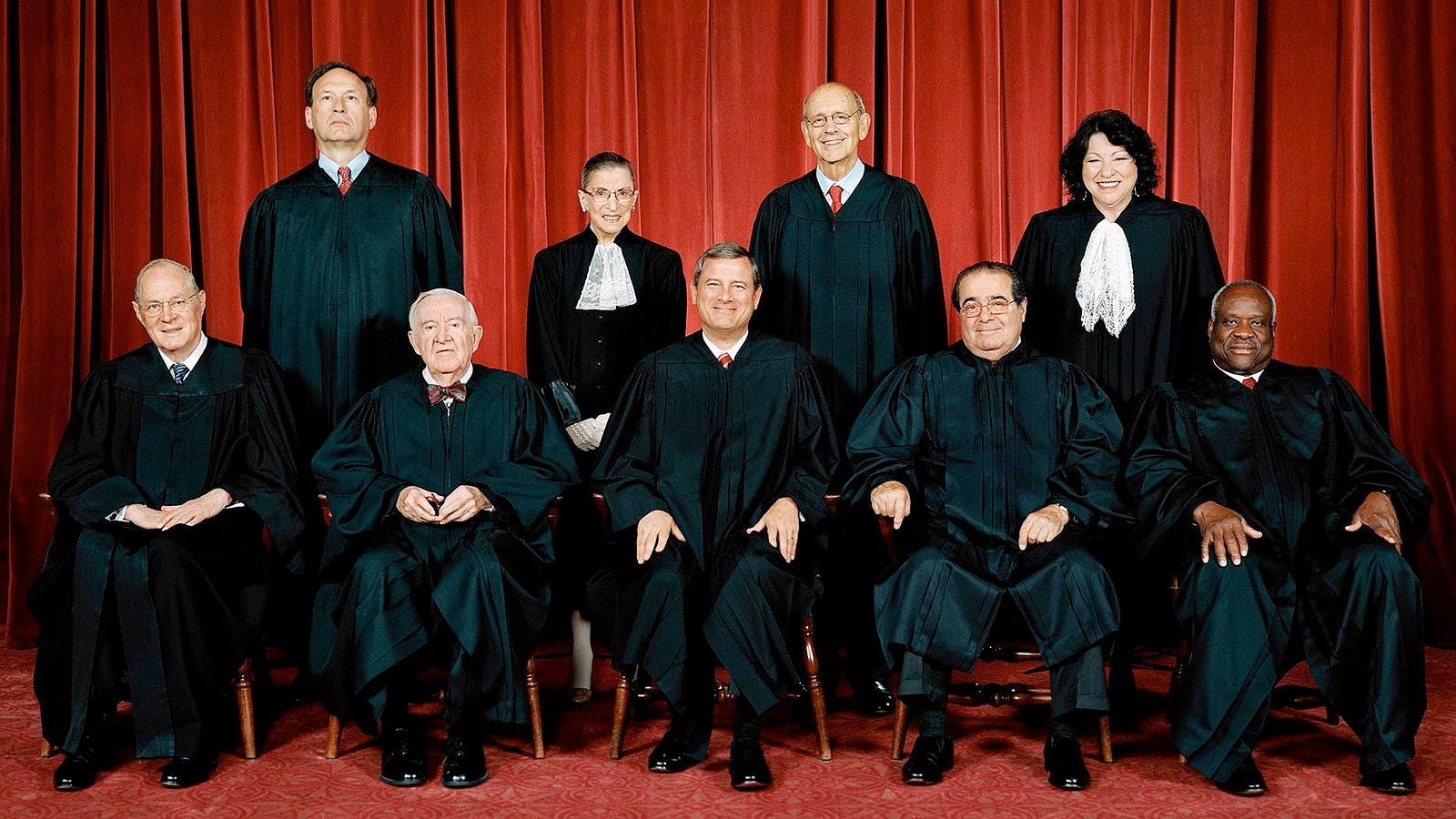
In the wake of Citizens United, the path was cleared for individuals and corporations to contribute unlimited amounts of money, mostly undisclosed, to pay for ads and other communications supporting or opposing individual candidates, as long as they were not working with campaigns and political parties. Unsurprisingly, within two years of the decision, about 85 percent of funding for congressional campaigns came from large contributors — mainly wealthy individuals and corporations. This had the effect — deadly for political equality — of crowding out the voices and influence of average Americans.
.jpg)
To make matters worse, this Supreme Court decision led to the creation of Super PACs that, according to the Brennan Center for Justice at New York University, “empower the wealthiest donors, and the expansion of dark money through shadowy nonprofits that don’t disclose their donors.”
Whereas traditional political action committees are limited to raising a maximum of $3,300 per year per candidate per election, Super PACs can accept unlimited contributions from individuals and corporations. Super PACs do have some disclosure requirements, but because many of these donors contribute through groups that are difficult to identify, the original source of donations — referred to as “dark money”— is often unclear.
For all these reasons, Citizens United has become the major inhibitor of political equality in American democracy. Referring specifically to the post-Citizens United rise of Super PACs, constitutional scholar Lawrence Lessig has concluded that “the only voices that our government listens to are the special interests who fund their campaigns,” resulting in a system of economic and political governance that is “rigged to favor the powerful and the well-connected.” That’s a system that has moved far away from the political equality the founders viewed as so essential to lived democracy.
So it should be no surprise that there is a movement afloat in Congress, driven mainly by Democrats with a few Republican colleagues, to tighten disclosure requirements for Super PAC donations and, more broadly, to take Citizens United off the books through constitutional amendment.
The Work for an Amendment
The push for a constitutional amendment to undo the damage to political equality caused by Citizens United faces a high hurdle — even though more than 75 percent of Americans appear to favor such an amendment. Amending the U.S. Constitution requires two supermajority votes: a two-thirds vote in both the House and Senate, and ratification by three-quarters of state legislatures. But no proposed amendments have come close to clearing this bar in recent decades. The Constitution appears to have become increasingly unamendable as our politics have become more polarized.
Increasingly, yes, but not impossibly. Jeffrey Clements’s nonpartisan group American Promise has shown substantial progress in building a movement for constitutional reform through a full range of civic actions: by recruiting proselytizing volunteers, signing petitions, gathering ballot signatures, voting on resolutions, visiting representatives, presenting to civic organizations, writing letters to the editor, commenting on social media, setting up tables at farmers’ markets, and so on. As a result, over the past 10 years, the legislatures of 23 states have passed bipartisan “ready to ratify” resolutions calling for an amendment to the U.S. Constitution that would provide states with authority to regulate campaign financing.
On the congressional side, amendments were re-introduced in 2025 in both the Senate and House of Representatives that would reverse the Supreme Court decision declaring that corporations were entities with many of the same constitutional rights as human beings and that money spent in elections is equivalent to First Amendment-protected free speech. The proposed amendments would also mandate that federal, state, and local governments require that all political contributions and expenditures be publicly disclosed.
But the big guns of democratic capitalism remain silent on the sidelines.
I know of no CEO or business organization that has publicly called for repeal of Citizens United. Without the support of a critical mass of business leaders for putting democracy back into democratic capitalism as a national ideal, it will be difficult for core democratic principles — like political equality — to be re-embedded into our system of economic and political governance. For the same reason, it will be impossible to curb such democracy-destroying practices as pervasive cronyism. It’s time for business leaders to take a stand.
The same can be said for the issues surrounding lobbying, which is of course protected by the Constitution. In this instance, the focus is on further disclosure requirements for lobbyists’ activities, something that the business community generally rejects in the face of increasing calls for reform. But without some pushing by business leaders, it is doubtful that any meaningful change will happen.
I will return to this conundrum in a further column in this series, where I address the question of why business leaders should think of themselves as guardians for the survival of democratic capitalism. But first, I will talk about how to fight back against restricted suffrage.
Democratic Capitalism Doesn’t Work Without Democracy
We’ve talked about cronyism, but that is only one of the forces that is corroding the system of democratic capitalism that has served the United States so well for so long. The other crisis that we face is restricted suffrage.
As I’ve argued, the capitalist component of democratic capitalism is fast losing its legitimacy as the influence of citizens is crowded out by pervasive cronyism. Similarly, the democratic component of democratic capitalism is losing its ability to represent the will of the people through the electoral process.
The phrase “restricted suffrage” refers to practices that stifle the voices of citizens by limiting prospective candidates’ right to run for office and inhibiting citizens’ right to vote. Practices limiting the right to run for office include restricted primary processes; for democracy to function, every viable candidate should be able to compete, and every election should reflect diverse views. Practices limiting the right to vote include the partisan redesign of voting districts; targeted polling station changes; restrictions on registration drives, same-day registration and early voting; and an absence of guaranteed time off from work to vote.
This series of columns may sometimes seem grim, so let me offer two pieces of genuinely good news. First, several important initiatives to reverse the attacks on suffrage are already under way across the country, so we are not looking at a “startup” renovation here. Second, the cluster of required changes is far less controversial than my anti-cronyism proposals. There is a clear path to making progress.
Across the country, well-organized efforts are building steam:
To eliminate the restrictions on voting detailed above.
To strengthen civic education, such as the “Civic Engagement in Our Democracy” program being introduced throughout Massachusetts by the nonpartisan Partners in Democracy, or the Roadmap to Educating for American Democracy.
To expand initiatives in civic engagement for young adults by offering community leadership programs that equip them with the knowledge and skills necessary to drive change.
To open ballot access to more diverse candidates through open primaries coupled and ranked-choice voting.
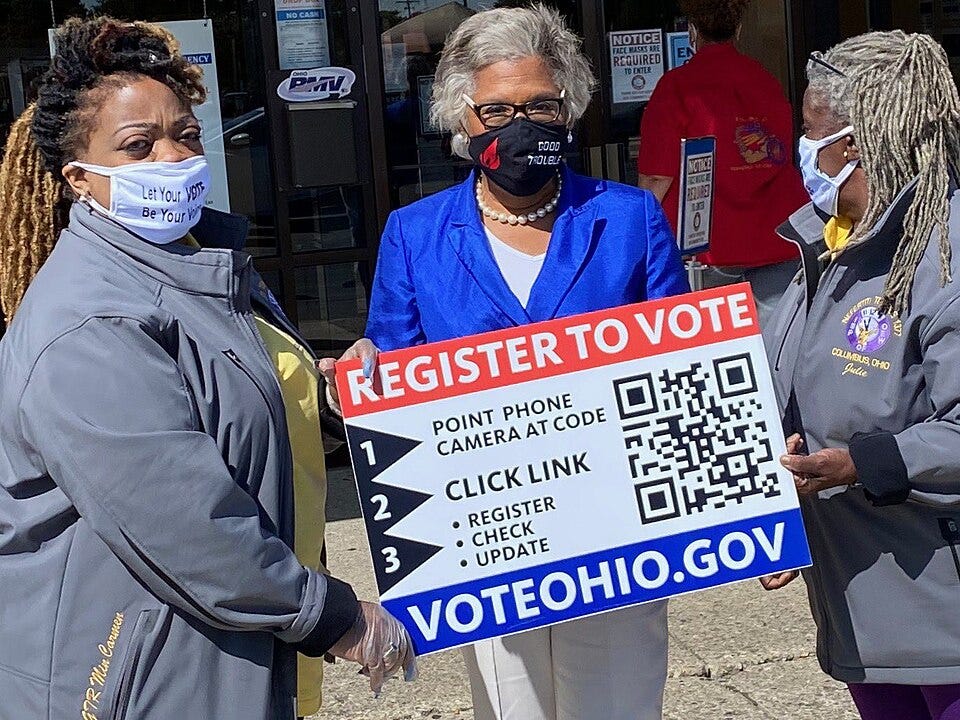

Indeed, it is difficult to come up with fair-minded arguments against ending right-to-vote restrictions, once legitimate concerns for voter fraud have been met. For sure, there are political actors at both the state and federal levels who oppose any element of “central control” that might infringe upon states’ rights to manage their own elections. But the fear — whether real or imagined — that measures designed to increase access could make it easier for ineligible voters to cast ballots is an election administration issue that lends itself to a systematic, nonpartisan examination of the true incidence and causes. Any such good-faith, data-driven effort would be difficult to reject.
Similarly, who can possibility oppose cultivating civic learning about, and adult civic engagement in, our most vital democratic processes, once care is taken to make sure those efforts meet the approval of a cross-ideological, multi-racial coalition?
Why the Status Quo Resists Open Primaries
Ballot access is the higher hill to climb. Our zero-sum political environment seems less conducive to the adoption of open primaries as a way of strengthening voters’ voice and influence. But as Danielle has shown in her columns here at The Renovator, this is the critical election reform for strengthening suffrage.
Consider a state like Massachusetts, with its extremely low level of voter turnout and competition for political office. According to Partners in Democracy, Democrats had primary choices in just 20 percent of state legislative seats in both chambers. Republicans actually had it worse, with a primary choice in just 5 percent of Senate and 1.25 percent of House seats. Those are not numbers indicating a healthy democratic system.
It’s worth spending a moment looking at the arguments against replacing partisan primaries with a single nonpartisan election in which candidates from all parties, including independents, run on one ballot and those who get the most votes move on to a general election using ranked-choice voting. There are four of these, and they focus on maintaining control over candidate selection, preserving party purity, and protecting favored office-holders.
Opponents of open primaries argue that political parties have the right to limit the selection of their nominees to party members, because allowing in non-members would destroy what the party stands for. Relatedly, opponents also argue that allowing non-party candidates into primaries increases the chance that a nominee won’t represent their party’s views, thus weakening the power and influence of that party and its supporters. (This a common position taken by labor unions with strong ties to the Democratic Party.) Opponents further worry about gaming whereby voters from one party might vote for a weaker candidate from another party to get a better chance of winning the general election. Finally, opponents of open primaries express concern about possible voter confusion over runoffs that use ranked-choice voting.
Aside from the last, which can be dealt with through voter education, all of these arguments drive in one direction — protecting a status quo that has ceased to operate in a genuinely democratic fashion. And they are all overcome by the principled argument in favor of open primaries — that they will strengthen suffrage as a democratic ideal and reality.
With open primaries, voters can reclaim the freedom and opportunity to elect officials that best represent their interests. They also give voice and political influence back to the people and, in doing so, invite more citizens to engage in local, state, and national political processes. And, in doing that, they breathe new life into our system of democratic capitalism.
A healthy democracy — and an economy based on democratic capitalism — depend on correcting the corrosive dynamics of restricted suffrage through these types of reform and renovation.
Bringing Business Leaders Into the Cause
So back to the question this series has been building to: How we can encourage business leaders, as leading economic actors in our political economy, to join with advocates of capitalist democracy to address the corrosive effects of restricted suffrage?
A good answer to this question needs to address why business leaders should embrace the idea that their mandate includes serving as informed guardians of our unique governance system as well fiduciaries for their suppliers of capital.
What gives special urgency to this question — and call to action — is the idea (revealed through repeated polling and surveys) that the more the fundamental democratic principle of political equality is integrated into our political economy, the more capitalism is legitimated in the minds of citizens as an ethical social enterprise. Another source of urgency is the knowledge — gained from American experience — that democracy and a market economy can co-exist and prosper together when they are functioning at their highest potential.
Where Are the Business Evangelists for Our Democracy?
In his 2023 book, “Ours Was the Shining Future,” David Leonhardt describes how moral suasion and the creation of a national organization promoting a new approach to labor relations in the 1930s and 1940s led to change across the U.S. business community. Leonhardt observes that after the Great Depression and Franklin Roosevelt’s New Deal initiatives, many in the business community continued to resist new economic regulations and social policy and to fight organized labor. But following repeated election victories by Roosevelt and like-minded politicians, some business leaders began to embrace the New Deal’s spirit of recovery — including, for example, the economic advantages of building a productive, high-wage economy rather than focusing solely on labor cost-cutting.
Accepting this new wisdom was very much the result of missionary work by of the newly formed Committee for Economic Development, which both triggered and embodied the shift in values — starting, first, at the edges of the business community and then expanding “to shape postwar economic policy and help staff both the Truman and Eisenhower administrations,” Leonhardt wrote. The CED’s purpose under the leadership of Paul Hoffman — a college drop-out who took a job at a car dealership that eventually led him to the chairmanship of Studebaker Motors — was no less than reforming the culture of American business.
“Hoffman became an evangelist for a corporate America that was less self-interested and more concerned with the national interest,” Leonhardt said. “He argued that good wages were crucial to prosperity for businesses and workers alike. He figured out how to work with labor unions and government regulators, at least most of the time. He tried to persuade other executives to adopt a similar approach — and many of them did. In the 1940s and 1950s, Hoffman’s vision of corporate America triumphed.”
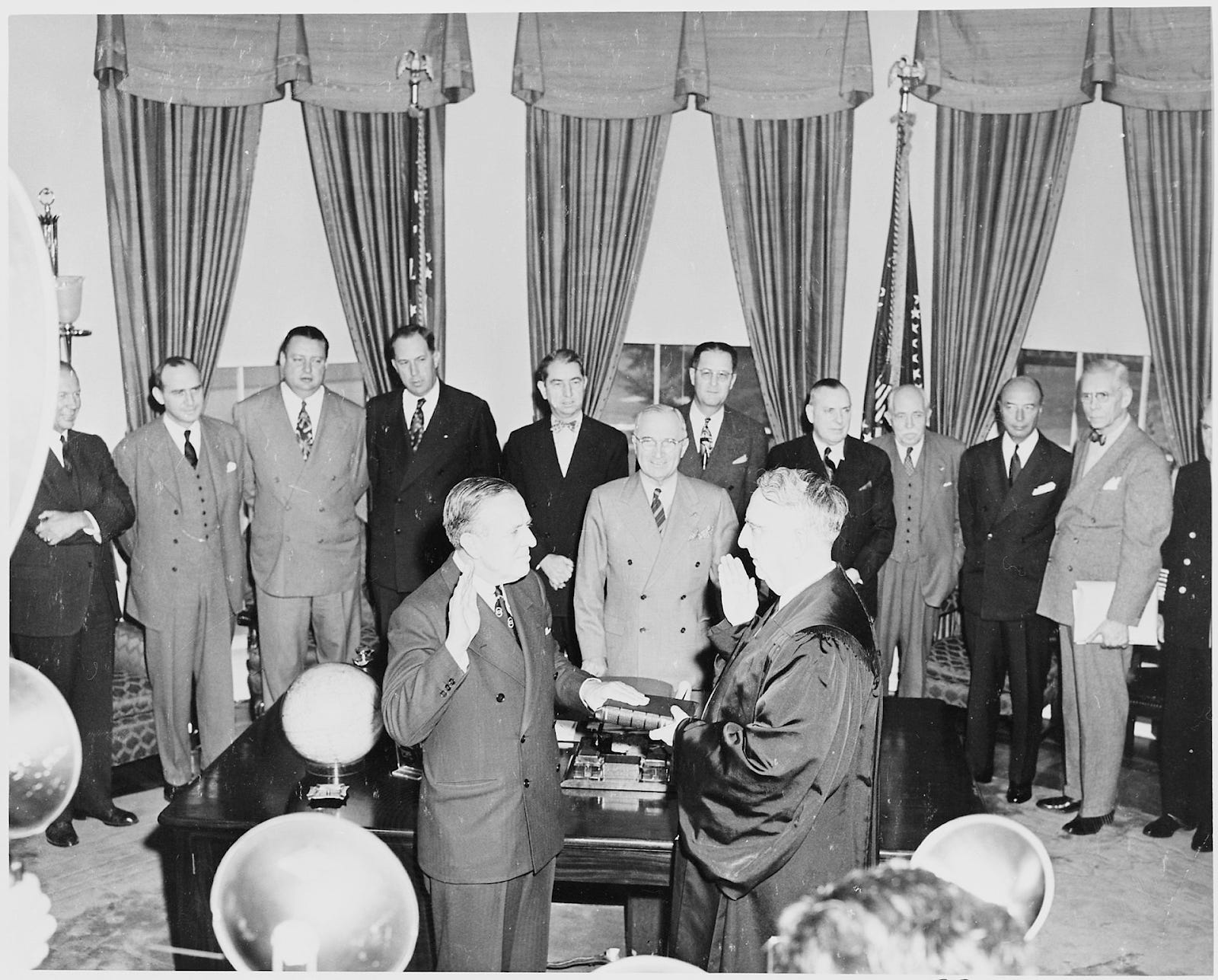

Along the way, Hoffman recruited some of the biggest names in corporate America, “including the magazine publisher Henry Luce and top executives at Eastman Kodak, General Foods, and Lehman Brothers.” Eventually other large corporations and their CEOs joined the project. Hoffman also sought advice from intellectuals such as Reinhold Niebuhr and Peter Drucker. Under his leadership, the CED developed into a grassroots movement with 2,000 chapters run by local businessmen and supported by a national group providing expert advice.
CED’s initial message was that “cost control was not the only route to profitability,” and it soon expanded that to include the proposition that “the twin crisis of depression and war had increased the appeal of a less rapacious version of capitalism.” In private, CED officials accused remaining hard-liners of being “‘intellectual Neanderthals’ who believed in ‘self, self, self and who were undermining the capitalist system they claimed to venerate.’”
By 1944, Hoffman was celebrated on the cover of Time magazine. Whatever the public kudos, the basic fact was that Hoffman’s campaign, carried to both local communities and the nation at large, converted the values of many in corporate America and probably saved the country from ideological lurches to both the left (as a result of the appeal of socialism during the 1930s) and the right (as a result to fears of Communism in the 1950s).
All of which raises the question: Where is the Paul Hoffman of our time?
At a moment when the governance system that has brought us so much wealth, innovation and freedom has entered a twin tailspin of cronyism and restricted suffrage, where are the business leaders who will champion and defend a vibrant democratic capitalism?
The Conditions for Business Success
Plainly, there are very good reasons for business leaders to support efforts to shore up the democratic and capitalist features of democratic capitalism — starting with the many protections and benefits granted to business under this governance system.
In addition, as my colleague Rebecca Henderson has written so eloquently in the Harvard Business Review, a healthy democratic system is essential for the survival of free-market capitalism, and with it the prosperity that has changed the lives of billions of people.
Henderson describes how strong democratic institutions provide:
the rule of law protecting property rights, contracts, and fair competition;
predictable regulations and clear legal frameworks that are crucial for businesses to plan, invest, and innovate;
social stability by allowing peaceful transitions of power and the resolution of grievances through dialogue and compromise, while fostering a sense of inclusion; and
public trust in business.
In essence, Henderson’s argument is that while businesses may sometimes benefit from focusing solely on short-term gains and shareholder wealth maximization, their long-term success is inextricably linked to the health of democratic institutions.
For all these reasons, why wouldn’t our business leaders want to accept a role as important guardians of our system of democratic capitalism?
The first answer, to be fair, is that many companies and their leaders do engage constructively in democracy preservation — especially with respect to strengthening suffrage. Important examples of businesses and business leaders supporting democracy initiatives include:
Time to Vote, a coalition founded by Patagonia, PayPal and Levi Strauss and including many other companies committed to increasing voter participation by providing workers with paid time off to vote or volunteer at the polls.
Run for Something, supported by such companies as Greylock Partners, Alphabet, Apple, and the ChanZuckerberg Initiative, which promotes civic engagement by helping young people run for office.
National Civic League, a nonpartisan, nonprofit organization created more than a century ago that promotes inclusive civic engagement and democratic innovation and is supported by companies such as Southwest Airlines and Amazon.
Democracy Fund, created in 2014 by eBay founder and philanthropist Pierre Omidyar, which promotes fair elections, a just society and accountable government.
Furthermore, today’s Committee for Economic Development (which is now the policy center for the Conference Board) includes “Sustaining Democratic Institutions” as one of its central policy areas. The CED has long held that a vibrant economy results from business competition in the marketplace, not the political arena, which I read as a strong vote against cronyism and excessive money in politics. It also describes itself as “deeply concerned about challenges to the strength of the nation’s democratic institutions, including practices that elevate the interests of private actors at the expense of the public good.”
That’s a lot of encouraging investment in democracy — which is why I believe the challenge going forward is not so much about generating new action in saving democratic capitalism as figuring out how best to magnify and focus the constructive efforts that are already underway.
Meeting this challenge faces two hurdles. The first is habit. The natural instinct of many in the business community has been to resist programs supporting democratic values, such as the introduction of Social Security in the 1930s and Medicare in the 1960s. Many have also resisted mutual engagement with unions. And we have seen how just about all companies and industry associations have flooded the political landscape with money in attempting to control legislative and regulatory rule-writing to their private benefit.
The second hurdle is the obsessive pursuit of the problematic shareholder wealth maximization doctrine by many business firms.
Shareholder Wealth Above All
Over the past 40 years, the embrace of the idea that shareholder wealth maximization is the only legitimate expression of corporate purpose has led to various forms of “detached capitalism” and self-serving behavior by powerful enterprises bordering, at certain times and places, on the sociopathic.
This doctrine offers both a justification and incentives for corporate executives and directors to place their interests way ahead of the interests of other constituencies of the enterprise and civil society in general.
For example, when corporations create stock-based compensation plans for executives that tightly link bonuses to increasing the price of their companies’ shares, executives have high incentives to seek to structure the economic game in ways that best serve their private interests. That naturally leads to “investing” in electoral politics and legislative/regulatory lobbying. In addition, shareholder wealth maximization provides a justification for executives to lock themselves into a perpetually dominant bargaining position over the distribution of corporate benefits vis-à-vis other participants in the enterprise — such as employees and local communities — who have a legitimate claim, under law and custom, to the firm’s resources.
This second hurdle is by far the most challenging. Cronyism is where we see the most toxic conflict between capitalism and democracy — where the wealth and influence of powerful economic actors crowd out the diminishing voice of ordinary citizens. This is not so much a problem of habit but of smelling and exploiting advantage. Thus, going forward, the toughest sale in mounting a more concerted effort to preserve the promise of democratic capitalism is curbing cronyism and its corrosive effects. But unless we can recruit business leaders who can speak and be heard as authentic evangelists for a governance system where the cancer of cronyism is reversed along with the restoration of suffrage and citizen voice, this system will surely continue to break down.
Success in this not a pipe dream, however. Six years ago, in 2019, the Business Roundtable issued a groundbreaking statement signed by 181 CEOs reversing the group’s long-held position venerating shareholder wealth maximization. Signatories acknowledged that adopting a more balanced vision serving all stakeholder needs — by investing in employees, delivering value to customers, dealing ethically with suppliers, and supporting outside communities — “is the only way to be successful over the long run.” The statement declares that serving these needs should be at the forefront of American business goals. For this claim to prove true going forward, reciprocity and power sharing will need to become more prominent governance norms, but the economic and moral underpinnings have been laid down.
What is needed now is follow-up with an equally courageous and groundbreaking position about corporate money in politics. To this end, I have argued for repeal of the Supreme Court’s Citizen United decision. Maybe business leaders can come up with some other, equally effective and appropriate course — but whatever the agenda, no less than a social movement is required for the renovation of democratic capitalism to achieve escape velocity from the gravity of current practice.
Paul Hoffman’s Example
The impressive precedent of Paul Hoffman and the CED show how effective moral suasion can be in the hands of informed evangelists. By recruiting national opinion leaders (other CEOs) and organizing and coaching local committees of businesspeople to serve as the CED’s local advocates, Hoffman and his associates changed the course of democratic capitalism. Indeed, they called for and received support for an entirely new set of values and priorities in conducting business affairs: more collaboration, less self-interest.
As far back as 1982, Mancor Olson described how democracy suffers when special interests mobilize sufficient political power to steer benefits to a concentrated set of members – thereby making one of the earliest cases for curbing the influence of pervasive cronyism. Similarly, in his 1992 book, Francis Fukuyama offered a broadly compatible vision of how democracy and capitalism can combine into a better (ethically, politically, and economically) governance system. The bell has been ringing for a truly democratic capitalism for a long time.
With this intellectual and political infrastructure moving into place, the time is at hand to build a supportive moral culture for democratic capitalism. Action principles have never been clearer. And an implementable plan to renovate democratic capitalism is taking shape. Others can undoubtedly add to the renovation blueprint I have proposed in these columns, but the essential elements of the work before us are in place.