

Pride, Reckoning, and Aspiration
A Plurality Nation Must Find Many Different Ways to Mark Its 250th Decade.

Caroline Klibanoff wrote a great Renovator piece recently talking about how to engage young people in America’s 250th anniversary, not just for the Declaration of Independence in 2026, but for more of America’s founding documents from 2027 through 2037 — what she calls “America’s commemorative decade.” If we extend that decade to 2042, these anniversaries coincide with the coming of age of the largest group of young people in America’s history.
Caroline argues that we have an extraordinary opportunity to engage these young people — a combination of Gen Z and Gen Alpha — in designing commemorations that are also sites of aspiration, to “inspire a new generation to understand, sustain, and improve our democracy.” Let’s imagine what that would look like, recognizing not only the tremendous size of this group of young people but also their unprecedented diversity.
As Caroline notes, 2007 saw the largest number of births in one year in U.S. history – some 4.3 million babies. That group turns 18 in 2026-27. Most will graduate from high school just weeks before the nation incandesces in red, white and blue bunting, fireworks, parades, floats, and speeches on July 4.
Gen Z, born between1997 and 2012, already reflects the America we are becoming. Roughly half identify as white, and of the other half are 25% Hispanic, 15% African-American, 6% Asian or Pacific Islander, 5% multiracial, and 1% American Indian or Alaska Native. As they explore our history, these young people will look back at an emerging nation of mostly white and Christian citizens. They will look around at one another, by contrast, as the builders of a plurality nation, a country that has no one numerically dominant ethnic and racial group, and a fast-growing number of multiracial citizens.
It’s appropriate, then, that many of these new high school graduates will be celebrating the nation’s new “Civic Season,” the two weeks between Juneteenth, marking June 19, 1865, the day when the enslaved people of Galveston, Texas, finally learned that they were free, and July 4. President Biden made Juneteenth a federal holiday in 2021; it stands for the end of slavery and thus a second Independence Day. A pluralistic nation celebrates plural moments of independence together.
Civic Season is the flagship program of Made By Us, an organization committed to connecting young people to American history in ways that invite them to shape their own celebrations and commemorations. For these two weeks, between “our oldest federal holiday and our newest,” museums, libraries, historic sites, parks, community spaces, civic groups and governments provide resources and activities to invite DIY celebrations designed by young Americans for everyone. The approach embraces what Danielle Allen calls “confident pluralism”: a commitment to developing your own views while actively affirming others’ right to develop theirs, even when they differ. As just one example, in 2026 hundreds of communities across the U.S. are hosting “wish walls” to “invite visions of America’s future.” Groups put on plays, design history lessons, identify civic superheroes, and much more.
This approach, one container for countless events, projects, and gatherings, offers a pluralist template for conceiving and designing our “commemorative decade.” New America has adopted the framework of “pride, reckoning, and aspiration” for our own Us@250 initiative. As Us@250 leader Ted Johnson says, pride often makes the left uncomfortable; reckoning often makes the right uncomfortable, but everyone should be able to come together around aspiration.
And in fact, we agree far more than we realize. More in Common’s research shows that over 80% of Americans agree with the statement, “I am proud to be an American, but I recognize my country’s flaws.” Yet both Democrats and Republicans dramatically underestimate one another’s willingness to embrace the patriotic or the critical part of the statement.
So. Suppose communities come together at the local level, led by their young people, to plan a decade-long program to put “pride, reckoning, and aspiration” into action. To start with the recognition of how much they agree on – that they embrace a patriotism that allows for both pride and criticism.
One example might be community groups coming together each year from now through 2037 and identifying one or more events that happened in their town 250 years ago. For communities that did not exist 250 years ago, it is an opportunity to explore the history of indigenous peoples who may have used the land.
For Princeton, New Jersey, where I live now, we don’t have to look very far, as the Battle of Princeton was fought on Jan. 3, 1777. Ken Burns’ account of the battle in his documentary series American Revolution is a great place to start – not just the events he relates, but the way in which he mixes history to be proud of with history to reckon with.
We should recall only the bravery and glamor of George Washington’s charge on a white horse to rally his troops, but also the identities of some of the 14 Black soldiers who fought in the battle. On the American side, these included Samuel Sutphin, an enslaved man who reportedly fought for the promise of freedom in return for his service, and Oliver Cromwell, a free Black man who enlisted in a unit attached to the Second New Jersey Regiment and also fought at Trenton, Brandywine, and Yorktown. . Princeton – both the town and the university – has taken many steps to acknowledge and reckon with the ways in which its history is intertwined with slavery; revising the many stories of its role in the American Revolution is a way to combine pride and reckoning.
This richer account of who did what in the Revolution also complicates assumptions about where the loyalties of even enslaved African Americans lay and provides a different strand of African American history to be proud of.
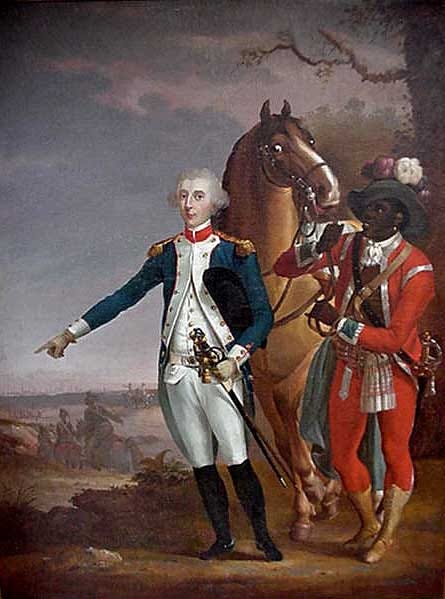
In my home state of Virginia, for instance, an enslaved man named James Armistead Lafayette enlisted in the Continental Army under General Lafayette. He played a vital role in the Revolution as a double agent, convincing the British that he was joining their forces in return for his freedom and offering his services to Benedict Arnold, of all people, as a spy. Once he had gained British confidence, he was able to collect and provide important information about British movements to the Americans. He was emancipated through legislation after the war.

Caroline Klibanoff is inviting young people across the country to create their own plural accounts of American history. One path is through research into the activities of their own families, what happened in their towns or counties, or, if their town or county did not exist during the Revolutionary era, what or who was there? They could work back as far as possible through a combination of oral histories of family or town elders coupled with a wealth of actual physical archives, many of which have now been digitized.
The possibilities are enormous, through the remainder of this year and the next decade. I hope that the duality of pride and reckoning captures the spirit of investigations, celebrations, and commemorations. That is the right foundation for a new age of aspiration, perhaps to become a nation defined less by e pluribus unum, from many into one, than by plures et unum, many and one. The young people can lead the way.
What local 1776 histories would you want to celebrate in our commemorative decade?
Thank you so much for this article. Just becoming aware of the concept of "pride, reckoning, and aspiration" is inspirational.