

On Marjorie Taylor Greene's Apology
Sometimes an apology matters less for what it reveals about the speaker than for what it asks of us.

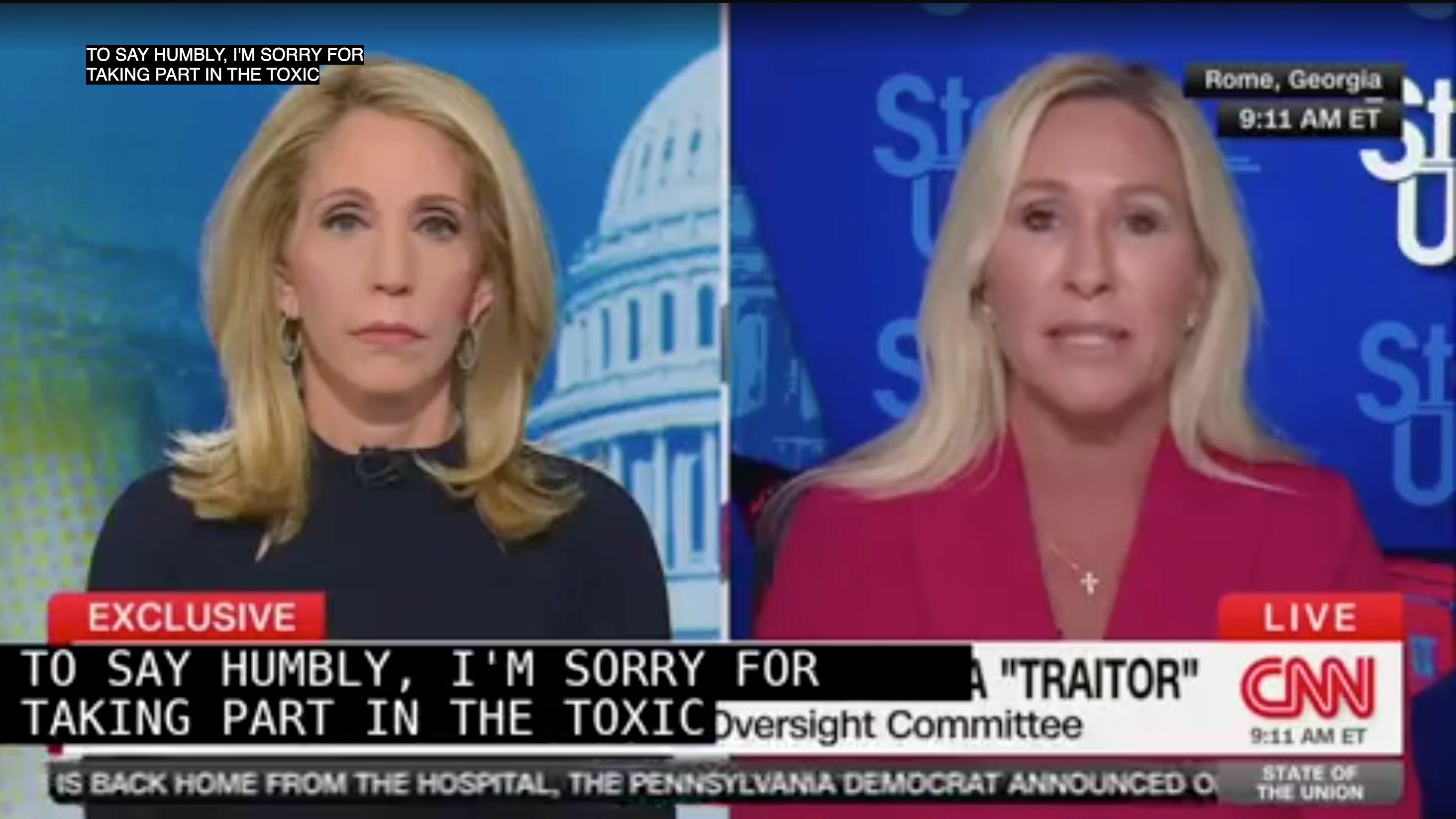
Marjorie Taylor Greene apologized recently for the divisions she has helped sow. In a television interview she said, “I would like to say humbly, I’m sorry for taking part in the toxic politics. It’s very bad for our country.”
It is easy—almost reflexive—for those she has harmed to dismiss the apology and to dismiss Greene, and the constituents who elected her, outright. I understand the instinct. She has caused real harm to people across the country—neighbors up north and neighbors back home—whom she caricatured or reduced to punchlines for political gain. And many of the people turned into symbols in her rhetoric are, for me, simply neighbors: family friends, people whose lives interlock with mine.
But we must resist the impulse to write off Greene or the people who sent her to Congress. Not because she has suddenly become a model of civic virtue. Not because apology erases injury. But because Greene is not the point—the country is. In the end, there are only two paths out of our current crisis of constitutional democracy.
The first is political violence.
The second is harder: to lower our guard long enough to apologize when we must, and to offer grace when others try to do the same—not because they cannot harm us again, but because there is no other path available to a people committed to the rule of law in the United States.
I grew up in rural Georgia, not far from the area now represented by Marjorie Taylor Greene. When I left for Harvard College in 2016, I was struck by how many of my new peers did not see my neighbors back home—the ones who voted for Trump and Greene—as full collaborators in our shared political life. Had I asked whether they were willing to share the project of self-government with those Georgians, many would have said “no” without hesitation.
And yet that is precisely what our constitutional system demands. At least in this country, citizenship is the act of sharing rule with people you did not choose.
We can work to persuade our neighbors and change their minds; we can hope our ideas defeat theirs at the polls or in Congress. But even then, we cannot get rid of them as our neighbors. The law knows no color or creed, no level of education, no dollar value of tuition. It does not matter that some up north—and some down south—believe themselves more enlightened.
If we decide that some portion of our fellow citizens can be dismissed outright, then we accept that they are not truly co-equal participants in the constitutional project. If we do not believe their votes deserve equal weight, then we accept that they are somehow less human, less capable of reason, and less deserving of the protections of law. Once equality is denied, what remains is force. Democracies collapse into cruelty, and we come to justify the inhumane treatment of our neighbors. When persuasion is abandoned, coercion fills the vacuum.
As the holidays approach, we are reminded of this truth in miniature. Every family has its disagreements—the uncle who sees the world differently, the cousin who pushes every button. Yet the point of Thanksgiving is not agreement. It is that for one night we sit at the same table: we share a meal, tolerate the jokes, and hold back the worst things we might say. The alternative is fracturing the family.
A republic is no different. If we want a country that stretches from sea to shining sea, we must sit at the same table with the people we have, not the people we wish we had. The alternative is fragmentation—or violence.
So again we face the same choice: push our political opponents out of the polity—roll our eyes when they apologize, or when they glimpse the harm they have done—or accept, like family at Thanksgiving, that our neighbors, whether we like them or not, remain ours to live with. The best we can do is persuade them, contest them, and practice the slow civic virtues that keep a republic intact.
Greene’s apology is imperfect, late, and surely self-interested. But if we cannot allow Americans—even those who helped lead us toward division—to step back from the brink, then we have already chosen the only remaining alternative.
 | A guest post by
|