Meta's Scam Monopoly, the AI Race, and 'Founder Mode'
Your Tech & Democracy news Roundup!

Welcome back to the Tech & Democracy Roundup. We’ll develop our biggest commentary up top, and our traditional list of news links can be found at the bottom.
~
In a major blow to those who wish to check the rapidly-concentrating power of Big Tech companies, a federal judge just ruled that Meta (formerly Facebook) is not a monopoly.
“Meta’s acquisition of Instagram and WhatsApp did not create an illegal social media monopoly, a federal judge ruled Tuesday, a decision that solidifies the future of the $1.5 trillion tech giant.”
Theodore Roosevelt would probably be bummed. So is Tim Wu at the New York Times: “How Can Anyone Seriously Doubt Meta is a Monopoly?”
In related Meta news, a bombshell report exposed Meta’s reliance on scam ad profits. Research by Reuters on five years of Meta practices and documents demonstrates what anyone who uses Instagram and Facebook already knows— outright scams are an essential part of the ecosystem.
“Internally, Meta estimates that users across its apps in total encounter 15 billion ‘high risk’ scam ads a day. That’s on top of 22 billion organic scam attempts that Meta users are exposed to daily, a 2024 document showed. Last year, the company projected that about $16 billion, which represents about 10 percent of its revenue, would come from scam ads.”
Ten percent of Meta’s revenue is from scams!
“Documents showed that internally, Meta was hesitant to abruptly remove accounts, even those considered some of the ‘scammiest scammers,’ out of concern that a drop in revenue could diminish resources needed for artificial intelligence growth.”
In fact, Meta was able to profit extra off these “scammiest scammers”:
“Instead of promptly removing bad actors, Meta allowed ‘high value accounts’ to ‘accrue more than 500 strikes without Meta shutting them down,’ Reuters reported. The more strikes a bad actor accrued, the more Meta could charge to run ads, as Meta’s documents showed the company ‘penalized’ scammers by charging higher ad rates. Meanwhile, Meta acknowledged in documents that its systems helped scammers target users most likely to click on their ads.”
Yeesh.
It is somewhat bleak that Meta imagines it can catch up in the AI race by extracting profits from scam ads and diverting them to high-profile AI-researcher poaching. Of course, it probably won’t work; dozens of star AI researchers at labs like OpenAI, Anthropic, and Google’s DeepMind have repeatedly turned down Meta’s offers, even rejecting pay packages worth over $100 million per researcher. Ultimately, superintelligence will be built by the cool kids, and the cool kids don’t want to work at Meta.
~
Speaking of the AI race, things have been heating up lately. Google turned a lot of heads with their release of Gemini 3, which many people seem to believe has surpassed OpenAI’s GPT-5. Marc Benioff of Salesforce, Andrej Karpathy (former Tesla AI CEO), and Stripe’s Patrick Collison all weighed in positively on the new model.
Not to be outdone, Anthropic released their new model, Claude Opus 4.5. Both Google and Anthropic continue to push the state-of-the-art frontier; the race to superintelligence, which once felt like it had a clear frontrunner in OpenAI, no longer feels so clear.
One element from this recent episode is worth considering: many on Twitter have praised the return of Google co-founder Sergey Brin as responsible for Google’s AI comeback.
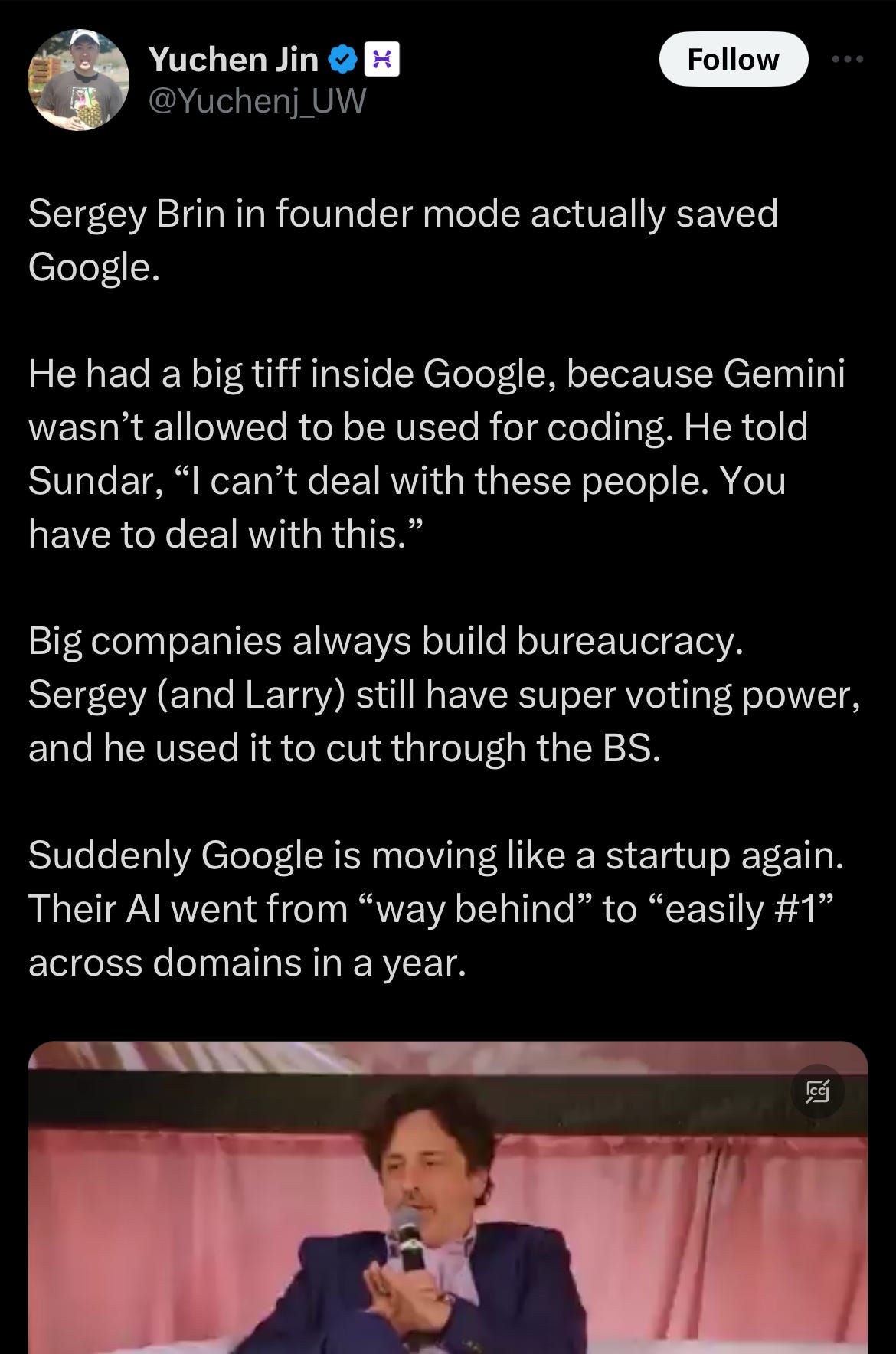
The story, it would seem, is simple: the highly agentic hero returned to a Google bloated by bureaucracy; he used his influence to cut through all the slow systems, spearhead big sprints, and return Google to its old startup energy. He went “Founder Mode,” as many on Twitter suggested, a term coined by YCombinator founder Paul Graham. Undoubtedly Brin’s return was a factor in pushing Google to new heights, though of course credit is also due to the massive team around DeepMind.
But the incident highlights something deeper; excitement around a company is often best generated with the story of a mythical, larger-than-life character. Humans tend to understand the world in terms of characters more than in terms of large systems or organizations. This is important, especially if your business is based on hype and fundraising. The Twitter hype about Brin has been at least as important to Google’s resurgence as Brin’s actual work, because it has excited the popular imagination of humans hardwired to think of the world in terms of characters. OpenAI becomes more mythically salient in the synecdoche of Sam Altman; and who would care about Grok if not for Elon’s cultural fanbase?
This raises the important question: where is the mythical representative of Anthropic? Does Dario Amodei feel larger-than-life? Does his story whip investors into a frenzy of mimetic desire? I’m not sure he has the juice. But if Anthropic is truly “the good team,” the one to root for if you care about safety and humanity— and that is their brand— then they will need a character to represent them thus in the popular imagination. This is a key problem for Anthropic; maybe these guys can help solve it.
~
Enjoy the following links keeping you up-to-date on all Tech & Democracy news!
In a closed-door meeting at Stanford, The Biggest AI Companies Met to Find a Better Path for Chatbot Companions. Leading AI researchers from Anthropic, Google, OpenAI, and beyond discussed guidelines for chatbot companions, especially for younger users.
Transcript: House Hearing on the Risks and Benefits of AI Chatbots
Larry Summers resigned from the OpenAI board amidst the Epstein emails fallout
“Promise and Peril: Generative AI’s Experimental Debut in U.S. Political Campaigns” — a report from the Center for Democracy and Technology
A philanthropy coalition to develop more humane AI: Humanity AI
What if AI tells us how to vote? — by Chris Oates
Trump calls for the end of state-by-state AI regulation on Truth Social, which would be a big win for tech companies, but perhaps a big problem for people
Gary Marcus chimes in: “Mayday: The White House is attempting to circumvent Congress and crush the rights of individual states to regulate AI.”
Dutch media outlets say Tech giants’ control of information poses ‘serious threat to democracy’
But lastly, for some encouraging news, we can turn to The Renovator’s friend Bruce Schneier, a Harvard researcher who wrote the book ‘Rewiring Democracy: How AI Will Transform Our Politics, Government, and Citizenship.’
Schneier’s new article in the Guardian teaches us “Four ways AI is being used to strengthen democracies worldwide”— a reminder that, while AI poses many threats to democracy, it also opens up fantastic opportunities for democracy’s enhancement.
~