

I've Never Cared About Local Politics. Could AI Change That?
Citizen-built apps are using AI to make local government information more accessible than ever.

I’d like to make a confession: I have never been interested in local politics.
The few times I voted in municipal elections, I walked into the polling booth not knowing who (or what) I was voting for. I’ve loosely followed a yearslong feud at Brookline High, my town’s public school, over deleveling classrooms. But I’m not sure where the school board lands on the debate. Or who the board members are. Or where most of my neighbors stand on it.
“Can’t you just Google it?” Well, sort of. Google’s Gemini pulls from Brookline.News, a hyperlocal outlet that launched in 2023, and gives a decent summary of the debate. But the most recent development it surfaces is from 2024. I still don’t know where things stand today.
And Brookline is not representative of the country as a whole. For most Americans, information about local affairs is not easily accessible. 50 million Americans live with limited or no access to local news. Even for those who do have a local outlet, the coverage leaves a lot to be desired: an estimated 1,500 of the nation’s 5,400 remaining newspapers have lost more than half their newsroom staff – what researchers call “ghost newspapers”. In those communities, a school board debate like the one over deleveling might never reach local residents at all.
This is not a new problem. Since 2005, 3,500 local newspapers have closed, and more than 75% of newspaper jobs have been cut. In the 2010s, community-rooted nonprofits began emerging across the country to fill the void. Organizations like City Bureau (2015) in Chicago, Outlier Media (2016) in Detroit, CivicLex (2016) in Lexington – among dozens of others – built small, dedicated teams focused on helping residents understand and engage with local government.
This work drew the attention of national philanthropy. In 2023, a coalition of foundations launched Press Forward, pledging more than $500 million over five years to revitalize the local news ecosystem — with significant commitments from the MacArthur Foundation, the Knight Foundation, and others.
Now, into this mix comes something new: AI-powered civic information apps. Since the public release of ChatGPT in late 2022 – and other large language models that followed – independent developers have been able to cheaply build apps that summarize public records and make local government information more accessible.
Last month, one of these apps – CivicDigest – appeared in my LinkedIn feed.
Developed by Brandi Kinard, a software engineer and North Carolina homeowner, CivicDigest produces AI-generated news reports on hyperlocal public affairs – city council meetings, zoning decisions, school board rulings, even HOA proceedings. The interface is pretty basic: type a city or topic into a search bar, hit “Generate”, and within a few minutes an audio summary appears, recapping your local council’s most recent meeting. Request the full broadcast and you get a fully composited AI news report in your inbox: an avatar of a young woman standing before a fabricated newsroom set, a headline bar and ticker scrolling below, reading a meeting summary.


Brandi built CivicDigest in two days on her laptop, inspired by her own frustration trying to follow the activities of her city council in Gastonia, North Carolina. Rather than relying on a general-purpose AI like Claude or ChatGPT – which are trained on the entire internet – she built her own smaller model, trained exclusively on city council meeting minutes from nine cities – Boston, Chicago, and Detroit among them. The whole process cost her three dollars, and helped her land a job at The New York Times.
I’ll be honest: the recording left me feeling a little queasy. There was something hollow about it – an AI voice reciting meeting minutes with no sense of how individual council members voted and why, or what it all meant for the people affected. By Brandi’s own admission, CivicDigest is a prototype. It currently covers a handful of cities, and has occasionally gotten budget numbers wrong.
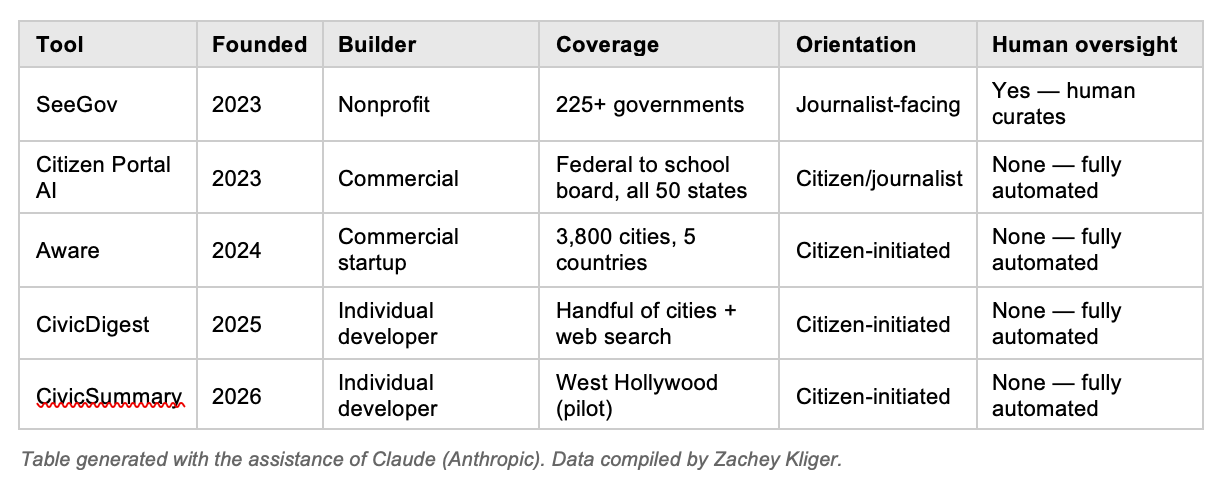
But CivicDigest is just one of dozens of apps that have launched since 2022. Alex Rosen founded SeeGov in 2023 after years of listening to government meetings on C-SPAN to fall asleep. “I realized that there are important moments in these meetings,” he told me, “but people don’t want to watch a four-hour meeting.” SeeGov uses AI to surface those moments, producing video highlights for journalists and advocacy groups. Citizen Portal AI (2023) tracks government spending and decisions across all 50 states, generating daily summaries and spending dashboards for subscribers. Aware (2024) converts audio and video from city council and school board meetings into concise, nonpartisan summaries. CivicSummary (2026) tracks not just what local officials decided but whether city staff actually followed through.
My reporting focused on tools like these — citizen-built apps designed to help residents understand their local government. But they’re part of a much bigger civic tech landscape. Platforms like Resistbot and MAPLE — the Massachusetts Platform for Legislative Engagement, which The Renovator covered earlier this year — use AI to help citizens communicate directly with their elected officials. Commercial vendors like CivicPlus and Granicus sell software to governments to help them manage their communications with residents. Deliberation tools like Pol.is and Talk to the City facilitate civic dialogue and channel public opinion into policy.
Beth Noveck, a professor at Northeastern University whose new book argues that AI could either strengthen or undermine democratic institutions, wrote that the size of this field is hard to pin down. “It’s growing fast but still fragmented,” she told me. “You have citizen-built tools like CivicDigest, and then government-deployed tools like Boston’s city council summarizer. The citizen-built side is still tiny, but the honest answer is we don’t have good aggregate numbers because most of these tools are built by individuals or small nonprofits who aren’t reporting to anyone. What we do know is that the need vastly outpaces the supply. There are roughly 90,000 local governments in the United States. Almost none of them have meaningful public-facing AI tools.”
What these apps do best is make dense public information digestible at a speed and scale not previously possible. “These are legibility tools at their core,” Beth said. “A tool that summarizes meeting minutes and links you back to the original transcript gives you a window into your democracy that we didn’t have before.”
These developers have started to find an audience – in both users and institutional backers. SeeGov now partners with more than 60 newsrooms and monitors 230 local governments, and in April received a Knight Foundation grant that will extend its reach to 1,000 communities. Aware has expanded to cover more than 3,800 cities across five countries, though its founder Alex Zaltsman acknowledges the user base is “still in its infancy”. The company recently launched Sundays.news, a companion newsletter delivering weekly AI-generated local summaries to 50 towns. Mozilla Foundation launched a Democracy x AI incubator this year, specifically seeking tools that make government decision-making visible and translate bureaucratic processes into plain language. Its first cohort was announced in June. And Protect Democracy launched an AI for Democracy Action Lab to incubate and accelerate AI-enabled civic tools.
Despite the promise of these apps, the field still must wrestle with some hard questions.
As I watched the CivicDigest recording of my town’s most recent city council meeting, I found myself thinking about Richard Young. A lifelong Kentuckian, Richard founded CivicLex to make civic information more accessible to Lexington residents. I’d worked with Richard recently at the American Academy of Arts and Sciences, where I staffed a democracy reform initiative that counted CivicLex as a partner. I wondered: what would someone who had spent a decade building this organization from scratch – cultivating funders, hiring staff, earning the trust of a community – make of all these new apps that seemed to short-circuit that entire process?
“I think tools like this have both a lot of promise and peril,” Richard wrote. “When fed good content produced by humans that is fact-checked and verified, they can fill gaps where traditional media is dying or disappearing. But AI tools without an editor can miss very obvious details and struggle to navigate the complexity that happens during in-person meetings. There’s also real value in having people physically present at public meetings — it shows elected leaders they are being observed, and creates a type of mutual accountability between those being observed and those doing the observing.”
Developers of these tools have taken different approaches to human oversight. CivicDigest and Aware are fully automated. SeeGov puts a human name on every piece of content and gives journalists the choice to select moments manually or with AI guidance. “We don’t want to create a single view of what happened but instead let many parties highlight what they thought the community should know about,” Alex Rosen told me.
There’s also an accountability question that none of these tools have fully resolved. Beth Noveck emphasized the need for disclosure: “This is why it’s important to disclose when AI is used, so people know to go and check the original source. You don’t want to file a legal action based on an AI summary without reading the original. But it’s much better to have a first draft with AI than nothing at all.”
An even thornier question is whether these tools are meant to substitute for local journalism in the long run. Their creators insist they are not. Brandi envisions licensing CivicDigest to local newsrooms and civic nonprofits: “My goal is to co-create the refined version of this with the people who actually do the work on the ground.” And SeeGov is already explicitly journalist-facing. “If we can help reporters monitor and share key moments quickly, they have more time to do that deeper reporting,” Alex Rosen told me, adding that his longer-term vision is to build shared data infrastructure across tools — a nonprofit data commons that could serve the whole ecosystem more efficiently.
Richard acknowledges that while the tools may be able to complement local journalism, they have real limits: “These tools can aggregate and convey information, but they aren’t good at building trust with an audience on their own. They also can’t put on the in-person events that are so essential to building local civic capacity. And they’re not able to do the hard work of institutional reform — creating new mechanisms for participation and co-governance — which may be the most significant problem that needs to be solved in this area.”
Something else lingered in the back of my mind throughout my reporting. Having spent time with several of these apps – navigating the interfaces, generating sample reports, watching AI anchors read public meeting summaries from fabricated newsroom sets – I kept thinking: would I actually use one of these? I had doubts.
After all, there are many reasons why only 9% of Americans under 30 follow local news very closely. Lack of access to legible information is just one among them. Resistbot’s founder Jason Putorti was blunt in his assessment that information access doesn’t translate into civic interest: “People don’t want to care about politics,” he wrote. “They do only when they have to – when there’s a data center in your backyard that sounds like a jet aircraft, or the school board is banning books.” Jason’s view is that civic engagement is fundamentally reactive – a view I imagine many in the democracy reform community would push back on.
Alex Rosen struck a more optimistic note, though he agreed the apps themselves wouldn’t directly spark greater civic engagement. SeeGov, he told me, isn’t really designed for ordinary citizens as end users, but instead for journalists and civic creators to reach them.
Whether legibility alone can move the needle on local civic engagement remains an open question. But the next time Brookline’s school board meets to vote on deleveling, at least I’ll know where to look.
Thank you for not writing the easy promotional version of this. You took on the hard question, and the piece is better for it.
The "hollow" reaction to my broadcast is fair, and it's the right instinct. A fully automated summary is a starting line, not a finish line. The version of CivicDigest I want to exist isn't a robot anchor replacing a reporter — it's plumbing. It does the translation busywork of turning 80-page PDFs into plain English so the people who do the real work (e.g. local journalists, civic organizers, the ones who actually show up to the meeting) get their time back for judgment, presence, and accountability. The machine handles legibility. People handle meaning.
Richard Young names the open problem exactly: these tools can convey information, but they can't build trust or do the hard work of institutional reform on their own. I agreed, and that's what I'm building toward, not pretending I've solved.
I'm genuinely glad to be part of this conversation alongside SeeGov, Aware, CivicLex, and folks like Beth Noveck. The question I keep coming back to: where does automation end and human editorial judgment have to begin? Curious where others here land on it.
Add that to the catalog. Want to be the catalog keeper?