

How Democracy Reform Actually Spreads
From Ed Shoemaker: Why local experience matters more than national arguments.
Ed Shoemaker is the Executive Director of Voter Choice MA, a non-partisan, politically diverse, non-profit organization dedicated to educating the Massachusetts public about Ranked Choice Voting.
Among public officials, democracy reform is often discussed as if it moves through argument alone. We write white papers, publish reports, marshal evidence, and sharpen critiques of the status quo. All of that work matters. But it is incomplete. Democratic change does not travel only through ideas; it travels through people, places, and the slow accumulation of trust.
That conviction is what led us at Voter Choice Massachusetts to make a series of short videos documenting the experience of Ranked Choice Voting (RCV) in Easthampton, Massachusetts. We made the videos modest by design. There is no soaring music, no sweeping claims about national transformation, no attempt to frame the city as exemplary or heroic. Instead, you’ll hear from local officials, candidates, and community members describing—in plain language—what changed, what didn’t, and what they learned.
The question worth asking is not simply why make videos, but what these particular videos teach us about how democratic reform actually spreads.
From Abstract Reform to Lived Experience
Much contemporary debate about democracy reform operates at a high level of abstraction. We argue about electoral systems as if they were interchangeable components—plug-and-play mechanisms whose effects can be predicted independent of context. In the Easthampton videos, we try to push against this tendency. They insist, quietly, that democratic systems are living institutions. They are experienced by clerks tasked with implementation, by candidates navigating unfamiliar incentives, and by voters encountering something new at the ballot box.
Our decision to focus on a small city like Easthampton instead of a metropolis like New York City or a state like Alaska was deliberate. Easthampton is not a national bellwether. It is not unusually polarized, unusually diverse, or unusually wealthy. That ordinariness is precisely what makes it instructive. If democratic reform works only in idealized conditions, it is not reform at all. If it works in places like Easthampton, it becomes legible as part of normal governance.
The videos document that normalization. Viewers see public servants speaking without defensiveness. They hear candidates describe adapting their campaign strategies without resentment. They encounter voters who do not frame RCV as a culture-war symbol, but as an administrative improvement that better aligns outcomes with community preferences.
This is not the language of disruption, it’s the language of incorporation.
We chose to tell the story of RCV in Easthampton through video, because it’s a medium that allows people to observe tone, posture, and ease—elements that rarely appear in policy analysis but matter enormously for legitimacy. Written testimony can describe that an election ran smoothly; video can show what “smooth” actually looks like.
In the Easthampton footage, what we tried to capture is not enthusiasm or radical change, but calm. The speakers are not trying to persuade an opponent or defend a contested decision. They are narrating something that has already proven successful and settled into institutional memory. That temporal distinction matters. Much of democracy reform discourse focuses on adoption battles: how to win, how to persuade, how to overcome resistance. The Easthampton videos shift attention to what happens after reform becomes routine.
This shift is essential. Democratic systems do not earn legitimacy at the moment of passage; they earn it through repetition. By capturing post-implementation reflection rather than pre-implementation advocacy, the videos document a phase of reform that is too often ignored.
One small step for Easthampton, one giant step for America?
Several lessons emerge from the Easthampton story.
First, local proof carries more weight than national argument. When residents of one city consider a change to their electoral system, they are far more persuaded by the experience of a comparable municipality than by national figures or academic models. The Easthampton videos function as a form of horizontal learning: cities learning from cities, not from distant authorities.
Second, reform succeeds when it lowers the temperature. Nothing in the Easthampton videos suggests a city riven by conflict over electoral change. Instead, we see a governance environment in which RCV became one decision among many—a tool rather than a symbol. This depolarized incorporation may be one of the most underappreciated indicators of democratic health.
Third, the strength of the RCV movement is municipal rather than maximalist. The Easthampton case underscores that reform spreads through accumulation, not breakthroughs. Each city that implements RCV contributes not only to aggregate numbers but to a growing archive of lived experience. These experiences create a scaffold for future reform that is difficult to dislodge because it is rooted in practice.
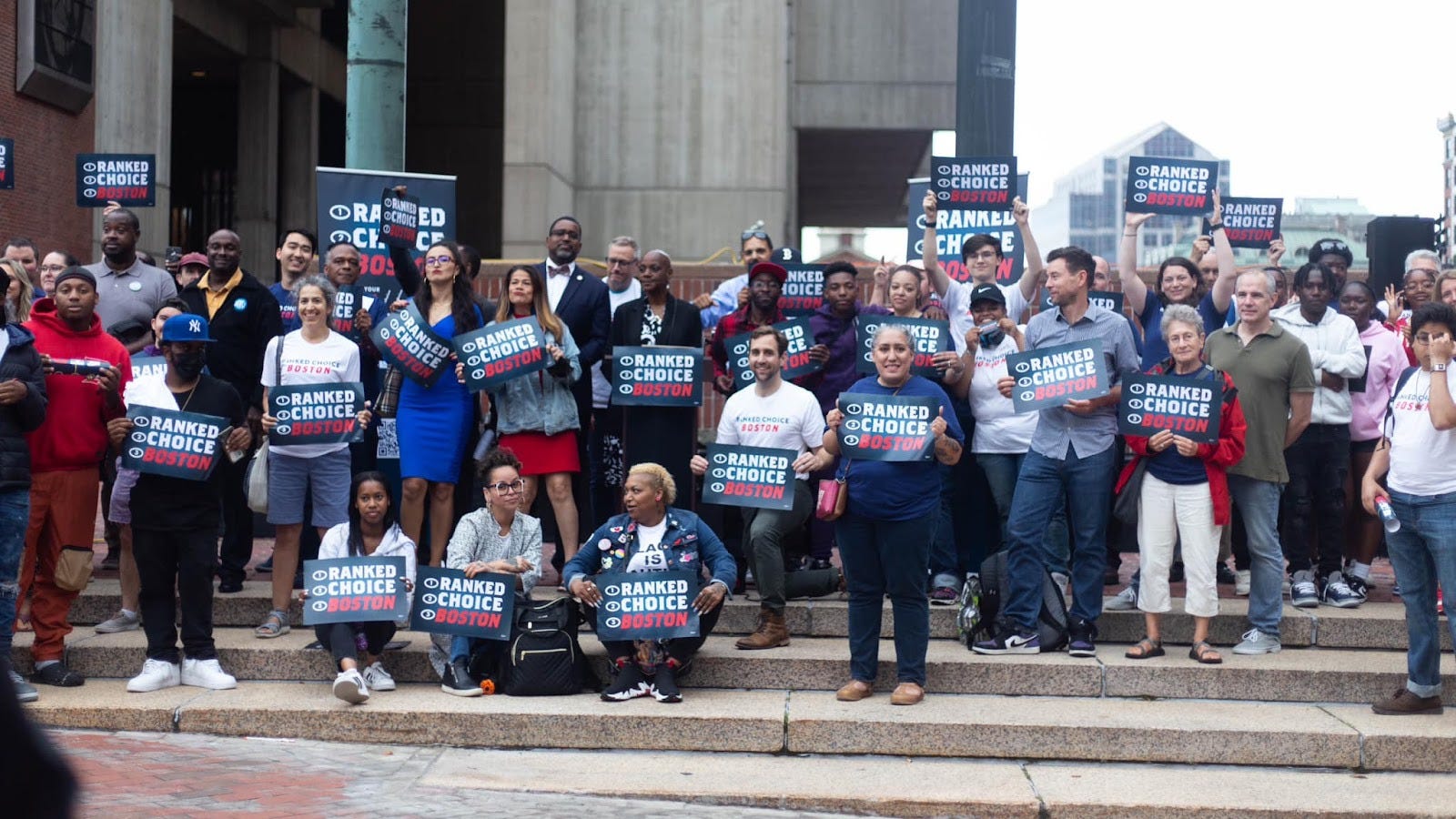
We’ll have a chance to see impact close to home, thanks to some MASSIVE (pun intended) new legislative wins. Last week in Boston, the state Senate voted to advance the city’s Home Rule Petition for Ranked Choice Voting, a major procedural step toward RCV in Boston. And for the first time, the local-option Ranked Choice Voting bill (S.2911, formerly S.531) advanced favorably out of the Joint Committee on Election Laws. This is a big deal: Instead of every city or town needing to pass a Home Rule Petition and then wait (sometimes for years) for Beacon Hill to act, S.2911 creates a clear, statewide permission structure that lets municipalities adopt RCV through their own local processes. We’re gathering people in the State House today to show support for RCV and keep the ball rolling.
Beyond RCV: Lessons for Democratic Reform
Although these videos focus on Ranked Choice Voting, their implications extend beyond any single reform. They suggest a broader lesson about democratic renovation: Durable change emerges when reformers attend as carefully to governance culture as to institutional design.
Too often, democracy reform movements oscillate between urgency and idealism. Urgency can produce overreach; idealism can produce detachment. The Easthampton videos model a different posture—one of patience, observation, and respect for local knowledge. They do not ask viewers to believe in democracy reform as an abstract good. They invite viewers to observe democracy reform as a lived process and to envision living it themselves.
This approach aligns with a renovation ethic rather than a replacement ethic. Renovation implies working with existing structures, honoring institutional memory, and accepting incremental improvement as a form of progress. Easthampton did not reinvent democracy; it adjusted it. And in doing so, it demonstrated that adjustment can be both meaningful and manageable.
Storytelling as Democratic Infrastructure
There is a tendency to treat storytelling as a secondary or even superficial component of reform work. The Easthampton project challenges that assumption. Storytelling is not an add-on to democratic infrastructure; it is part of it. Without shared narratives of how institutions function in practice, reform remains brittle—dependent on advocates rather than embedded in civic understanding.
By documenting how RCV operates in a real place, with real constraints and real people, these videos contribute to the informational commons that democracy depends on. They reduce uncertainty. They counter misinformation not by rebuttal, but by example. They make reform legible.
Importantly, they do so without claiming universality. Easthampton is not presented as a template to be copied wholesale. It is offered as a signal: This is what democratic change can look like when it is allowed to settle, adapt, and belong to a community.
Democracy is renovated not when people are convinced all at once, but when they recognize themselves in the outcome.
Looking Forward
The next phase of the RCV movement—and of democracy reform more broadly—lies less in louder megaphones and more in deeper documentation. Cities and towns telling their own stories. Officials reflecting on what they learned. Voters articulating what felt different and what felt familiar.
The Easthampton videos are an early contribution to that archive. They suggest that the future of democratic reform will be built not only by winning campaigns, but by cultivating memory. By making visible the ordinary success of institutional change, we create the conditions for confidence elsewhere.
Democracy is renovated not when people are convinced all at once, but when they recognize themselves in the outcome. We hope you’ll watch our videos about Easthampton and see the possibilities for your own city or town, no matter how small—and start strategizing how to make it happen.
"They encounter voters who do not frame RCV as a culture-war symbol, but as an administrative improvement that better aligns outcomes with community preferences." Yes! Most smaller town citizens don't really want a lot of buzz. Does it work better? Meaning, is it going to improve things for us, now-ish? Is it more efficient? Does it cost less/no more? Will it help us sustain what we have here that we love? In my renovation work I aim to use language that mirrors what people want in their small towns, generally community sustainability. Not flashy! The tone of this article is so calming in and of itself, which is a much needed balm.