

Gold Medals and American Unity: The Surprising Civic Power of Sports

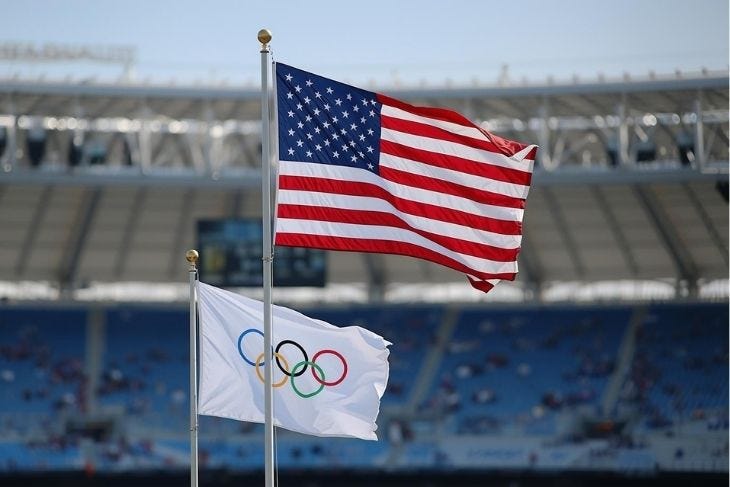
Sports might be one of the last places Americans still practice being a “team.” And we are about to witness it again as the Winter Olympics commence.
That’s not a sentimental claim. It’s a practical one—about rituals that pull us out of our splintered tribes and into a shared story. We show up. We learn the cheers. We wear the gear. We experience joy and disappointment in public, together. And, most importantly, we enjoy the permission to feel something grand: community.
This winter, I was thinking about the power of sports and media to change culture while watching Heated Rivalry, the viral gay hockey romance. Somehow it became both a guilty pleasure and an unexpected viral hit. A Vanity Fair piece reported that the show has even found a huge and passionate audience in Russia, home of one of the main protagonists, where it isn’t legally available. Audiences there rate it higher than juggernauts like Breaking Bad and Game of Thrones. For many Russians, the show is an act of “rebellion and hope”.
So what does all of that mean for those of us trying to design “game-winning” strategies for healthier, more engaged communities? Maybe this: sports and the culture around sports still do something our politics struggles to do. They create belonging at scale and catalyze community engagement.
Ben Valenta and David Sikorjak make that case in Fans Have More Friends, arguing that fandom can function as an antidote to loneliness, strengthening social ties and a sense of belonging. More in Common, one of Shared America’s research partners, went a step further and tested what belonging looks like downstream: civic engagement, democratic norms, and our willingness to coexist with people we don’t agree with.
In partnership with FOX Sports, More in Common found that passionate fans aren’t just more engaged—they’re also, in key ways, less toxic about it. Among the “most passionate” fans, compared to non-fans:
92% are registered to vote (vs. 75%)
64% participate in local elections (vs. 35%)
82% are interested in working on mutual community goals with people who disagree politically (vs. 65%)
73% say democracy is “definitely” the best form of government (vs. 53%)
That combination—higher engagement, lower toxicity—is unusual. More in Common notes that the most politically engaged Americans are often also the most likely to distrust and misperceive “the other side.” Sports fandom seems to soften some of the downsides of being tuned in.
Sure, sports fans are more communal. They have friends. They own folding chairs. They talk to neighbors. But that’s not a joke—it’s basically the operating system democracy runs on: social trust, shared norms, and repeated experiences of “I can be in a room with people who aren’t like me and still be part of something.”
Over the last couple of decades, American politics has been struggling to carry the emotional weight of identity, belonging, meaning, status, and community — longstanding aspects of our politics but newly challenged in 21st-century conditions. Sports carry much of that weight, too. Sometimes beautifully. Sometimes terribly. But it’s carrying it either way.
Let me be clear: the opportunity isn’t to use sports to push politics. That’s how you ruin sports and politics at the same time. The opportunity is to notice what sports already do well—and draft off the design.
Sports work as a civic engine because they offer:
Low barriers to entry (you don’t need a political science degree to show up)
Repeat rituals (every week, every season)
Shared identity without ideology (“we” without a manifesto)
Rules and norms (at least in theory)
Spaces that feel public (arenas, parks, watch parties, school gyms)
Here’s the key: Americans already love doing democracy-adjacent things inside sports culture. We don’t need to invent the next shiny civic program; we can study the stuff people already happily participate in.
We literally vote in stadiums. On Election Day 2020, 33 professional sports venues across 16 states and Washington, DC served as polling places—larger, familiar, community-centered spaces where people could participate safely. Madison Square Garden alone served about 60,000 eligible voters, making it New York City’s largest polling site.
We turn rivalry into public good—and people show up. The Big Ten and Abbott run “We Give Blood,” a conference-wide competition that basically says: donate blood for your school and talk trash while doing it. The Big Ten’s own summary says the effort helped save nearly 250,000 lives. That’s not democracy in the textbook sense, but it’s the same muscle group: participation, shared norms, collective purpose, repeated habit.
Leagues run cause campaigns at a scale most civic nonprofits can only dream about. The NFL and the American Cancer Society’s Crucial Catch initiative have raised more than $35 million since 2009, supporting more than 840,000 cancer screenings and reaching over 1.9 million people through programs designed to expand access. The NHL’s Hockey Fights Cancer has raised over $44 million since its founding in 1998. Again: not partisan. Not ideological. Just a massive, repeated, emotionally resonant “we do this together” gesture.
It’s telling that so many of the best examples aren’t about abstract unity. They’re about tangible contribution—giving blood, expanding screenings, making a stadium a site of participation instead of pure consumption.
That’s where Heated Rivalry comes back in. The show isn’t a public service announcement. It’s a romance. It’s also cultural permission—tenderness and vulnerability placed inside one of the most stereotypically “straight” institutions we have. In the U.S., the show is entertainment. In Russia, as Vanity Fair argues, it’s landing like a dare to hope. Either way, Heated Rivalry offers proof that shared stories still move people—sometimes across barriers we assume are immovable.
The most cynical take on modern America is that we no longer share a reality. Yet, we still show up at Little League practice, and we still cheer for the Winter Olympics. As Heated Rivalry also revealed, Americans are still eager to cheer for a happy ending, even in unexpected contexts. We still want permission to care publicly. We still want to belong.
If we are serious about saving our civic life, we must look at the one place where Americans still volunteer, donate, and gather with strangers. If democracy is going to cool down, it won’t start with persuasion—it will start with proximity, one shared story at a time.
 | A guest post by
|