

Democracy Futurists at Work
How Democracy 2076 is Rewriting the Constitution

When I hear the term “world-building,” I think of my favorite works of science fiction and fantasy (Broken Earth trilogy, anyone?). Worlds dreamed by brilliant authors, each with its own imagined laws of physics, its own mythologies and geographies and languages and galaxies, its own conflicts and struggles, revealed piecemeal as the narrative unfolds. Some have histories of colonialism, imperialism, authoritarianism, or extractive exploitation of natural resources that echo our own world, and some have avoided or escaped those ills in ways that help us imagine alternatives for ourselves.
Democracy renovation is a kind of world-building too, as I came to realize after speaking with “democracy futurist” Aditi Juneja. We’re not talking about a patch job or a new coat of paint; we’re imagining profound, transformative changes that would bring us closer than ever to a vision of government of the people, by the people, for the people. “We won’t go back,” we hear from protestors at marches for women, Black lives, reproductive rights, Pride, and science. But what lies ahead? Or we hear calls to “Make America Great Again,” the way it was before. But what American customs or institutions are we restoring or realizing, and from what time period? That takes world-building.
Aditi Juneja never imagined herself as a democracy futurist when she was admitted to NYU Law in 2014. She planned to become a progressive prosecutor. Then, just as her first year began, Michael Brown was shot and killed by a police officer in Ferguson, Missouri. Memorials, vigils, protests, and riots ensued for months, many repeating Brown’s reported last words – “Hands up, don’t shoot.” They started up again in late November, when a grand jury decided not to indict the police officer for criminal conduct. Then, in March, a Department of Justice investigation concluded that the Ferguson police department had routinely violated the constitutional rights of African Americans in the city. The conflict between what Aditi was learning in her law classes and what activists were saying about the realities of injustice and inequality under the law became more and more disturbing for her. The Constitution held immense power, transcendent ideas captured and articulated through a democratic process of writing so long ago, yet its power was insufficient to protect the lives and liberty of American citizens.
That gap between the world built in our Constitution and the world we live in has become the focus of Aditi’s work ever since. After law school, instead of becoming a prosecutor, she put her legal expertise to work for Protect Democracy and Movement Voter Project. Then she founded Democracy 2076, an organization that’s coordinating with organizations around the country to build the world – and the Constitution – they want.
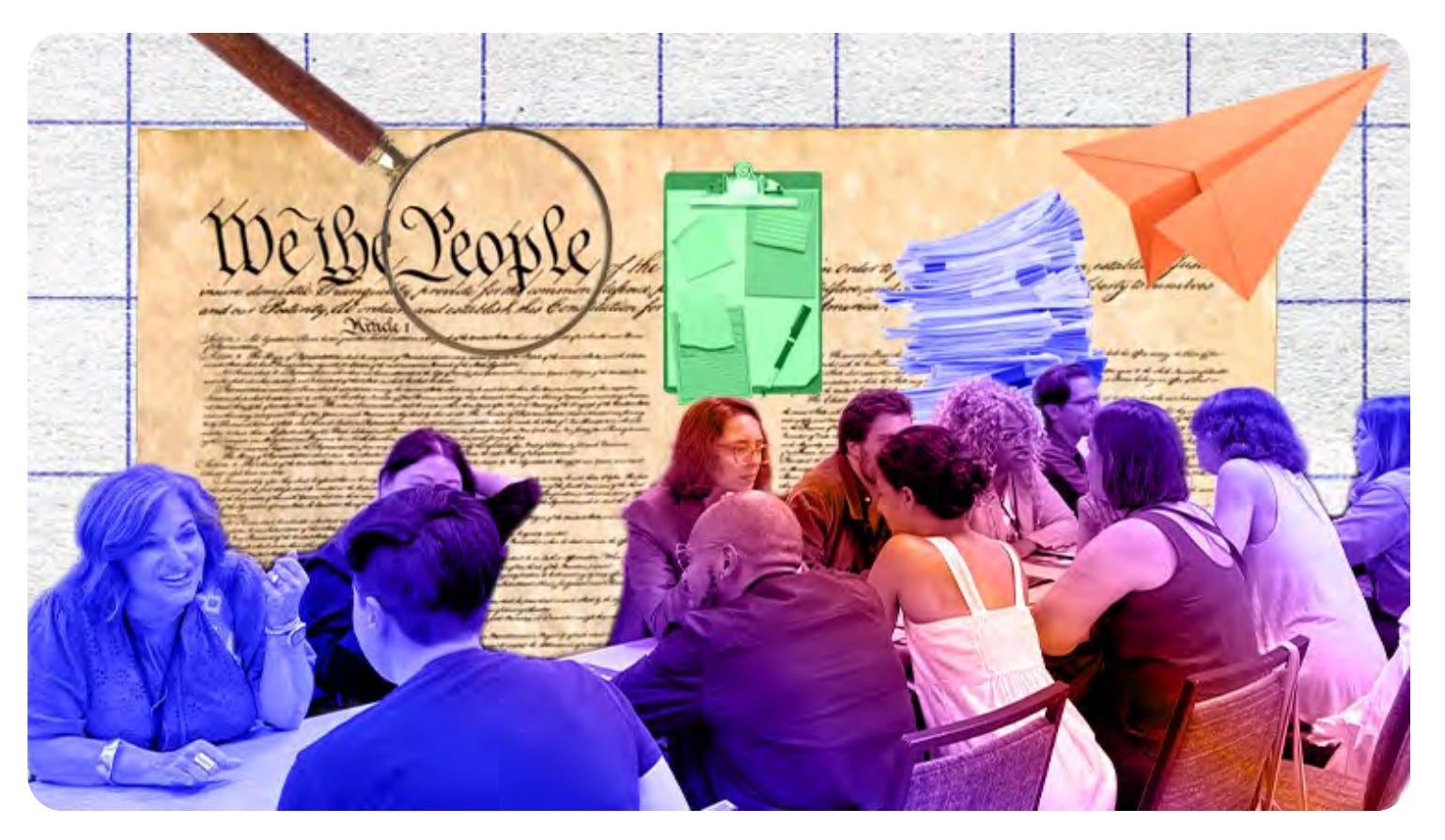
The revamp Aditi has in mind isn’t about elections or redistricting or policy issues or Supreme Court packing. It’s bigger than that. Aditi disagrees with scholars (and Renovator authors) who think those reforms will be enough to drive fundamental change. They swing the pendulum toward the ascendance of one party for some temporary period of time; in the long term, she thinks, historians might care about those changes, but the rest of America won’t. If democracy futurists succeed by 2076, however, Aditi hopes that the United States (assuming they’re still united by then) will be celebrating successes in shoring up the Constitution, to ensure that our government reliably delivers on what the majority of Americans want. Americans will still be disagreeing on how to solve public problems in 2076. Still, the underlying rules of engagement – the framework of democratic governance – should be more solid than ever and applied equally to all.
“Before the 2024 election, I had a harder time getting people to understand that democracy itself was under threat in this country,” Aditi says. “After 2024, our work became more salient, as people realized that enormous structural change can actually happen very quickly under certain conditions. People don’t write that off as impossible anymore.”
As the first step toward this ambitious goal, in 2023, Aditi and her team at Democracy 2076 gathered 53 organizational leaders hailing from 41 states and Washington, D.C. in a room in Santa Fe for four days of world-building. Aditi and her team laid out some possible scenarios for the future and asked participants: How would you draft new constitutional amendments to address that scenario and achieve the best possible outcome? How could we use new amendments to build the world we dream of?
The groups came up with 68 amendments in total. They proposed electoral reforms like sortition, proportional representation, campaign finance reform, and term limits, as well as shifts in the separation of powers to introduce new checks and balances (some eliminated either the House or the Senate entirely). They argued for codifying rights to data privacy, wellness or health, employment, leisure and rest, and even the rights for future generations protected by state constitutions in Colorado, Hawai’i, and Montana. One group proposed a Truth and Reconciliation Commission modeled on South Africa’s, as well as a national public service requirement. Participants shared that this convening was the first time they’d thought about their work in the really long term – not just five or ten years but fifty years into the future. They felt creative and hopeful, and excited rather than overwhelmed.
The following June, a few weeks before Kamala Harris became the Democratic nominee for president, it was time for the Democracy 2076 participants to gather again to strategize: How would you build a coalition big enough to reach the threshold for ratifying a constitutional amendment, two-thirds of Congress and three-quarters of states? Many state-level organizers had never worked to build a coalition that broad. National organizers had even less experience with it. In fact, they hadn’t wanted to grow their coalitions to that degree, because it would mean working with people who didn’t share their vision of the future. But constitutional amendments and democracy renovation, they realized, require a supermajority of Americans who may disagree on every policy issue under the sun, but who come together to insist on a shared belief that we must make decisions on those policy issues democratically. We’re not all driving to the same destination, but we have to follow the same rules of the road.
The organizers from this convening are now building their coalitions, their bridges, and a campaign for democracy in their home states. That’s as it should be, Aditi says. “States are laboratories of democracy where promising ideas can be piloted. Our partners in each state are the ones who decide what reforms to support and what will work for them. Our goal is to support them, but also to make sure that the work of all of our partners together is more than the sum of its parts – that we’re connecting orgs and states who are working on the same reforms, to learn from each other and support each other.” This year, Democracy 2076 will provide additional support to select state partners to build their capacity and boost their reform campaigns, to get the ball rolling and build momentum across the country. But the state partners are the ones with the relationships and local knowledge, and they’ll be the ones leading the work and making the strategic decisions.
In the meantime, Aditi and Democracy 2076 continue world-building on other fronts, imagining how new partisan alignments, coalitions, and wedge issues might change the political landscape. “Black and Latino men and White women voted Republican in 2024 in numbers that surprised a lot of people. Where did that come from? What were the wedge issues that establishment political consultants missed that didn’t fit into the old picture of what each party represents? We’re trying to tell them – that’s happening on TikTok, on Instagram. And you can be deliberate and get ahead of it by creating content that helps to build consensus before the issue is really politicized,” Aditi says.
On another front, Imagining 2076 is the arts and culture wing of Democracy 2076, a collaboration with communications professionals, artists, and content creators who are interested in elevating civic agency and visions of the future in their work. This effort immediately made me think of Caroline Klibanoff’s recent post for The Renovator, and her work with MadeByUs and Youth250 on democratic media – she also mentioned the Civic Alliance’s initiative.
Young people like Caroline and Aditi understand intuitively that social media is the water we’re all swimming in, that we absorb overt and covert messages from it all the time – and that pro-democracy voices can either share their narrative or get drowned out. Think of how many people reach for references to A Handmaid’s Tale, Parable of the Sower, 1984, or The Diary of Anne Frank to describe our current political world. The books we read, the shows we watch, and the media we scroll through are absorbed into our consciousness and teach us how to understand the world, whether we realize it or not. If I told you to reach for a reference to a book, show, or movie that showed people successfully enacting democratic reforms or creating the democracy of the future, could you do it? If not, that may be a symptom of the times we’re living in, but what if it’s also a cause?
Young people like Caroline and Aditi understand intuitively that social media is the water we’re all swimming in, that we absorb overt and covert messages from it all the time – and that pro-democracy voices can either share their narrative or get drowned out.
Aditi is particularly interested in signal-boosting narratives where everyday people have real agency and influence over public affairs. That, she says, is what’s missing for many young people in the United States, especially those who don’t vote at all – a larger contingent than those who voted either for Kamala Harris or Donald Trump in 2024. Low-propensity voters aren’t apathetic across the board. They care deeply about certain issues and communities. They may even support radical structural change. They just don’t see the world of electoral politics as the right place to get that done. “When you ask those people about changing the Constitution, then they’re more likely to engage. They don’t think the solutions on offer are proportional to the problems they’re facing, not big enough swings for a broken system. They do care a lot, actually. They just don’t want a band-aid to the status quo.” In fact, that’s true for more and more reliable voters as well.
Meeting people where they are – also a theme that emerged from Caroline’s work – is, after all, one way of translating democratic principles and values into practice. “We want it to be a normal practice to co-create strategies and priorities, not to hand people policies we think they need or research they didn’t ask for.” Democracy 2076 is meant to be more of a hub, a convener, and supportive capacity-builder than a top-down megaphone.
If dreaming up constitutional amendments and democratic world-building sounds like a good time to you (and I bet it does, Renovators!), check out the reports on Democracy 2076’s website to find out about a state partner near you and review the amendments they’ve proposed (Appendix A pulls out a list). Or leave us a comment here: What constitutional amendment do you think would ensure that we have a participatory, responsive constitutional democracy in 2076?
This is so cool. I like to think we'll have reformed campaign finance/ ditched Citizens United by 2076 (some great progress toward this in the states right now!). But by the end of many of the Founder's lives, they expressed regret that the Constitution didn't explicitly include corporate power in its checks and balances scheme. We need an eighth Article doing exactly this -- it'll take more than an amendment to reimagine and redefine the relationship between private wealth and power and the state. (Those tentacles go way beyond just money in politics!)
I seriously doubt that just one Constitutional Amendment would do the trick. There are many reforms that are needed. But if we could have only a single amendment, the reform I'd like to have is one that requires Balanced Approval Voting to be used in elections of federal officials.
https://www.opednews.com/articles/What-is-so-Special-about-B-Approval_Balanced-Voting_Voting_Voting-Machines-241208-232.html