

Commemorate America250, Commence America250+
From Zachary Cote at Thinking Nation: Advocating a New Minimum Standard for History Education.
As the country commemorates the semiquincentennial this year, I cannot help but think about a university’s commencement ceremony. When I was in college, “commencement” felt like a funny word choice. I was ending my time there, wasn’t I? But, after a second or two of reflection, it made perfect sense. School is not meant to be our final destination. It’s a preparatory season.
So what does that mean for this year-long commemoration of the founding of our nation? What parallels can we draw from these yearly ceremonies that take place on college campuses throughout the country?
The ceremonies themselves do, in fact, commemorate. We celebrate the rewards of long nights of study, thoughtful dialogue about big ideas, and the internalization of complex procedures and formulas. Yet, as students cross the stage, a degree now in hand, a new season commences. Moving the tassel from the right to the left side of my cap was a symbol to those in attendance, and to myself, that a new chapter had begun.
In a similar way, I hope that 2026 does not simply serve as a commemoration of our nation’s 250th birthday. But, like commencement ceremonies imply, a new chapter for its citizens. Don’t get me wrong, I am just as excited to celebrate America250 as I was to throw my cap into the air, but I am also anxious for what is next.
2026 has the potential to usher in a new chapter filled with fresh insights and a rejuvenated sense of purpose for the preservation of our constitutional democracy. It can serve as an inflection point where we don’t just commemorate America250, but commence America250+.
There are a lot of ways that we can do this. America250+ is not confined to a particular course of action. It’s not defined by a particular field, region, or political persuasion. America250+ is a future-oriented mindset that sees commemoration as a pathway to commencement.
At our organization, Thinking Nation, we see our call to action as bettering the space we already occupy: history and social studies education. We want to leverage the study of the past in ways that can better our collective future. In order to do this, we think we need to re-evaluate our approach to history education in American classrooms. We want students to engage with history in a way that centers their own agency and empowers them as thinkers and doers. We are not satisfied with students leaving classrooms where the measure of their success is defined by the strength of their memory.
For our America250+ initiative, we are calling for a new minimum standard in history education, one where thinking is the minimum. We are striving to raise the floor for every classroom and what is expected of every student.
To do this, we’ve identified seven critical components of a history classroom where thinking is the minimum output for all students. To cultivate an engaged citizenry, we advocate for a history education that meets seven criteria:
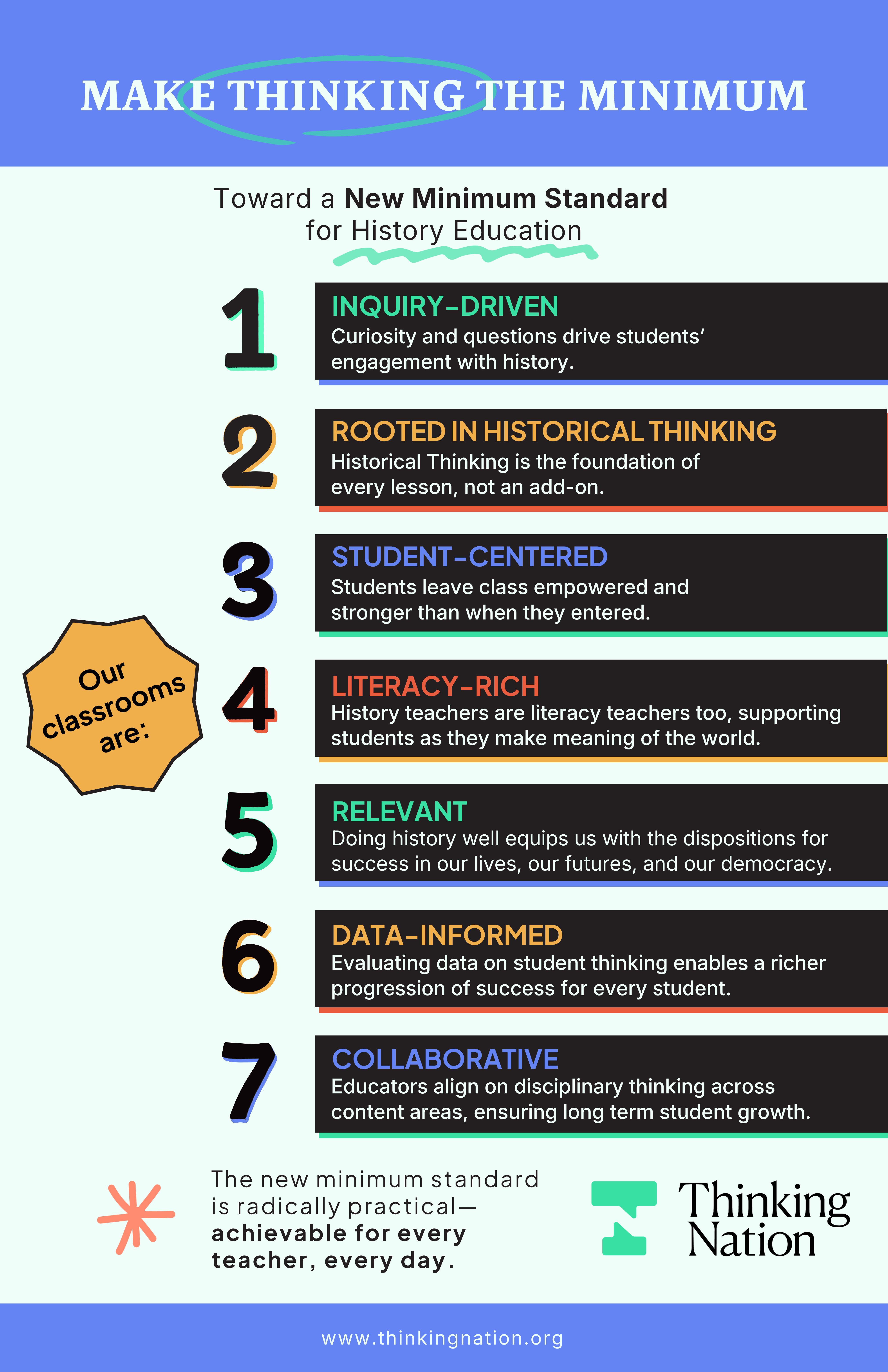
These are not added benefits to a core subject area. These are the new minimum. By definition, history is a discipline that equips students to explore and answer historical questions. It must be inquiry-driven. The toolbelt to do this is historical thinking and robust literacy. When students engage in the study of the past this way, they are empowered to ask and answer robust questions, making classrooms student-centered and relevant. But this type of environment only produces systemic change when teachers are data-informed and collaborative. These components are critical if we want a history education to be the citizen-equipping field that it has the potential to be.
Classrooms marked by these attributes facilitate an atmosphere critical to civic thriving. Take Cabrillo Middle School in Ventura, CA—one of Thinking Nation’s partner schools.
