

Civic Education News Roundup: Reports of the death of civic education have been greatly exaggerated.

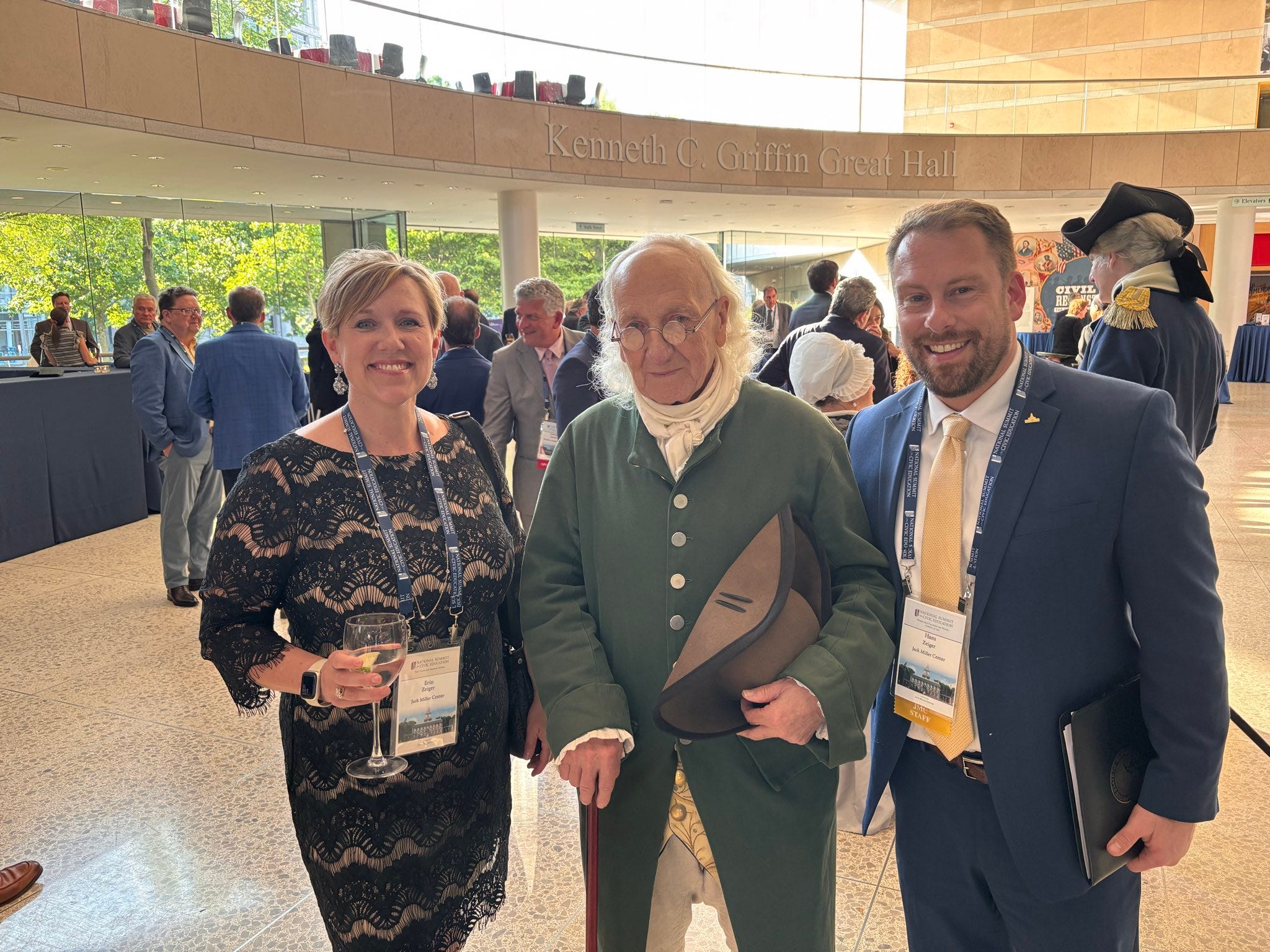
It felt like summer in Philadelphia last week, but I hope attendees at the Jack Miller Center’s annual summit beat the heat and visited some historical sites in honor of America’s 250th!
Be sure to check out the Spring 2026 issue of Civics Magazine from the Jack Miller Center: Teaching the Words that Changed the World: The Declaration of Independence and America at 250, featuring articles by Danielle Allen, Colleen Shogan, Jon Meacham, and many more distinguished historians and civic educators.
Speaking of Danielle Allen, in a New York Times piece last weekend, she challenged some recent civic education doomerism:
“Frequently, when people decry the state of our politics, the conversation always lands in the same place: a lament that we just don’t have civic education any more. I want people to know that this is no longer true. The decline of civic education hit bottom about a decade ago and is at last on the rebound. That fact brings me hope.”

Joshua Dunn and Michael B. Poliakoff of the American Council of Trustees and Alumni joined the chorus in the Washington Post. Eveline Dowling of Expand Democracy agrees and writes about some great examples. In The Dispatch, Joe Pitts writes about Paul Carrese’s optimism on this score, celebrating the publication of Paul’s new book Reflective Patriotism. In Six Gifts for the Republic, John Bridgeland highlights six areas of growth and renewal under way for America’s 250th (beginning with civic learning), and organizations leading efforts in each. The Christian Science Monitor’s Editorial Board praises a recentering of civil discourse in higher ed nationwide.
And then there’s hip hop artist Pitbull, who is partnering with a tech company to develop an AI-based Founding Fathers interactive chat.
One more piece from Danielle on education and democracy:
Education and Its Public Purposes: How schools can support both individual and collective thriving in our democracy. By Danielle Allen for the Stanford Social Innovation Review’s Special Issue on Renewing Public Education’s Purpose, defining democracy education as the preparation of “authentic, equitable citizens,” and one that is best provided by public schools.
Made By Us has put out a summer guide/checklist to help you plan your celebration of this Civic Season:
The National Assessment of Educational Progress (NAEP), an important source of data about civic knowledge in K12, is set for some important updates:
A Year Ago, Experts Worried About NAEP’s Future. Now, the Test is Expanding: The results would drill down on what students know in their senior year, as well as in civics and science. By Linda Jacobson for The74: The National Assessment Governing Board approved a new testing schedule that allows for state-level results in eighth and 12th grade civics as of 2032.
Hopes and anxiety for the Semiquincentennial:
Renewing the American mind at 250, by Jack Miller and Pete Peterson for American Habits.
America at 250: Will We Learn from Our Past? By John Bridgeland, Colleen Shogan for The Fulcrum
America at 250: Battling over national identity by Will Marshall for The Hill, on competing visions in DC for celebrating the semiquincentennial.
4 Ways Philanthropy Can Repair Civic Education: As the nation’s 250th anniversary approaches, funders can draw on a proven Illinois model to help schools prepare the next generation of engaged citizens. By Louise Dubé, Geri Mannion and Ambika Kapur, pointing to the Illinois Civic Mission Coalition and Massachusetts’ robust funding for civic learning as strong models.
Learning from history:
In Pursuit’s series of essays with lessons from American presidents and first ladies have reached Franklin and Jane Pierce (we shared Danielle’s piece about John Adams a few months ago) – and don’t miss the accompanying podcast!
America at 250: Revisiting Thomas Jefferson and John Quincy Adams recording from a UVA Miller Center event featuring Colleen Shogan, Lindsay Chervinsky, and Andrew Davenport.
Remembering Washington’s Patriotism, By Mark Dillon, Steve Carney & Hans Zeiger for RealClear Politics.
Every 50 Years, America Falls Apart. Then Celebrates Anyway: What 1826, 1876, 1926, and 1976 Tell Us About 2026, by Lindsay M. Chervinsky.
Reflections on Our Enduring Ideals: A Conversation with Justice Stephen Breyer (Ret.), an event recording from the National Constitution Center celebrating the new anthology The Promise of America
Technology in civic learning:
Data & Society (D&S) announced the launch of AI Civics: “AI Civics will partner with organizations across a range of sectors that are integral to the health of our communities and civic fabric, beginning with libraries; subsequently, the program will seek partnerships with labor organizations, faith groups, educational communities, and others. Through this two-year program, Data & Society will lay vital groundwork for a national civic coalition dedicated to ensuring that people and communities know how to influence local decision-making about how AI is used in and around their daily lives.”
The Founders’ Case for Human Authorship in the Age of AI, by Laurel Kilgour for Tech Policy Press: “From a republican perspective, human creation is worth promoting not merely for its outputs, but because a society of people who write, create, and invent is better equipped for self-governance.”
Civic education in the states:
Tennessee Civics Survey: A Report by the Institute of American Civics at the Howard H. Baker, Jr. School of Public Policy and Public Affairs, University of Tennessee, Knoxville: Tennesseans regard civic education as very important but their civic knowledge leaves a lot of room for improvement, and many Tennesseans across the ideological spectrum are afraid their reputations could be damaged if they share political opinions. Responding to the survey, Joshua Dunn and William Lyons argue that a lack of civic knowledge is a major culprit in our toxic political arena.
A new report from The Civics Center focuses on Pennsylvania and builds the case that in competitive elections, registered youth turn out to vote at very high rates.
When Students Vote with Their Schedules, by Samuel J. Abrams for the American Enterprise Institute, on UNC Chapel Hill’s School of Civic Life and Leadership (SCiLL), soon to become an independent academic unit - also the subject of a piece by the Wall Street Journal’s editorial board, and another WSJ piece by Jack Miller, “Civics Gets a Reboot in American Education”
Iowa state legislators have proposed a new higher ed general education requirement in American history and government; at the University of Iowa, students would be required to fulfill this requirement by taking courses through the Center for Intellectual Freedom created by the legislature last year.
The Center for Constitutional Law at the University of Nevada, Reno, in partnership with the Nevada Center for Civic Engagement, will welcome K–12 educators from across Nevada this July for the 2026 Summer Teacher’s Institute at the University’s Lake Tahoe campus. Together, the two organizations will combine scholarly expertise with statewide K–12 outreach to promote constitutional knowledge and civic learning.
Civic Futures Institute, America 250-Ohio and American Exchange Project Unveil Vision & Investment in Civic Exchange, bringing American students to spend time in communities geographically and demographically different from their own.
Civic learning resources
Campus Compact has posted professional learning opportunities for faculty and staff in higher ed, including their Engaged Scholars Initiative and Community Engagement Professional Credential.
Everyday Democracy’s new OurNext250 Gathering Toolkit—a free resource with practical tools to help you plan and lead your own community conversation.
GBH has posted footage from April’s Civics in Higher Education National Summit, held at Tufts University, and I thought all the panels were excellent (including the afternoon’s sessions, which I guess GBH did not record):
Civics in the Classroom: Curricula at U.S. 250, featuring Stanford’s Josiah Ober, Yale’s Bryan Garsten, OSU’s Michael Clune, and Tetyana Hoggan-Kloubert from Universität Augsburg
Keeping Community at the Core: Three educators describe their transformational civic work, featuring UW’s Amber Wichowsky, UCSD’s Fonna Forman, and Leslie Garvin from North Carolina Campus Engagement
New publications:
Teaching America: Reflective Patriotism in Schools, College, and Culture by Paul Carrese from Cambridge University Press.
From CIRCLE: Stronger Civic Access, Support, and Culture Address Engagement Gaps by Rurality and Education: The key assets of our CIRCLE Growing Voters framework are associated with higher self-reported voter turnout and civic action among underserved groups. By Ruby Belle Booth, Seona Maskara, Yanlin Ren.
America, U.S.A.: How Race Shadows the Nation’s Anniversaries By Eddie S. Glaude Jr. from Penguin Random House.
Radical Duke: How One Aristocrat-and the American Revolution-Transformed Britain By Danielle Allen from Norton.
“Fostering Civil Dialogue,” a research brief from the Chronicle of Higher Education: The Chronicle surveyed administrators and faculty across the country and interviewed various experts who study civil discourse and free expression to learn more about how colleges are:
Expanding efforts to promote civil dialogue on campus.
Developing strategies to encourage this kind of dialogue within the classroom.
Overcoming the various challenges to implementing these initiatives.
Mind the (generation) gap on Democracy Notes: Sophia Winner, Research Program Coordinator at the SNF Agora Institute, unpacks findings from the recent report, “Examining Generational Divides – Political Attitudes and Behavior.”
Upcoming Events:
Call-to-Action Symposium: From Planning to Impact, an Express Virtual Symposium on Campus Action Planning for Civic & Community Engagement from Campus Compact, May 27-28
Defining Democracy: A ‘1619’ PD Series from the Pulitzer Center, Mon, Jun 1, 2026 4:30 PM EDT
American Political Science Association’s Engaging America’s 250th Webinar Series: Making the Founding Documents Relevant in the 21st Century, Tuesday, June 2, 1:30 PM (ET) / 10:30 AM (PT), featuring Paul Carrese, Arizona State University; Roosevelt Montás, Bard College; Jeremy Bailey, University of Florida; Jocelyn Evans, University of West Florida
Campus Compact: Showcasing Newman Fellow Mini-Grant Projects June 2, 9, 16, and 23
An Essential Partners Dialogue Experience: America @ 250, a three-hour facilitated Reflective Structured Dialogue, June 16, 3:00 PM ET
Joint National Youth Leadership Council (NYLC) National Service-Learning Conference and Points of Light Social Impact Conference, June 22-25, 2026 Washington, D.C.
Civil War Round Table: Lincoln & the American Revolution - Founding Forward talk with Dr. Allen Guelzo, Professor of Humanities at the Hamilton School for Classical and Civic Education at the University of Florida, livestreaming on Youtube on June 24, 6:00 PM
Teaching250: Civics Renewal for America’s 250th and Beyond - from The Center for Civic Education In Partnership with the National Constitution Center, July 9, 7:00-8:30 pm EST
2026 RESULTS National Conference in Washington DC, July 12-14, 2026: RESULTS is hosting three days of learning, action, and connecting with advocates across the country. We will have a special program followed by a day of advocacy on Capitol Hill, with coordinated, powerful advocacy meetings with members of Congress. (You may remember our guest post by Sam Daley-Harris about RESULTS back in February, about how citizens pushed Congress to grow a backbone and defend foreign aid)
Institute on Experiential Learning and Engaged Dialogue | AAC&U, July 14 – 17, 2026: a four-day, online, team-based institute for colleges and universities committed to strengthening applied learning, dialogue across difference, and civic preparation.
Smithsonian National Education Summit—Together We Thrive: Towards a More Perfect Union July 14–16, 2026, in person and online.
Place-Based Justice Network 2026 Summer Institute, “Summer of Solidarity:” Join a community of higher education and community practitioners committed to values-driven, justice-centered work to reconnect, learn from one another, and strengthen our capacity to act in solidarity with our communities. August 3, 11, and 19.