

Civic Education News Roundup: Common Sense turns 250, dialogue across difference, and exciting new publications.

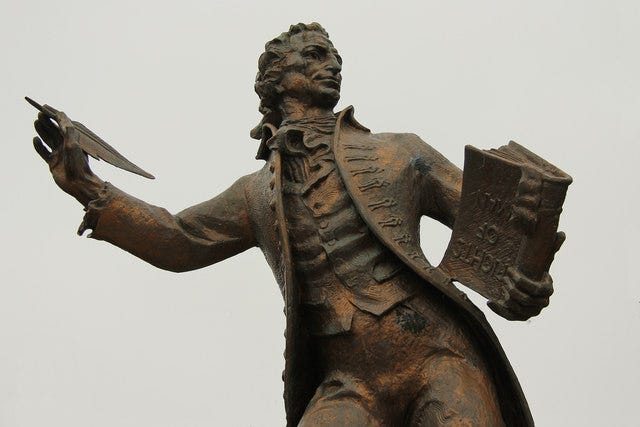
Thomas Paine’s 1776 pamphlet “Common Sense,” which played a major role in turning American public opinion toward independence, turned 250 years old on Saturday! Danielle Allen wrote her own pamphlet about Venezuela in the style of Common Sense last week, a Paine memorial in D.C. is in the works, and Jennifer Schuessler wrote about “How Americans Learned to Love Thomas Paine” for the New York Times. Check out the Bill of Rights Institute and the Gilder Lehrman Institute for educational resources on Paine and Common Sense, or this clip from Ken Burns’ American Revolution documentary.

Didn’t catch my live conversation with Juliana Tafur of Bridging Differences, about their higher ed playbook and neuroscience-backed approach to dialogue and disagreement? Check out the recording here, and two clips that I thought were especially insightful!
More stories about civil dialogue:
Everyone’s Starting ‘Civil Dialogue’ Programs. Will they work? By Eric Kelderman and Francie Diep for the Chronicle of Higher Education
In Northwestern’s Trump Agreement, International Students Singled Out For ‘Open Debate’ Training | By Sonel Cutler for the Chronicle of Higher Education
The Professor of Pluralism: Kwame Anthony Appiah on free speech, thick skin, and the mistakes of DEI offices. | By Evan Goldstein and Len Gutkin for the Chronicle of Higher Education - on the importance of dialogue across difference and equality in higher ed
A call for contributions from the Institute for Democracy and Higher Education: Help Build an Open Repository of Pro-Democracy Teaching and Learning Resources
Please contribute to a new, open-source collection of educational materials designed to strengthen learning for a democracy in question. We seek materials across disciplines, including the humanities, social sciences, physical sciences, and professional studies.
We are seeking resources in three categories:
Teach-Ins: Interactive activities, worksheets, digital tools, and other downloadable materials that reduce prep time and can be used immediately.
Curricular Inserts: Ready-to-use readings, discussion guides, prompts, and multimedia resources for embedding democratic learning into existing courses.
Cross-Disciplinary Programs: Materials that support pro-democracy learning across all fields—bridging STEM, social sciences, the humanities, and professional programs.
News from the National Endowment for the Humanities
A new call for proposals:
At the February 2026 deadline, NEH invites proposals for endowments to build the applicant organization’s capacity in research and teaching of Western civilization, American history and government, and civics.
And two summer institutes that might entice K-12 civic educators - apply by March 6:
History and Civic Learning, from 1776 to 2026
A podcast from the American Enterprise Institute: WTH: America 250 Begins! With Professor Gordon Wood. By Danielle Pletka + Marc A. Thiessen, January 1, 2026.
Peter Levine appears on the Story Preservation Initiative podcast to talk about The Foundations of American Democracy and the history of “civic turning points” in the U.S.
NY lawmakers want to require public schools to teach history of Jan. 6 Capitol riot, from WWNY TV News
Civics Lesson: Educators prepare future journalists and do what they can to shore up democracy | By Tara McKelvey for Liberal Education
New publications:
Check out this great list of books, articles, and publications from 2025, from the Hoover Institution:
Notable Developments in the Citizenship Sphere: June–December 2025 | Compiled and reviewed by Eva Margaret Lacy, Jed Ngalande, and Sophia Craiutu, for the Hoover Institution’s Working Group on Civics and American Citizenship
Assessing What Matters in Civics: A Practical and Credible Tool for Student-Led Civics Projects | by Chaebong Nam, David C. Kidd & Liz Block for The Social Studies
This paper introduces the Civic Thinking Summary, a novel performance assessment tool embedded in a curriculum developed to support student-led civics projects, which are now mandated for Grade 8 and high school students in Massachusetts.
Affective Polarization Convening Summary Report from the Civic Education Research Lab and the Institute for Citizens & Scholars, with “insights from 14 research studies and conversations among scholars, practitioners, and students focused on young people ages 14-24. The report traces how affective polarization emerges in K-12 classrooms, college campuses, families, the media landscape, and election contexts, and also points out promising opportunities for interruption and intervention.”
The Pursuit of Liberty: How Hamilton vs. Jefferson Ignited the Lasting Battle Over Power in America by Jeffrey Rosen for Simon & Schuster
Teacher Educators as Scholar Citizens: Activism and Resistance in Uncertain Times | by Sarah Kaka, Matthew S. Hollstein, Elizabeth Kenyon, Nancy Patterson for Bloomsbury
Coming out on January 20: University: A Reckoning by Lee C. Bollinger (president of Columbia University from 2002-2023) for Norton.
Upcoming Events:
Revolutionary Voices: Student Media-Making and THE AMERICAN REVOLUTION | Organized by KQED Education Events, Tue, Jan 13, 2026 7:00 PM EST
The Alliance for Civics in the Academy hosts “Beyond the Ivory Tower: What Elite and Non-Selective Colleges Can Teach Each Other About Civics” with Thomas Schnaubelt, J. Cherie Strachan, Scott Arcenas, and Josiah Ober on January 14, 2026, from 9:00-10:00 a.m. PT.
We Can Teach Hard Things: iCivics webinar on civil dialogue around contentious topics in the classroom, January 14, 6pm PT/9pm ET or February 11 and April 29 at 7pm ET
60-Minute Civics from the Center for Civic Education - America 250: Reimagining 1776 for Today’s Classrooms | January 15, 2026, 7:00 p.m. ET / 4:00 p.m. PT
Applying the Themes of Democracy & Freedom Throughout a US History Course | Facing History and Ourselves, January 21, 2026, 6:00 pm to 7:30 pm EST
APPLY BY January 23: The Sandra Day O’Connor Institute’s U.S. Constitution Social Studies Educator Workshop 2026, June 7-12, 2026 at the National Constitution Center, Philadelphia
2026 is Here: Seizing the Moment of America’s 250th in the Classroom | Join Natacha Scott from iCivics and Rachel D. Humphries from the Bill of Rights Institute, for this free webinar as they discuss ways to harness the energy of this historic year using the Civic Star Challenge. January 27, 2026 07:00 PM ET
The Civic Learning Institute’s next online course, Difficult Conversations in the Classroom, begins January 29th. Learn more and register for Difficult Conversations here. You can also contact CLI to learn about custom workshops!
The Declaration of Independence and the Push for Racial Equality | National Constitution Center webinar, Monday, February 2, 1:00 pm - 2:00 pm Eastern
Civic Assembly Exploration Event for Community Colleges | Campus Compact in partnership with New America, Thursday, February 5, 2026, 3:00 PM - 4:00 PM ET
The Alliance for Civics in the Academy hosts “What Counts as Success? Assessing the Impact of Civics in Higher Ed” with Trygve Throntveit, Rachel Wahl, Joseph Kahne, and Peter Levine on February 18, 2026, from 9:00-10:00 a.m. PT.
Some big in-person convenings coming up:
We the People: National Symposium on Civic Education Research hosted by The Center for Civic Education and the Civic Education Research Lab (CERL), Washington, D.C., March 6–7, 2026
America250: National Convention for Christian Education: A national convention on cultivating Christian, civic virtue in our students, March 8-10, Philadelphia
Civic Learning Week National Forum Liberty and Learning: Civic Education at 250, hosted by iCivics and the Democratic Knowledge Project in Philadelphia, March 9-10, 2026 (registration is free)
The Fund for American Studies’ 2026 Annual Conference, Developing Courageous Citizens: Revitalizing Civic Education and America’s Founding Principles, March 11-12 in Washington, D.C.
Campus Compact 2026 Annual Conference in Chicago, March 16-18, 2026 - the American Association of State Colleges And Universities (AASCU) has scheduled their American Democracy Project conference for March 15-16 on the same site, so you can attend the two conferences back to back (at a discount)
Jack Miller Center 4th National Summit on Civic Education: Join organizations and philanthropists committed to reinvigorating American civic education with our nation’s founding principles. Pennsylvania, May 18-19, 2026
Speaking of Common Sense and our Constitution, it is very well worth thinking about what Danielle emphasized in her post about Paine: as Paine put it, “in America the law is king. For as in absolute governments the King is law, so in free countries the law ought to be king; and there ought to be no other.”
Speaking of civic education, it seems that very few people (frighteningly few lawyers, legislators and judges) today know of and care about the first rule of law in the United States (the foundation of the rule of law in the United States). In 1988, Justice Scalia highlighted the same problem in his famous dissenting opinion in Morrison v. Olson (which many fanatics of executive power routinely invoke to support the myth of the Unitary Executive). Justice Scalia emphasized the opposite of the power of any man or men:
"It is the proud boast of our democracy that we have 'a government of laws and not of men.' Many Americans are familiar with that phrase; not many know its derivation. It comes from [ ] the Massachusetts Constitution of 1780, which expressly emphasized that “the government of this Commonwealth" was constituted (under a written constitution, which (for the first time in history, was ratified by the People) "to the end it may be a government of laws and not of men.”
I learned the foregoing because I had previously learned that Chief Justice John Marshall in perhaps the most famous opinion of SCOTUS in Marbury v. Madison had emphasized, “The government of the United States has been emphatically termed a government of laws, and not of men.” As I addressed in a comment about Marbury v. Madison in response to Danielle's post about Paine, the great Chief Justice and that early SCOTUS said much more. They explained how our Constitution stated the first rule of law in the U.S. They explained the great significance of the Supremacy Clause and the Oath Clauses (in Article VI, as well as in Article II) and in federal law in 5 U.S.C. Section 3331. Americans today need to rediscover the great truths of our past. Very often, the truth isn't even close to what we are being told today.