

Civic Education News Roundup: celebrating Bill of Rights Day, and a live conversation coming up about Bridging Differences

My heart breaks for the community around Bondi Beach in Australia and for the community at Brown today. That at least two students at Brown had lived through mass school shootings before already – including one who was actually shot – is just too much to contemplate. Yet you’ll read below that many students in this generation are more determined than ever to work toward a better world, and governance that secures life, liberty, and the pursuit of happiness.
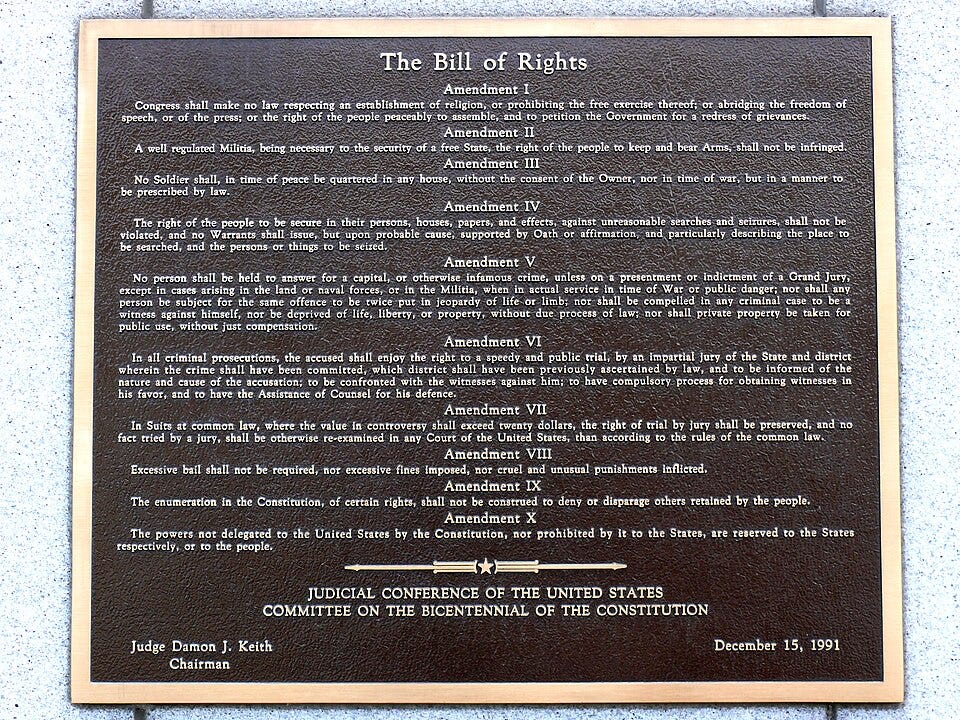
For Bill of Rights Day today, try challenging yourself with the National Constitution Center’s Bill of Rights quiz! For a refresher or a lesson plan, iCivics has a video playlist and of course the Bill of Rights Institute has a ton of good educational resources as well.

Join me on Wednesday at 1pm Eastern for a Substack Live conversation with Juliana Tafur, Bridging Differences Program Director at the Greater Good Science Center located at University of California, Berkeley!
And in case you missed it, check out our post by Mary Gentile about Giving Voice to Values, an ethics curriculum tool:
How To Do The Right Thing: Knowing your values is one thing; it’s acting on them that’s the real challenge.
Stories of success in civic learning:
From Casey Burgat at Sharon McMahon’s The Preamble: “The Kids Are Already in Charge: Stories that prove the next generation isn’t waiting to lead” - awesome stories from California, Alaska, Colorado, Rhode Island, Pennsylvania, and more of student-led civics projects, literally too many for Substack to include in one email!
From Jahnavi Rao and New Voters for the Center for Rising Generations: “The Network Effect: How High Schoolers are Finding Purpose through Civic Leadership.” “At New Voters, having youth lead every aspect of our work not only gives that opportunity, but it strengthens our programs.”
Campus Compact’s latest issue of Common Cause: Strengthening our democracy features success stories from Salem State University’s Civic Fellowship Program, Howard University’s Center for Journalism and Democracy, Indiana University Bloomington’s civic engagement certificate, Carleton College’s discourse-centered living-learning community, and Davidson College’s Deliberative Citizenship Initiative.
From the Philadelphia Inquirer, “Rutgers professor seeks to spread kindness and compassion digitally: Yoona Kang and her graduate researchers are studying how to spread kindness digitally and in everyday life through the use of a mobile app called Daily Compassion.”
Finland tops the European Media Literacy Index, according to this article from New Humanist in the UK, in large part because of how they incorporate media literacy into every subject in K12 schooling: “Teaching when to trust: As fake news accelerates, we need to teach our children how to think critically. Finnish schools are leading the charge”
From Civics of Technology, Evan Shieh (of the Young Data Scientists League) writes “Data is Power: Teaching Critical AI Literacy in K-12”
What kind of civic education do we need?
From Michael T. Nietzel for Forbes, “Proposed Model Bill Would Change College Tenure, Teaching, & Research.” The “American Higher Education Restoration Act” proposed by the Goldwater Institute, Defending Education and the James G. Martin Center for Academic Renewal, suggests creating a special pathway to tenure for faculty who teach an “Americanism and Western Civilization” course; these faculty and faculty in STEM disciplines would have lower teaching loads, greater access to research funding, and exemption from governing board review in hiring.
From Jaden Edison in the Texas Tribune, “Texas launches plan to open Turning Point USA chapters in every high school: Republican officials in Oklahoma and Florida have also launched plans to expand the presence of the conservative youth organization founded by Charlie Kirk.” Governor Abbot added that “Any school that stands in the way of a [TPUSA] Club America program in their school should be reported immediately to the Texas Education Agency.”
From Princeton’s Robert P. George in the Wall Street Journal, “A Solution to Campus Extremism: New programs emphasizing classical and civic education promote healthy dialogue in higher education” under the auspices of the Foundation for Excellence in Higher Education.
From social studies and Lived Civics educator Hilary G. Conklin for the Chicago Tribune: “These are the civic lessons that ICE is teaching our children.”
“When Education Serves the Machine: The Technocapitalist Capture of Universities” By Bruna Damiana Heinsfeld for Civics of Technology, a scathing account of “AI Camp” at Cal State.
From Lauren Porosoff on ASCD: “The Trouble with Compensatory Programs: Schools don’t need more supplemental or one-off programs; they need instruction that brings their values to life every day.”
Johns Hopkins English professor Jeanne-Marie Jackson writes in the Chronicle of Higher Education: “Viewpoint Diversity Misses the Point,” advocating instead for “cultivating the individual, internal intellectual agility essential to think beyond ‘positions’ whose political implications are set. Neatly declarable viewpoints, no matter which ones or how many, should not be the academy’s stock-in-trade.”
Thinking Nation’s Zachary Cote writes for the Fulcrum: “For the Sake of Democracy, We Need to Rethink How We Assess History in Schools.” Thinking Nation has developed new assessment tools for history education to support critical thinking and the development of evidence-based historical arguments.
For The Objective’s Civic Media series: “Students plugging local news gaps isn’t sustainable for students, communities, or journalism: Carla Murphy on how expecting college students to “fill the gap” in local news without addressing institutional power may reify inequities.”
New publications:
Not exactly a publication, but The National Constitution Center’s Jeffrey Rosen has just wrapped up a 12-part podcast series: Pursuit: The Founders’ Guide to Happiness explores how the founders understood personal growth, and how you can put those ideas into practice today.
Campus Compact Democracy Inventory Guide and accompanying Activity Rubric: Guidance for colleges & universities in inventorying democratic engagement efforts
The AAUP has released a new report on Artificial Intelligence and Academic Professions, based on surveying a sample of 500 members, to document concerns about academic freedom, job security, privacy, intellectual property, lack of choice or transparency in adoption of new ed tech tools, and more.
The James G. Martin Center for Civic Renewal put out a report on state civics mandates and their implementation: “50-State Comparison: Civics Education”
Upcoming Events:
First Amendment | professional development webinar online from the National Constitution Center. Laura Little, the James G. Schmidt Professor of Law at the Temple Beasley School of Law, examines historical and modern interpretations of the First Amendment. Brande Vogle, a member of the Center’s Teacher Advisory Council, will share classroom-ready resources on the First Amendment and the amendment process. Wednesday, December 17, 6:30 pm Eastern
ASU Project ACCLaIM: Advancing Civics Curriculum Learning through Instructional Microcredentials focuses on professional development for K–12 teachers in the areas of American history, civics and media literacy via a comprehensive microcredential program. New cohort begins in January.
60-Minute Civics from the Center for Civic Education - The Constitution as Living Document: Progress or Departure? An America 250 Webinar | January 7, 2026, 7:00 p.m. ET / 4:00 p.m. PT
Winter ‘26 Institute on Teaching Social Action, January 9-11: This three-day virtual institute will introduce faculty and teaching staff to an experiential learning approach in which students develop and launch a social action campaign of their choosing as a part of a course.
60-Minute Civics from the Center for Civic Education - America 250: Reimagining 1776 for Today’s Classrooms | January 15, 2026, 7:00 p.m. ET / 4:00 p.m. PT
The Civic Learning Institute’s next online course, Difficult Conversations in the Classroom, begins January 29th. Learn more and register for Difficult Conversations here. You can also contact CLI to learn about custom workshops!
We the People: National Symposium on Civic Education Research hosted by The Center for Civic Education and the Civic Education Research Lab (CERL), Washington, D.C., March 6–7, 2026
Civic Learning Week National Forum Liberty and Learning: Civic Education at 250, hosted by iCivics and the Democratic Knowledge Project in Philadelphia, March 9-10, 2026
The Fund for American Studies’ 2026 Annual Conference, Developing Courageous Citizens: Revitalizing Civic Education and America’s Founding Principles, March 11-12 in Washington, D.C.
Campus Compact 2026 Annual Conference in Chicago, March 16-18, 2026 - full program now online! The American Association of State Colleges And Universities (AASCU) has scheduled their American Democracy Project conference for March 15-16 on the same site, so you can attend the two conferences back to back (at a discount!)