

Civic Education News Roundup: A recent convening, new reports, and summer learning opportunities

Note: Don’t miss the next meeting of The Headstrong Club, a live conversation between Danielle Allen and Ben Rhodes, former Deputy National Security Advisor under President Barack Obama, on April 29 at 1:15PM Eastern.
Shout-out to Nick Longo, Elizabeth Matto, and the Rutgers Democracy Lab team as well as Campus Compact, the Democratic Knowledge Project, and the Allen Lab for Democratic Governance and Innovation for a great event in New Jersey last week! The RDL Think and Do Tank student fellows featured their impressive work at an inspiring project showcase, and a group representing democracy and civic engagement centers in higher ed across the country worked to define the field, or perhaps movement, to which they might all belong.
It’s no easy task. Depending on the institution, a center’s work might be aimed at students, the campus, and/or the neighboring community. A center might prioritize a particular aspect of this work: civil dialogue, voting and civic engagement, or civic knowledge. And political contexts vary widely from state to state and across institutional types. At the core, though, or perhaps on the horizon as a guiding star, are a basic commitment to nonpartisanship joined with American values: pluralism, civic friendship, individual agency, and constitutional government of, by, and for the people. One running theme was the need to build institutional cultures that make these values a daily reality, involving students, faculty, leaders, and staff, not just individual programs.
Some resources shared and cited at the Rutgers gathering:
Teaching Civic Engagement Across the Disciplines, a 2017 volume from the American Political Science Association, particularly the chapter “Civic Engagement Centers and Institutes” by Elizabeth Matto (one of our hosts) and Mary McHugh. Due for an update, as Elizabeth pointed out. Grad students, take note!
The New Landscape of “Civics Centers” in Higher Education, a 2025 report from the Heterodox Academy.
Assessing the Civic Campus: The Link Between Higher Education and Democracy, a report from ITHAKA and AASC&U on how institutions may embrace and evaluate their work for civic engagement from 2024.
Democracy Inventory Guide: Guidance for colleges & universities in inventorying democratic engagement efforts from Campus Compact, 2025.
The Civic Profile, a new self-assessment tool from Stanford’s Center for Revitalizing American Institutions that anyone can (and should!) take.
Check out these two write-ups of a Harvard event featuring Danielle Allen earlier this month, the first from the Graduate School of Education and the second from the Kennedy School — the conversation was great, despite a power outage that meant the speakers had to wrap it up before sunset.
Teaching Civics and Strengthening American Democracy: Experts at the Harvard Graduate School of Education’s Askwith Education Forum weighed education’s role in meeting the moment as America celebrates its semiquincentennial, featuring Professor Danielle Allen, former Secretary of Education of the Commonwealth of Virginia Aimee Rogstad Guidera (who led an effort to rewrite Virginia’s K-12 social studies curriculum), and 2023 Massachusetts History Teacher of the Year Jessica Lander.
“We hit bottom in civics a couple of years ago, and we’re actually on the way back up”: Harvard Professor Danielle Allen, former Virginia Secretary of Education Aimee Rogstad Guidera, 2023 Massachusetts History Teacher of the Year Jessica Lander, and HGSE lecturer Eric Soto-Shed on a “renaissance” in American civics education.
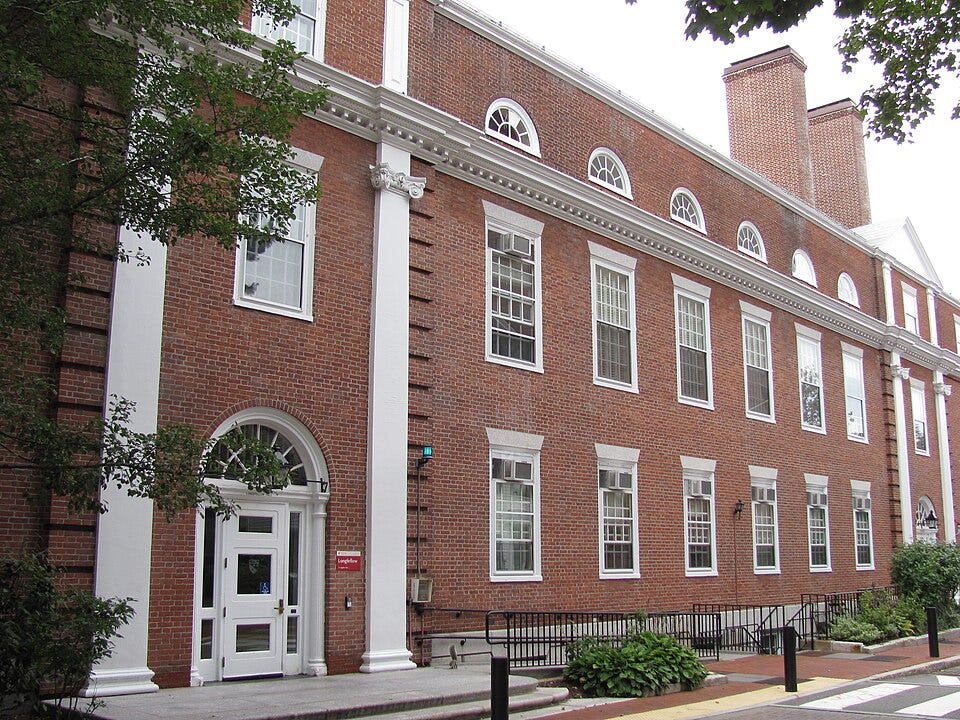
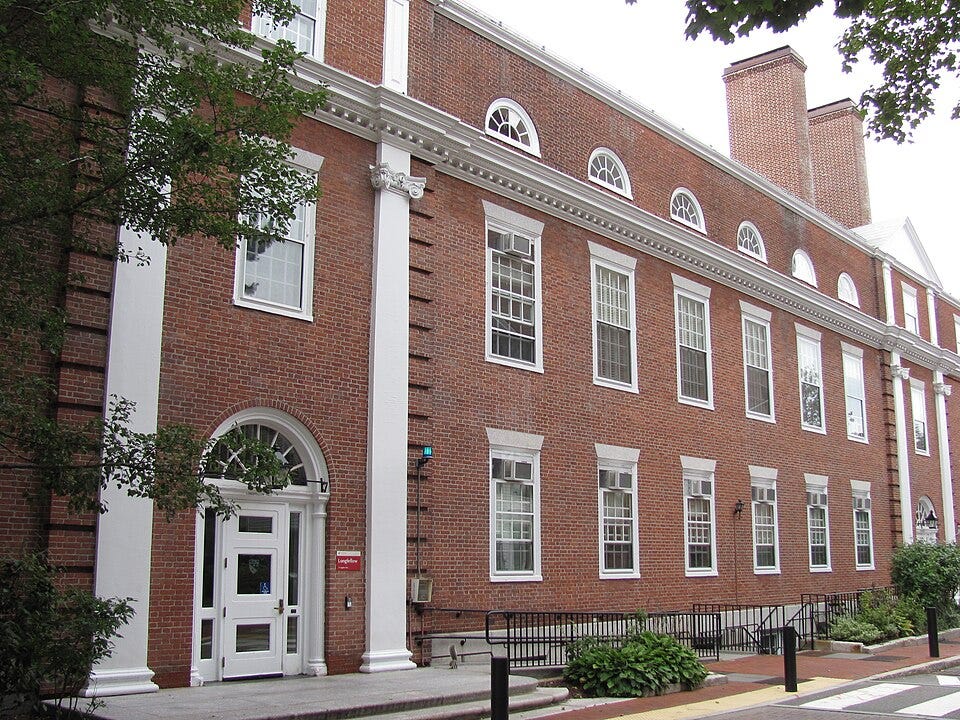
Longfellow Hall at Harvard’s Graduate School of Education, the host of this year’s Askwith Education Forum.
In other news, Sharon McMahon, billed as “America’s government teacher,” was scheduled to speak at Utah Valley University’s commencement, but McMahon’s since-deleted posts on X about Charlie Kirk’s death provoked a backlash from many students and commenters online as well as several congresspeople and legislators from the state. While UVU’s president initially defended McMahon, it has now been announced that UVU will no longer have a commencement speaker. The Salt Lake Tribune’s editorial board criticized the silencing of McMahon as antithetical to Kirk’s own stance on free speech.
The approaching Semiquincentennial is provoking apprehension as well as optimism:
America Is Anxious About Its 250th Birthday. So Are Historians. At the annual meeting of the Organization of American Historians, scholars wrestled with what people want from national anniversaries — and whether historians can give it to them. | By Jennifer Schuessler for the New York Times.
Monticello’s Jane Kamensky: Democracy’s “Baton Pass” | the A250 Interviews podcast from iCivics, available on Spotify, Apple, and Youtube.
America’s 250th Is Repeating a Familiar Mistake | By John Garrison Marks for Time: “Freedom 250, the initiative leading the White House’s 250th anniversary celebrations, fails to adequately address the impact slavery has had on our country.”
America at 250: Our Lost Opportunity | By Robert Pondiscio for American Enterprise Institute Commentary — “A culture in which every public gesture is interrogated for partisan coding cannot sustain a ritual whose sole purpose is to affirm shared inheritance.”
Justice Clarence Thomas, “Remarks on the 250th Anniversary of the Declaration of Independence” | Civitas Institute, University of Texas at Austin.
Reflecting on civil dialogue:
A Blueprint for Civil Discourse on Campus | by Shannon Watkins for The Fulcrum.
We Say We Believe in Free Inquiry — but Our Classrooms Tell a Different Story. If we want to prepare students to participate in American civic life, we need to start teaching differently. By Mella McCormick for Inside Higher Ed, on the need for more continuing education in pedagogy for higher ed faculty.
Why Civic Discourse Is A Necessary Part of Campus Life | By Clare Antesberger, a student at Rhodes College, for Forbes.
With DEI Training, Higher Ed Made a Lot of Mistakes. Now We’re Repeating Them. The new civics movement should heed that warning. By Andrew J. Perrin and Christian Lundberg for the Chronicle of Higher Ed: “Getting civic dialogue right this time around means making it an intentionally organized, collectively theorized, systematically integrated effort: one that is academic, serious, and meaningful” and engages the researchers and intellectuals within the institution.
Stories of success in civic learning:
What Meaningful Character Education Looks Like Around the World: We interviewed global educators about how they teach values, virtues, citizenship, and what it means to be good. By Emily Brower for the Greater Good Science Center.
Why Civic Knowledge Matters More Than We Think | By Patrick McSweeney for the Civic Education Research Lab, on why civic knowledge is a key adjunct to civic skills.
The Future of Civic Engagement is Already Here, Featuring Alex Edgar, LaJuan Allen, and Jahnavi Rao | Democracy Lab podcast from Expand Democracy.
Teaching Skepticism in Kyiv and Nablus: Close attention can foster compassion and spur action | by Peter Levine for Public Seminar.
Theater for Young Audiences — What Role Can It Play In Saving Our Democracy? | By Joan Lancourt for The Arts Fuse.
Inspired by the Next Generation at the We the People National Finals | by Diana Owen and the Civic Education Research Lab.
Civic learning resources
New Online Tools Create On-Ramp to U.S. Democracy for Youngest Voters. Not sure where to start? Click your state to find rules, tools, and motivation. The Civics Center has created state-specific online educational resources aimed at answering students’ most frequently asked questions and increasing youth participation in our democracy. | By Laura W. Brill for The Civics Center.
The American Association for State and Local History launches the History & Democracy Initiative (HDI), including innovative programming, strategic collaborations, and original research to help history organizations further their contributions to rebuilding America’s civic culture from the ground up.
Terms of Engagement podcast from Harvard’s Kennedy School: American Birthright: The Constitution, Citizenship, and Immigration with University of Pennsylvania political science professor emeritus Rogers Smith.
Summer learning opportunities:
The Kettering Foundation Democracy and Community focus area will be hosting the Summer Institute of Civic Studies at the Kettering Foundation Dayton campus this summer from Sunday, Aug. 2, to Saturday, Aug. 8. This is an opportunity for scholars and practitioners from around the country to learn and connect with each other. Apply by April 30.
Summer Voting Rights Course and Democracy Training: Student Voting, Civil Rights, and the Practice of Democracy is a three-credit political science course open to any college or dual-enrollment students, designed by historians, political scientists and an election law professor and practitioner. It is taught synchronously and online. The course is led by Jonathan Becker, Professor of Politics; Erin Cannan, Vice President for Civic Engagement at Bard College; and Yael Bromberg, constitutional rights litigator, legal scholar, and election law professor. When: June 22 – July 28. Classes are held online. Cost is $150. Apply by May 27.
Enrollment is open for the 2026 Digital Inquiry Group Summer Institute for educators in grades 5-12 on July 7, 8, and 9.
New publications:
For ALL College Students: The CLDE Guide for Generative Curriculum Planning from the Civic Learning and Democracy Engagement (CLDE) Coalition, including the webinar recording from the report launch.
The CLDE Guide for Generative Curriculum Planning is a resource for educators who want to make college civic learning empowering for students, feasible for faculty, and renewing for a divided and skeptical democracy. It includes chapters on curriculum design, planning new curricular pathways, planning for leadership teams, and strategizing for long-term investment in faculty and staff learning (including adjuncts and visiting faculty) as the key to success.
The Promise of America: Reflections on Our Enduring Ideals from the National Constitution Center, featuring an esteemed group of authors led by U.S. Supreme Court Justice Stephen G. Breyer (Ret.), who provides the introduction, and U.S. Supreme Court Justice Neil M. Gorsuch, who authors the epilogue. It also includes a line-by-line annotated Declaration of Independence prepared by constitutional scholar Akhil Reed Amar. Additional contributors include Jeffrey Rosen, CEO Emeritus of the National Constitution Center; historian and author Walter Isaacson; Pulitzer Prize–winning historian Gordon S. Wood; MacArthur Fellow Danielle Allen; Hon. Jeffrey Sutton, Chief Judge of the U.S. Court of Appeals for the Sixth Circuit, and leading scholars including Robert P. George, Jane Kamensky, Yuval Levin, Mary Sarah Bilder, Lindsay Chervinsky, Rosemarie Zagarri, David Armitage, and Eric Slauter.
To Counter America’s Civic Illiteracy Crisis, ACTA Urges Universities to Require Foundational Coursework in U.S. History and Government: The American Council of Trustees and Alumni (ACTA) released A Broadside for the Nation: Preparing College Students for Informed Citizenship.
Jefferson on Race: A Reader, Edited by Annette Gordon-Reed from Princeton University Press.
Ray Block, Jr. (2026). “The Classroom as Civic Sanctuary: Teaching, Learning, and the Emotional Labor of Democracy.” Journal of Political Science Education.
Forthcoming in May: Teaching America: Reflective Patriotism in Schools, College, and Culture by Paul Carrese for Cambridge University Press.
Upcoming Events:
Lexington’s First Civic Assembly | New America webinar, April 27, 11 a.m.– 12 p.m. EDT.
Advancing Open Inquiry within University Systems | Heterodox Academy members only, April 28, 2 p.m. EDT
Standing Up to Bigotry and Hate: Tools for Young People in a Complex World | Facing History and Ourselves, April 29, 7 p.m. to 8 p.m. EDT
News Deserts and Universities | Campus Compact and The Center for Community News (CCN) webinar, Thursday, May 7 at 2 p.m. EDT
Inside the Vault: The Brotherton Tribe During the Revolutionary Era | Gilder Lehrman Institute, May 7, at 7 p.m. EDT.
2026 Civic Discourse on Campus Virtual Summit | NASPA—Student Affairs Administrators in Higher Education, May 8.
Jack Miller Center 4th National Summit on Civic Education: Join organizations and philanthropists committed to reinvigorating American civic education with our nation’s founding principles. Pennsylvania, May 18-19.