

Civic Education News Roundup: A Fiery Resignation Letter, a Big Court Ruling, and More Chaos on Top of a Busy Season of Events

“If I did not resign that day, I was told that the DOJ would extract/block hundreds of millions of dollars from UVA before they would even negotiate.”
President Jim Ryan resigned from UVA under pressure from the university’s Board of Trustees as well as the DOJ, according to a long public letter, in which he also describes the event leading up to his resignation. It’s an inside look at the pressures on academic freedom that we’ve been tracking for the last few months.
In related news, on Friday, a California federal judge ruled that Donald Trump cannot demand that UCLA pay a $1.2 billion settlement, calling Trump’s actions toward the university “coercive and retaliatory.” The settlement would have set controls on admissions and curriculum, with a threat of research funding freezes if the university did not comply. Restrictions on curriculum are being enforced at other universities: An Indiana University Social Work prof has been removed from her “Diversity, Human Rights, and Social Justice” course after a student complained to one of Indiana’s senators. Texas A&M’s president will review course content related to race or gender identity, and Alabama’s state anti-DEI law limits Auburn’s curriculum.
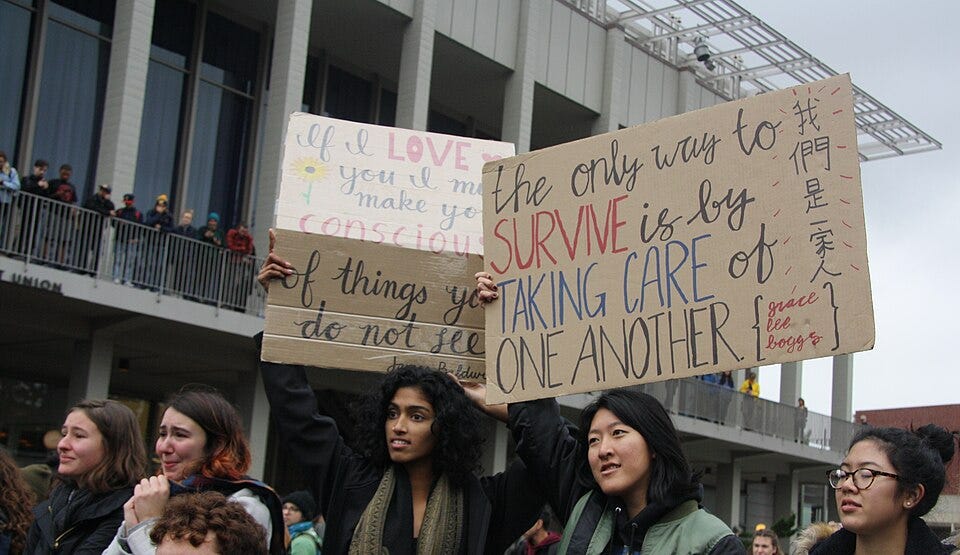
CIRCLE reports that students had a major impact on 2025 elections with turnout surging in Virginia in particular, and many students and faculty are also speaking out about academic freedom. Students at more than 100 campuses across the country rallied on November 7 against the administration, with AAUP and Debt Collective members even marching outside Marc Rowan’s office in Manhattan. The AAUP held an info session on how ICE activities are affecting campus communities. But at Berkeley, a student protest against Turning Point USA’s “American Comeback Tour” ended in violent clashes with riot police, sparking investigations by the university and the DOJ.

During the government shutdown, college students as well as community members in California, New Mexico, North Dakota, North Carolina, Pennsylvania, and more felt the effects of the SNAP shutdown and used campus resources even more than usual. In Denver, students in a culinary training program turned to the program for food themselves. Check out this Statement from the Student Basic Needs Coalition (SBNC), which was quoted in a piece Rainesford Stauffer wrote for Teen Vogue about how young people and students are disproportionately affected by the SNAP shutdown and food insecurity.
“At the Student Basic Needs Coalition (SBNC), we believe that no student should have to choose between eating and earning a degree. Yet the ongoing federal government shutdown threatens to make that choice a reality for the 1.1 million students receiving support from the Supplemental Nutrition Assistance Program (SNAP), as the U.S. Department of Agriculture (USDA) announced that they will not be distributing SNAP benefits beginning November 1st. This will create an immediate and inequitable hardship for students who rely on these funds to afford food.
We are calling on colleges and campus leaders to take action now to prevent further harm and ensure students continue to be able to access the resources they deserve.”
In this moment, what kind of civic education do we need?
On EdWeek, Sarah D. Sparks writes that “Teachers Value ‘Patriotic’ Education More Than Most Americans: The findings stand in contrast to conservative rhetoric about ‘indoctrination’ in the social studies.” She spoke with the University of Missouri’s Brian Kisida, who urges the Trump administration to focus on spending more time and resources on civic education, rather than fighting over how patriotic it is. He was the lead author on “Should Schools Teach That America Is Good?,” a study on public opinion published on Education Next this past summer.
The America250 coalition promises patriotic education from a conservative lens: How Turning Point USA could revive civics education across the country: Hillsdale College president calls Turning Point USA founder a ‘martyr’ as Trump administration launches civics education push | By Joshua Q. Nelson for Fox News – or check out Shauneen Miranda’s story in the Ohio Capital Journal
Youth250 and MadeByUs ask: “Is Civics Education Enough to Engage Young Adults? Gen Z is looking for something more tangible than civic education. The question is: are our institutions ready to bring young people to the table?” (Actually, this contentious headline masks the fact that the piece largely agrees with leaders in civic education today about what is needed.) Oct 15, 2025.
JD Mangat urges more educators to prepare students for the National Civics Bee on Colorado Politics.
And a new report has been published by Thomas Schnaubelt, Karina Kloos, and Connor Begovich from the Hoover Institution Center for Revitalizing American Institutions (RAI) at Stanford:
Surveyed over 7,600 educators and students from 2023-2024 and interviewed 102 leaders in the field to develop an understanding of the American civic education landscape as a part of RAI’s larger mission to study the reasons behind the crisis in trust facing American institutions, analyze how they are operating in practice, and consider policy recommendations to rebuild trust and increase effectiveness. Civic educators need support from experts in civic thought, from practitioners of dialogue across difference, and from researchers who can assess programs and tell us more about best practices.
As we’ve reported also at The Renovator, civic education has generally suffered from a lack of resources and investment, and political polarization has made this work much more fraught for educators. But there’s cross-ideological consensus that we need to do more, and momentum is growing, with new policies being implemented especially at the state and local levels.
Reports from two big gatherings for civic education:
The Global Forum on Higher Education 2025: Renewal of the Democratic and Civic Mission was hosted by Charles University in Prague in partnership with The Ministry of Education, Youth and Sports of the Czech Republic. Presenters shared how they were working to raise consciousness of the democratic mission of higher education institutions around the world, and how they were building capacity and supportive resources for that work. Check out some of the presentations on their website, or Bobbie Laur’s reflections on the Campus Compact website.
Over 470 leaders from across the U.S. and internationally gathered in Baltimore for the 2025 Coalition for Urban and Metropolitan Universities (CUMU) Conference, The Power of Place. Over three days, attendees reflected on how urban and metropolitan campuses are deeply rooted in their local context and connected to national and international challenges and opportunities. The second day kicked off with Community Experiences — opportunities for attendees to explore local neighborhoods and programs where CUMU members are engaged. A plenary panel brought together the leaders of Baltimore’s anchor institutions, including universities, and the mayor of Baltimore to discuss how they’ve partnered to reduce crime and violence together.
Through it all, community-engaged learning goes on:
Campus Compact’s Kerry Foxx McVey writes a series for Higher Ed Jobs called Campus to Community: Stories of Impact in Higher Ed. One featured the Street Medicine Institute at Washington and Lee in Virginia, which has been integrated into coursework and community-engaged research. On November 7, his post was entitled “Uncommon Places: How San Diego State University Is Opening College Pathways Inside Prison Walls,” featuring stories about SDSU’s first cohort of graduates of the university’s Valuing Incarcerated Scholars Through Academia (VISTA) program.
“The first cohort of graduates received a degree in Interdisciplinary Studies which integrated communication, journalism & media studies, and art & design. Practically, this mix of disciplines allows students to engage in critical thinking and storytelling. Now, the current cohort of students is working towards a BA in journalism.”
Rethinking Schools’ Bill Bigelow writes: “Baltimore Students Fight for Climate Justice — and Their Own Lives” about Free Your Voice, an after-school student group in South Baltimore’s Benjamin Franklin High School.
Akin Olla calls for a revival of State Student Associations and student unions in “How to Build Student Movements That Last” for Nonprofit Quarterly.
New publications:
Teen-Centered Civics for Human Thriving: A new blueprint for learning and human flourishing | from History Co:Lab, October 2025 - suggests 18 core civic learning experiences to support civic thriving. You can read Karen Pittman’s piece about it on Youth Today. From the report:
“This white paper combines the insights from the science of adolescent development, history, the humanities, and pedagogical practice to propose an actionable framework for civic learning that addresses these three critical gaps. We attempt to lay the foundation for civic thriving which positions civic engagement as a compelling pathway for human development.
Civic thriving emerges when adolescents:
Feel seen and valued as they develop a secure sense of self
Form meaningful connections across differences, grounded in belonging and empathy
Experience purpose and contribution, realizing their capacity to shape community and society”
ENACTing Change: A Handbook for Teaching Advocacy and Civic Engagement | by Kathleen Cole, Robert W. Glover, Richard J. Meagher, and Katharine A. Owens for Brandeis University Press
ENACT: The Educational Network for Active Civic Transformation aims to teach college students about democracy through engagement with the state legislative process. Built on the values of knowledge, cooperation, justice, and integrity, ENACT is a national, intercollegiate nonpartisan network. The program empowers students to be active participants in democratic processes by connecting with policymakers and community organizations, conducting research and analysis, and informing public policy with evidence and expertise.
Julie Marsh, James Bridgeforth, Jacob Alonso, Akunna Uka, Laura Mulfinger, and Miguel Casar publish guidelines for school board members in California: Navigating Democracy in Divided Times, USC Rossier School of Education, September 2025.
Joshua M. Jansa, Eve M. Ringsmuth, and Alex P. Smith. “Calibrating Confidence: Civic Education and the Relationship between Objective Political Knowledge and Political Knowledge Confidence.” Perspectives on Politics 23, Special Issue 3: Special Section: Challenges to Democracy (2025): 997–1012. -
Upcoming Events:
Native American Heritage Month programs at the National Constitution Center, including in-person and virtual options, going on all month. Check out Professional Learning for Educators: Native Americans and the Constitution on Wednesday, November 19 at 6:30 p.m. ET
Supporting Values-Driven Teaching in Politically Charged Times: Join EdEthics on Wednesday, November 19th (2 different times), for a webinar event! We will walk through a new resource hub that contains a variety of activities and information to help K-12 educators in the US respond to policy shifts and to lead with their values in complex times.
Introduction to the Collaborative Discussion Project Toolkit | Interactivity Foundation, November 18 @ 12:00 pm – 1:00 pm EST
60-Minute Civics Webinar: Who Decides What Patriotism Looks Like? | Danielle Allen (DKP Director, Harvard University) and Paul Carrese (Arizona State University), November 20, 2025, 7:00–8:00 p.m. ET
A MORE PERFECT UNION on PBS examines America’s founding and the ideas and values articulated 250 years ago. It features Ken Burns and Sarah Botstein, co-directors of THE AMERICAN REVOLUTION, and Yuval Levin of the American Enterprise Institute, in conversation with Jeffrey Rosen of the National Constitution Center and Melody Barnes of UVA’s Karsh Institute of Democracy. Airs November 24 at 9pm Eastern.
Coalition of Urban and Metropolitan Universities (CUMU) Anchor Learning Network 2026 kick-off: Workforce development and the anchor mission | December 3, 2025 3:00 pm EST – 4:00 pm EST
Info Session: Facing History School & District Programs | Facing History And Ourselves, December 4, 2025
Campus Compact Fall 2025 Coalition Conversations: Navigating Uncertainty in Higher Ed | December 5, 12:00 - 1:00 PM ET
Mapping Deportations Curriculum Workshop from the Zinn Education Project, Monday, December 15, 7pm – 8:15pm ET. Join us to learn about “Mapping Deportations” a classroom-friendly digital resources that invites visitors to see the history of U.S. immigration enforcement not as a series of disconnected events, but as a pattern.
ASU Project ACCLaIM: Advancing Civics Curriculum Learning through Instructional Microcredentials focuses on professional development for K–12 teachers in the areas of American history, civics and media literacy via a comprehensive microcredential program. New cohort begins in January.
The Civic Learning Institute’s next online course, Difficult Conversations in the Classroom, begins January 29th. Learn more and register for Difficult Conversations here.
We the People: National Symposium on Civic Education Research hosted by The Center for Civic Education and the Civic Education Research Lab (CERL), Washington, D.C., March 6–7, 2026