

Can The Pope + Steve Bannon Save Us From AI Acceleration?
The plot has thickened— Tech & Democracy's greatest hits are back in this Roundup

This week, let’s return to some of our favorite themes from across previous Tech & Democracy Roundups, and see how they’ve developed!
First— following our last roundup “Meta’s Scam Monopoly, the AI Race, and ‘Founder Mode’”— let’s check back in on the high-stakes AI race, this time examining the government’s role in it.
A big-dollar lobbying war over the future of AI regulation is coming to a boil. Will states retain the authority to regulate AI safety, or will the federal government preempt them and institute a single framework on behalf of Big Tech donors?
From Paulo Carvao in Forbes and his “Tech and Democracy” Substack:
“Artificial intelligence has ignited a $150 million political battle over federal preemption. Congress must soon decide whether to include preemption language in the National Defense Authorization Act while the White House weighs an executive order that could override state rules. Two coalitions are racing to shape the outcome. One side, backed by some of Silicon Valley’s largest investors, wants to block state oversight and establish a single federal framework. The other, funded by safety-focused donor networks, is fighting to preserve state authority if Congress can’t pass meaningful national standards. Each has built a structured network of Super PACs, donors and advocacy groups. Their battle is about who writes the rules, who enforces them and whether states can act at all.”
The Big Tech side has the upper hand here, especially since so many of Trump’s donors and advisors are openly grifting on behalf of technocapital, and themselves. Remember my classic Tech & Democracy piece on “Crypto Corruption, AI Erotica, & the Antichrist,” where I took aim at the corrupt David Sacks? Well, looks like the New York Times reads The Renovator! In their recent article “Silicon Valley’s Man in the White House Is Benefiting Himself and His Friends,” they wrote “David Sacks, the Trump administration’s A.I. and crypto czar, has helped formulate policies that aid his Silicon Valley friends and many of his own tech investments.”
This all comes at a time when Trump— who writes pardons and executive orders on behalf of anyone who flatters him, more compliantly than any autopen— recently signed an executive order establishing “Genesis Mission”— “a dedicated, coordinated national effort to unleash a new age of AI‑accelerated innovation and discovery that can solve the most challenging problems of this century.”
“The Genesis Mission will build an integrated AI platform to harness Federal scientific datasets — the world’s largest collection of such datasets, developed over decades of Federal investments — to train scientific foundation models and create AI agents to test new hypotheses, automate research workflows, and accelerate scientific breakthroughs.”
Trump is all in on national AI acceleration. But, interestingly, not all of MAGA is on board. As noted in Beth Fukumoto’s last Democracy in the States Roundup, two Republican governors— Florida’s Ron DeSantis and Utah’s Spencer Cox— are moving ahead with state-level guardrails on AI, even as the Trump administration resists new regulation. And, perhaps more surprisingly, key MAGA leader Steve Bannon has come out swinging against the potential dangers and complications of rapid AI development:
Matt Walsh, Tucker Carlson, and Josh Hawley are also on this “MAGA/anti-AI” team. Perhaps this faction could be helpful in the fight to ensure AI is developed safely and aligned with human values— a useful Trump-world counterweight to nihilistic accelerationists like Marc Andreessen.
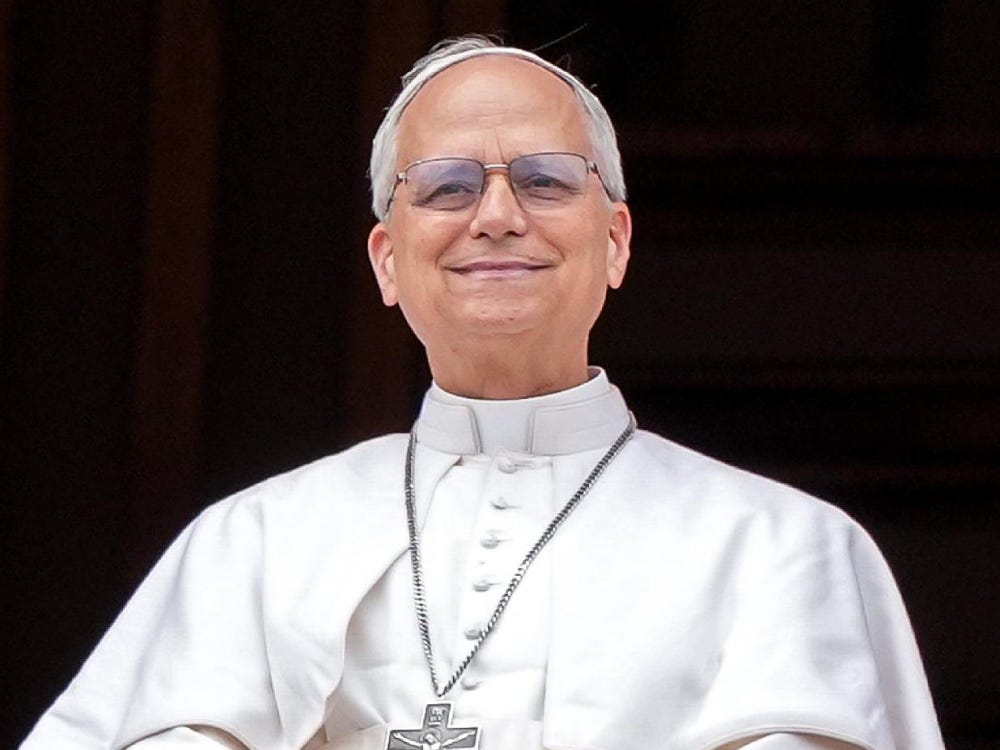
Speaking of Andreessen, thank you to all the Tech & Democracy readers who made “The Pope vs. Marc Andreessen: The Future of Tech & Democracy” our top Renovator post of November! You all either really hate Marc Andreessen or really love the American Pope— perhaps both. It is nice to see the Pope using his moral authority to influence the culture around AI development. Come to think of it, it’s nice to hear from a genuine moral authority these days, period.
Pope Leo XIV gave an address December 5th on “Artificial Intelligence and Care of Our Common Home.” I’ll let His Holiness speak for himself. Take it away, Leo!
“How can we ensure that the development of artificial intelligence truly serves the common good, and is not just used to accumulate wealth and power in the hands of a few? This is an urgent question, because this technology is already having a real impact on the lives of millions of people, every day and in every part of the world… [T]his challenge requires asking an even more fundamental question: What does it mean to be human in this moment of history?
Human beings are called to be co-workers in the work of creation, not merely passive consumers of content generated by artificial technology. Our dignity lies in our ability to reflect, choose freely, love unconditionally and enter into authentic relationships with others. Artificial intelligence has certainly opened up new horizons for creativity, but it also raises serious concerns about its possible repercussions on humanity’s openness to truth and beauty, and capacity for wonder and contemplation. Recognizing and safeguarding what characterizes the human person and guarantees his or her balanced growth is essential for establishing an adequate framework for managing the consequences of artificial intelligence.
In this regard, we must pause and reflect with particular care upon the freedom and inner life of our children and young people, and the possible impact of technology on their intellectual and neurological development. The new generations must be helped, not hindered, on their path to maturity and responsibility. The well-being of society depends on their ability to develop their talents and respond to the demands of the times and the needs of others, with generosity and freedom of mind. The ability to access vast amounts of data and information should not be confused with the ability to derive meaning and value from it. The latter requires a willingness to confront the mystery and core questions of our existence, even when these realities are often marginalized or ridiculed by the prevailing cultural and economic models. It will therefore be essential to teach young people to use these tools with their own intelligence, ensuring that they open themselves to the search for truth, a spiritual and fraternal life, broadening their dreams and the horizons of their decision making. We support their desire to be different and better, because never before has it been so clear that a profound reversal of direction is needed in our idea of maturing.
In order to build a future together with our young people that achieves the common good and harnesses the potential of artificial intelligence, it is necessary to restore and strengthen their confidence in the human ability to guide the development of these technologies. It is a confidence that today is increasingly eroded by the paralyzing idea that its development follows an inevitable path. This requires coordinated and concerted action involving politics, institutions, businesses, finance, education, communication, citizens and religious communities. Actors from these areas are called upon to undertake a common commitment by assuming this joint responsibility. This commitment comes before any partisan interest or profit, which is increasingly concentrated in the hands of a few. Only through widespread participation that gives everyone the opportunity to be heard with respect, even the most humble, will it be possible to achieve these ambitious goals.”
Thanks, Leo. And thank you to all you Renovators out there working to ensure that technology empowers humanity.
I’ll end with two very relevant articles by two friends of The Renovator:
“Human Agency Must Guide The Future Of AI, Not Existential Fear” by Paulo Carvao
“How to Build AI for Democracy” by Bruce Schneier
This is excellent synthesis work - pulling together threads that most people see as disconnected (AI regulation, MAGA factionalism, moral authority) and showing how they're all part of the same structural battle over who shapes these systems.
The federal preemption fight is particularly interesting from a governance design perspective. It's not really about "AI safety" vs "AI innovation" - it's about whether we lock in one regulatory framework that serves concentrated interests, or preserve the capacity for experimentation and adaptation at state level. The $150M lobbying war tells you everything about which approach actually threatens power.
And the MAGA split on AI acceleration is genuinely fascinating. You've got the nihilistic accelerationists (Andreessen, Sacks) who see regulation as an obstacle to their returns, versus the populist conservatives (Bannon, Hawley) who actually recognize that unchecked AI development concentrates power in ways that threaten their constituency. It's rare to see a policy issue cut across tribal lines like this - which means there might actually be space for coalition-building around sensible guardrails.
The Pope's framing around human agency and co-creation (vs passive consumption) really cuts to the heart of it. This isn't a technology question, it's a design question: are we building systems that enhance human capacity for reflection, choice, and authentic relationship, or are we building systems that extract value from human attention and behavior?
Really appreciate what you're doing here - connecting the structural patterns across tech, democracy, and governance. (Also enjoyed your piece on Crypto Corruption - the Sacks corruption is just blatant at this point.) Following with interest, and hoping to see more of this kind of cross-domain synthesis.