

Beyond the Bubble: What America at 250 Asks of Young People
By Eva Lacy, a Hoover Institution student fellow with the Working Group on Civics and American Citizenship, within Stanford's Center on Revitalizing American Institutions (RAI).
America turns 250 this year. My peers and I are certainly aware of this fact, but I’m not sure how many of us have stopped to think about what it actually means. In high school, we were taught that America is a great democratic country that works to spread its model and its principles around the globe. 250 years of this “experiment” is a grand feat, but as members of a younger generation, we don’t have firsthand experience of how challenging this has been, or how many ups and downs have occurred over those centuries. For the past 250 years, Americans have fought to make their country more democratic, including the 15th and 19th Amendments and the Voting Rights Act. Accomplishments were accompanied by pushback and backlash.
Young people should care about America’s 250th birthday out of gratitude for those who came before us for advancing this project of self-government. Holding a critical eye to your government is an important aspect of patriotic citizenship, but that criticism is most productive when it comes from a genuine desire to make things better.
College campuses, even — or perhaps especially — the most elite, can function as bubbles around the students inside. Students can become oblivious to the goings-on in the broader community, the state, and the nation. I myself am guilty of ignoring the news headlines that cross my phone screen, or choosing to discuss my upcoming weekend plans and homework instead of the most recent SCOTUS ruling. Obviously, we all do this from time to time, but on my campus, it is the standard.
By the end of my freshman year, I was craving something to pull me out of the bubble. I felt my disconnect with the wider community growing and my sense of civic duty slipping. I applied for and received a student fellowship with the Hoover Institution’s Working Group on Civics and American Citizenship, within the Center on Revitalizing American Institutions (RAI). I found myself suddenly surrounded by other student fellows who shared similar frustrations about our lack of attention to the state of the nation and the world around us. I had the privilege of working alongside faculty and fellows who have devoted their lives to thinking, writing, and leading efforts to increase democratic participation and strengthen our education system. My work with Hoover and RAI drew me out of my campus bubble.
Our largest project has been creating the Civic Profile, a three-part online self-assessment, built to provide individuals, educators, and organizations an opportunity to explore civic knowledge, values, and engagement behaviors. You can take the Civic Profile quiz right now, and based on your responses, you’ll get a report about what kind of values and principles shape your particular civic identity, and how your profile compares to others.
I wouldn’t have anticipated my highest Civic Profile value to be “constructive patriotism” or my lowest to be “civic solidarity,” but there were many moments where I surprised myself with my choices when the Civic Profile quiz asked me to grapple with two compelling and competing ideas. This pioneering project opened my eyes to the variety of civic identities that exist, and how rarely we have discussions about our views. This lack of conversation can weaken our engagement and strengthen the bubble. We need to think about what we believe and learn about other perspectives, especially as young people actively developing our civic identities.

My Hoover experience inspired me to seek other bubble-breaking opportunities, which led me to spend the winter quarter last year interning for my Congressman in Washington. I began each morning collecting press clips to send to the rest of the office team. This mainly meant summarizing news from our district, along with general news from national sources. After 55 straight days, I expected the news habit to continue back on campus in the spring. Yet within a few days of returning to the dorm and classroom, I felt my newfound public-affairs mindset begin to fade. Fortunately, I was given an opportunity to continue my work with RAI and the Civic Profile.
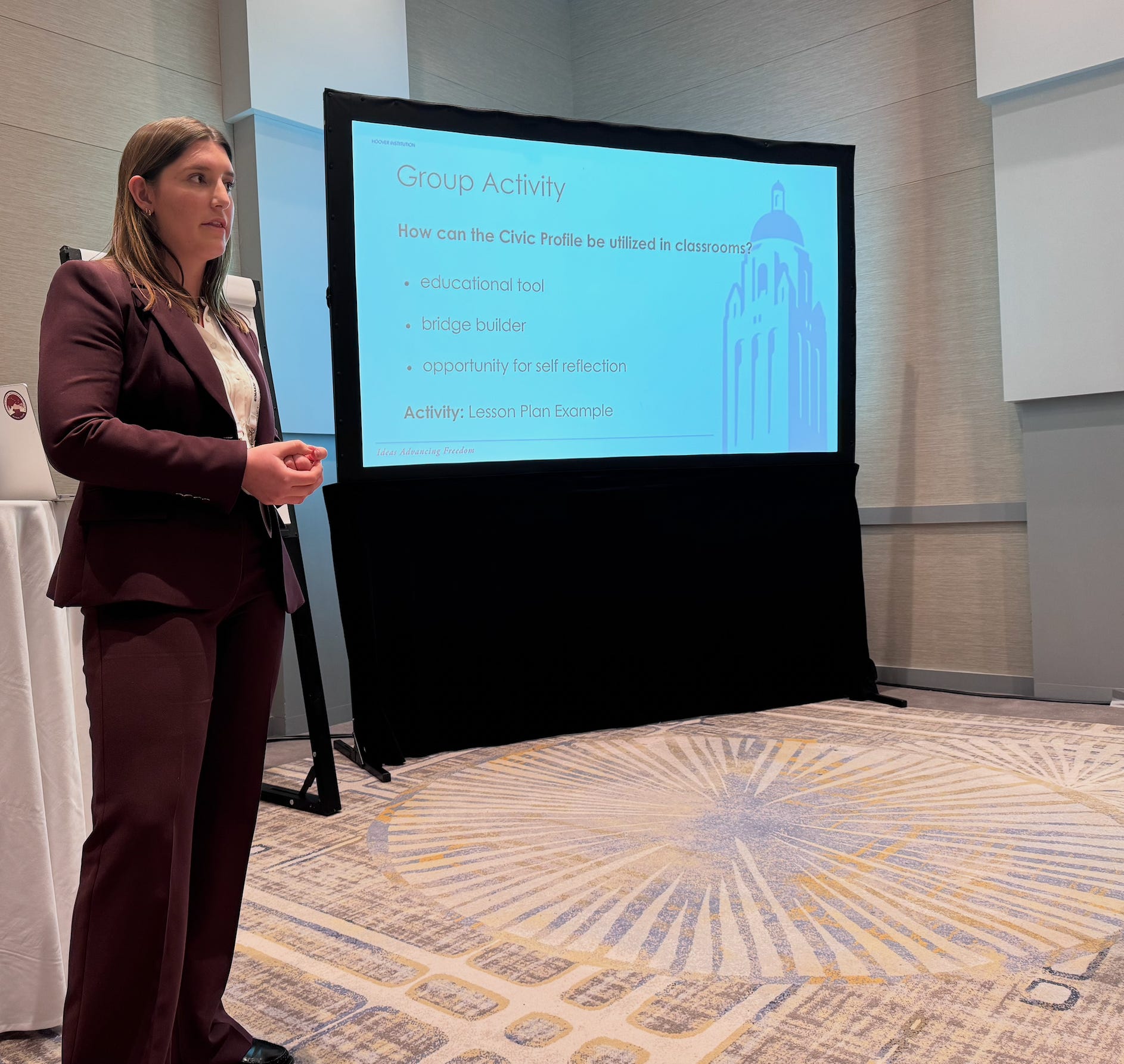
Civic engagement doesn’t just mean keeping up with current events and voting every few years, although I need to keep pushing myself to do that. It also means holding our government accountable and working to correct the flaws that we see in our immediate communities and beyond – something that feels particularly important to me, with a high score for “constructive patriotism” in my Civic Profile. It means connecting with our neighbors and engaging respectfully with those who hold different views — an example of being a “community builder,” from the engagement section of the Civic Profile.
Working on the Civic Profile, I have been constantly reminded that being engaged can also look like volunteering at a local food bank, being part of clubs on college campuses, or boycotting a specific brand for the way they make their clothing. It means, particularly for my fellow young people, struggling with the complicated reality that we inherited a deeply flawed system, but one that affords us something genuinely rare in human history: relative security, legal protection, and the freedom to dissent. It is up to us to ensure we move it closer to the ideals articulated in the Declaration.
Becoming involved in this project has broadened my perspective on civic engagement, and I hope it has made me a better citizen in the long run. But most importantly, this experience made me realize how important civic education is as a part of my education and college experience. If we don’t learn about the history of winning our rights to vote, or practice disagreeing respectfully in a class seminar, how will we exercise these skills in the real world? The Civic Profile opened my eyes to the plethora of civic identities and to the importance of civic education to help us each cultivate our own.
I encourage others—not just fellow college students—to try the Civic Profile themselves. Yes, take it in observance of America’s 250th birthday, but please take a bit more time to reflect not just on your own results but also on what it means to be engaged in keeping our “Great American Experiment” afloat. Each of us has a slightly different Civic Profile, a different set of interests, values, and principles. We don’t all have to participate in democracy in the same ways or for the same reasons, but we all owe it to each other – and to those who came before – to get out of our bubbles and do something.
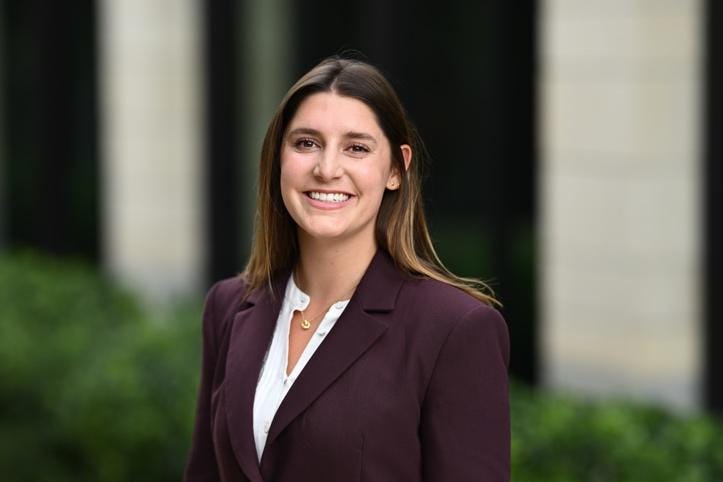
Eva Lacy (’27) is a rising senior at Stanford University studying Economics and Public Policy. She is passionate about strengthening our democratic institutions through increasing civic engagement and has furthered this passion through a Student Fellowship at Stanford’s Hoover Institution for the past two years. Outside of Stanford, she enjoys spending time outdoors, creating community events, and listening to live music.
Hello Eva, I read your article and took the test. Interesting! I did pretty good but I probably should be more engaged. I posted a series on Substack titled, A Tale of Two Generations, that compares my life graduating in the 60s with my great nephew who just graduated this year. You might be interested in reading it. It describes how and why times have changed, and not for the better, unfortunately. Good luck to you, Eva, we desperately need you young people to take the reins.