

Bad Politician: The Phrase I Hated — And Had to Reckon With
"Loyal opposition" always felt like a demand to submit. I had it wrong. So did everyone telling me to do it.

Some political phrases just make your chest tighten. For some people, it’s words like bipartisanship, family values, or progressive agenda.
For me, it’s “loyal opposition.”
So I’ll be honest: When Renovator founder Danielle Allen started publishing her series on the Loyal Opposition, it took me a week just to open the first post. My history with that term runs deep.
The word “loyal” is certainly part of the problem. It sounds like a command to submit — to make myself smaller for someone else’s comfort. If you’ve spent any time in the resistance, a call for loyalty to the country, the institution, the process, can feel like capitulation. Like being told to keep your voice down while the house is on fire.
That’s an earned response. But the problem is that my gut collapses two things my brain knows are different: The people currently in power and the institutions they occupy.
When you’re furious — and a lot of us are — that distinction is almost impossible to hold. The people in charge become the system itself. “Loyal” starts to sound like loyalty to them -- to the administration, to the outcome you’ve been fighting against.
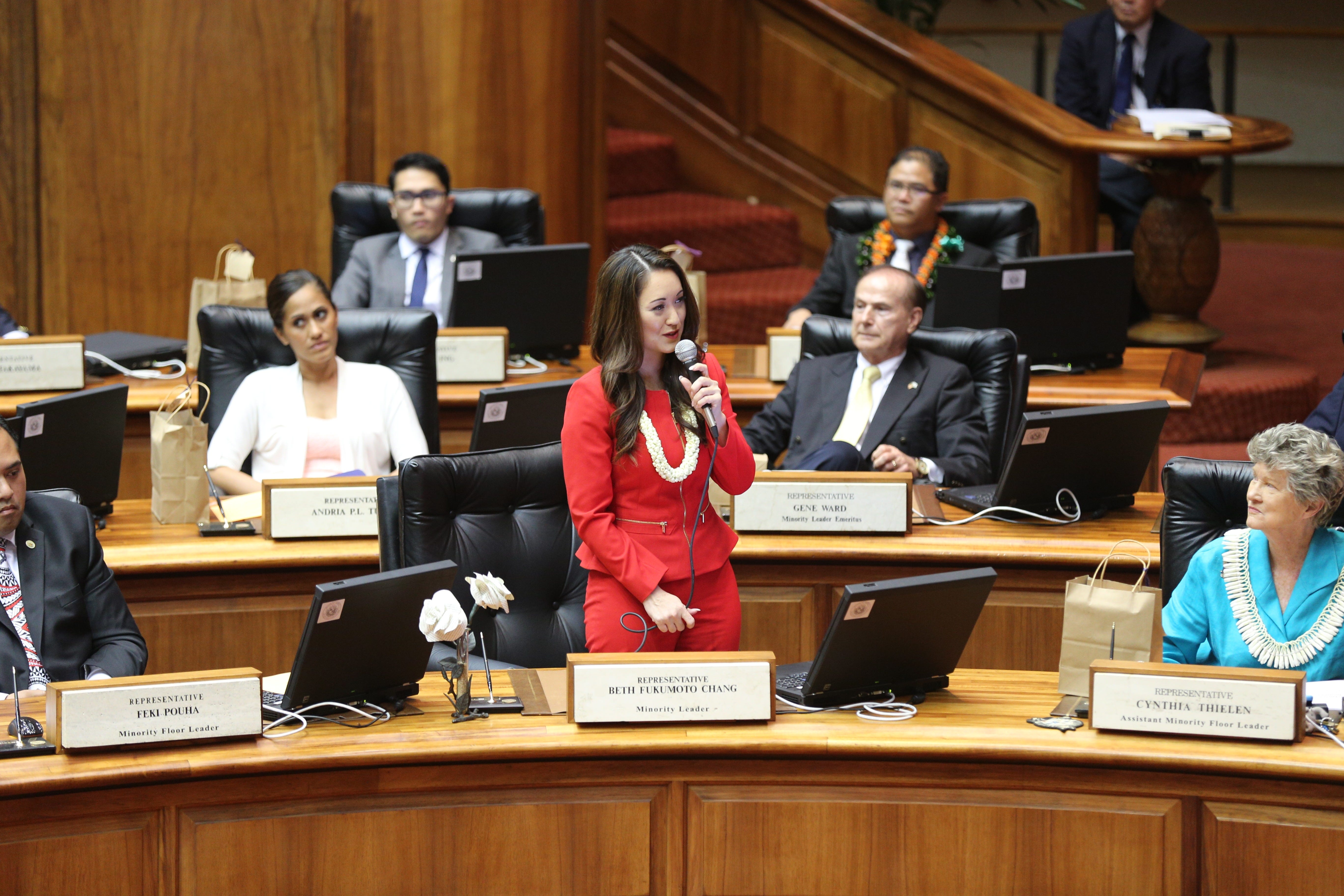
During my time as minority leader in the Hawaii Legislature, “loyal opposition” was what people said when they thought I was failing. It carried three meanings, none of them generous: Prove your loyalty to the party. Play the critic. And build contrast for the next election. We pretend these are aligned. Sometimes, they actually are. But in the worst moments, the first and third hijack the second, and “loyal opposition” becomes cover for something much smaller — simply being against the other side, all the time, no matter what.
I get why that’s tempting. I felt it before I was even elected. As a young staffer at the Capitol, I watched a committee chair kill bill after bill by crossing them off a list with a thick marker — no explanation, no debate, just power on display. It was grotesque but clarifying. It made me hungry for opposition. It made me want to run as a Republican in a supermajority Democratic state, to be the person standing up and saying, no, not like that.
What I didn’t understand was what happens when that hunger turns into a permanent posture. Working for the minority caucus, I kept running into the same wall: We’d attack a proposal, score points in the press, and offer nothing in return. Finally, I knocked on my boss’s door and asked: When we oppose something, why don’t we ever propose an alternative? What are we actually for?
He told me we didn’t have the time. And once I became a legislator, I saw what he meant — there was never time, and, honestly, most of our caucus didn’t care much about details. The real priority was contrast. You can tear down all day without ever proposing something workable. Tearing down is easy. Building is hard, slow, and risky — and it hands your opponents something to attack.
But it’s also hollow. And I think most people in political life know it’s hollow, even when they keep doing it.
That kind of opposition — reflexive, contentless, loyal only to your tribe — doesn’t require much from you except your anger and your willingness to perform it. What I’ve come to believe — and what Danielle’s been writing about -- is that the moment we’re in asks for something harder.
After finally sitting with Danielle’s work, I realized I’d had the phrase wrong. Not just in the way I’d applied it as minority leader, but wrong in both directions — me and the people making demands of me. None of us were actually doing what the phrase names.
Because the loyal opposition Danielle describes is not about finding common ground. It’s not a hug, or a truce, or an invitation to sand down your anger. It’s something narrower and, in some ways, more demanding than either resistance or compromise. It’s about linking arms with people you disagree with on almost everything to protect something essential that you share: the foundational rules that make it possible to disagree vehemently and still live together.
I know how that sounds. I’ve been in rooms that were supposed to feel hopeful and left enraged instead.
A few years ago, at a bipartisan leadership fellowship I’d been part of for years — one that really had been a lifeline, connecting me to colleagues across the aisle who became real friends — I sat through an evening panel on saving democracy. And then I watched those same people, minutes after the panel ended, lament the state of civil discourse.
It took everything I had not to stand up and shout, “Where the fuck were you six years ago?”
In 2017, when I finally confronted my own party over its backing of President Trump, many of the same people had gone quiet. Some sent me private texts saying I was right, then let me fall alone. How could they talk about saving democracy from Trump now when they didn’t lift a finger to stop him then?
But I resisted the urge to give voice to my anger. Because I want to protect the institutions we’ve built over the past 250 years, and if someone truly wants to join me in that work, it won’t help to slam the door in their face.
But I want to be honest about what that costs. It doesn’t feel noble, in the moment. It means swallowing something that deserves to come out. It’s staying in the seat when every instinct says leave.
That’s the lived, physical experience of cross-partisan anything. And it’s exactly why the loyal opposition is so hard to build — because it requires you to sit with that discomfort.
Discomfort, though, doesn’t prove that the idea of a loyal opposition is wrong. Consider it an indication that you’re doing the harder thing: separating your anger at the people in power from your commitment and -- dare I say -- loyalty to the institutions that are supposed to constrain power.
At an even more basic level, it’s putting the desire to strengthen and protect our democratic institutions above the very human pull toward sameness, comfort, belonging, and, yes, revenge.
And that’s necessary because — there will be an after.
There are governments built on the premise that you can eliminate your opponents. Democracy is not one of them. Whatever we’re resisting right now, the people we’re resisting alongside or against will still be here when it’s over. If the rules hold, we’re still going to have to share this country, which means the opposition has to stand for something, not only against something. Otherwise, we’re just a demolition crew.
Democracy needs opposition. But it doesn’t need opposition that’s loyal to a party above all else. It needs opposition that’s loyal to the rules — so the winners can’t turn government into a weapon, and the losers don’t decide the whole system is illegitimate. Right now, it needs an opposition that can demonstrate what government is supposed to be.
Truth be told, I know I would get more immediate satisfaction from tearing things down — on my own and with my own tribe. I am tired of reaching across the aisle. The aisle has been a very dangerous place for many of us.
But I also know that if anyone, anywhere, wants to check executive power, protect basic human rights, and build a better path forward for our country, I’ll join them. Even if those same people go right back to arguing with me about health care and education. Even if they still stand on the other side from me in the next election.
And maybe that means I am a part of the loyal opposition after all.
Bad Politician: When Not Giving the Speech They Wanted Changed Everything

The beginning of the end of my time as a Republican arrived in a bright ballroom at the Filipino Community Center in Waipahu, Hawaii. It was August 2016, at our state’s party convention, and I was the youngest female party leader of any state legislature in the country. For months I had been navigating my colleagues’ embrace of then-candidate Donald Tru…
Very well said. The spirit of loyalty (to particular principles and people) as well as the spirit of opposition (to other people or to pernicious practices) are well-illustrated in the laudable illustrations here of reconciliation and compromise.
Also well-illustrated is the danger inherent in choosing an established symbol like the expression “loyal opposition.” Sometimes, we have very good and very powerful reasons to strive to overcome negative perceptions of symbols. That is true, e.g., of the Declaration of Independence and the people who handed it down to us. Other times, however, there is no good reason to choose a symbol that seems new to us but which already is burdened with a deeply-entrenched negative history. The expressions “loyal” and “opposition” and “loyal opposition” already are burdened with history that powerfully weighs them down. They already symbolize in the minds of many certain ideas or concepts for which the Renovator doesn’t stand. The Renovator choosing a symbol like “loyal opposition” is like choosing to compete in a race with a drag chute already deployed.
The symbols “renovator” and “renovation” already are much better than any symbol that uses the words “loyal” or “opposition.” Renovation is consistent with and reminiscent of our Declaration of 1776 and our Constitution of 1788.
To the founders, our Declaration was the renovation of the best principles of the (unwritten) British Constitution. Our Constitution was then a renovation of the text and spirit of our Declaration. The foregoing were the most powerful messages of Bernard Bailyn his book “Ideological Origins of the American Revolution.” The latter renovation (our Constitution as a renovation of the spirit of our Declaration) was even more clearly and directly the message of Gordon Wood in his concise, enlightening and powerful book “Power and Liberty: Constitutionalism in the American Revolution.”
Our Constitution’s improvements also are the product of renovation. Their text reveals the revolutions of a planet-like body rotating and revolving around the sun. Our Constitution was “ordained and established” by “the People” to “secure the Blessings of Liberty to ourselves and our Posterity.” The idea was that “the People” would secure the blessings of liberty by continuously working toward “a more perfect Union” and continuously striving to better “establish Justice.” The first 10 amendments, the Reconstruction Amendments, the 17th Amendment, the 19th Amendment, the 24th Amendment and the 26th Amendment were moments when we did so. They highlight when we faced the sun. Renovators and renovation already are much better symbols the words “loyal” or “opposition.”
I understand loyal opposition to mean loyal to the country but contesting its government or government policies. My Native American friends, when asked, would say, "We love the country but can't stand the government." Their love is reflected in high military service numbers despite long mistreatment and neglect. I am not a Native American, but with two bronze stars and other awards followed by four years of government civil service, I continue to love the country and demonstrate that love and loyalty by seeking to improve the government and the welfare of all its inhabitants, a necessary and unceasing endeavor.