

Are We Ready for a New Voting Rights Movement?
An Estimated 1 out of 4 American Voters Is Structurally Disenfranchised

The recent Supreme Court decision in Louisiana v. Callais has prompted renewed debate about voting rights. The crisis is even worse than people realize — and it doesn’t stem just from Callais.
By a constitutional and functional definition of full enfranchisement — one that requires every voter to have access to a meaningful election without compelled partisan affiliation — only a small minority of states fully protect voting rights. Under this framework, as many as a quarter of Americans face structural disenfranchisement.
An analysis based on U.S. congressional and state elections has brought me to the startling conclusion that Americans are fully enfranchised in only 12 states. These are states where all voting-age citizens, regardless of party status, have the opportunity to place a vote in the decisive elections in their state — regardless of whether that is the primary or general election — and also can do that on the basis of free association with the party of their choice, not compelled association. This means that we have only partial enfranchisement of Americans in the other 38 states.
Where are all voters fully enfranchised? There are three categories of states: (1) in states with all-party primaries, where all voters get all the choices on their ballots for every election; (2) in states with open primaries and competitive general elections, where everyone has a vote in a decisive general election, regardless of party affiliation; and (3) in states with closed primaries but competitive general elections, where everyone has a vote in a decisive general election, regardless of party affiliation. In none of these states is any voter forced into “compelled association” with a specific party to cast a meaningful vote. They can and do choose parties, but those choices are truly choices of free association. These are the states in the top row in the chart below.
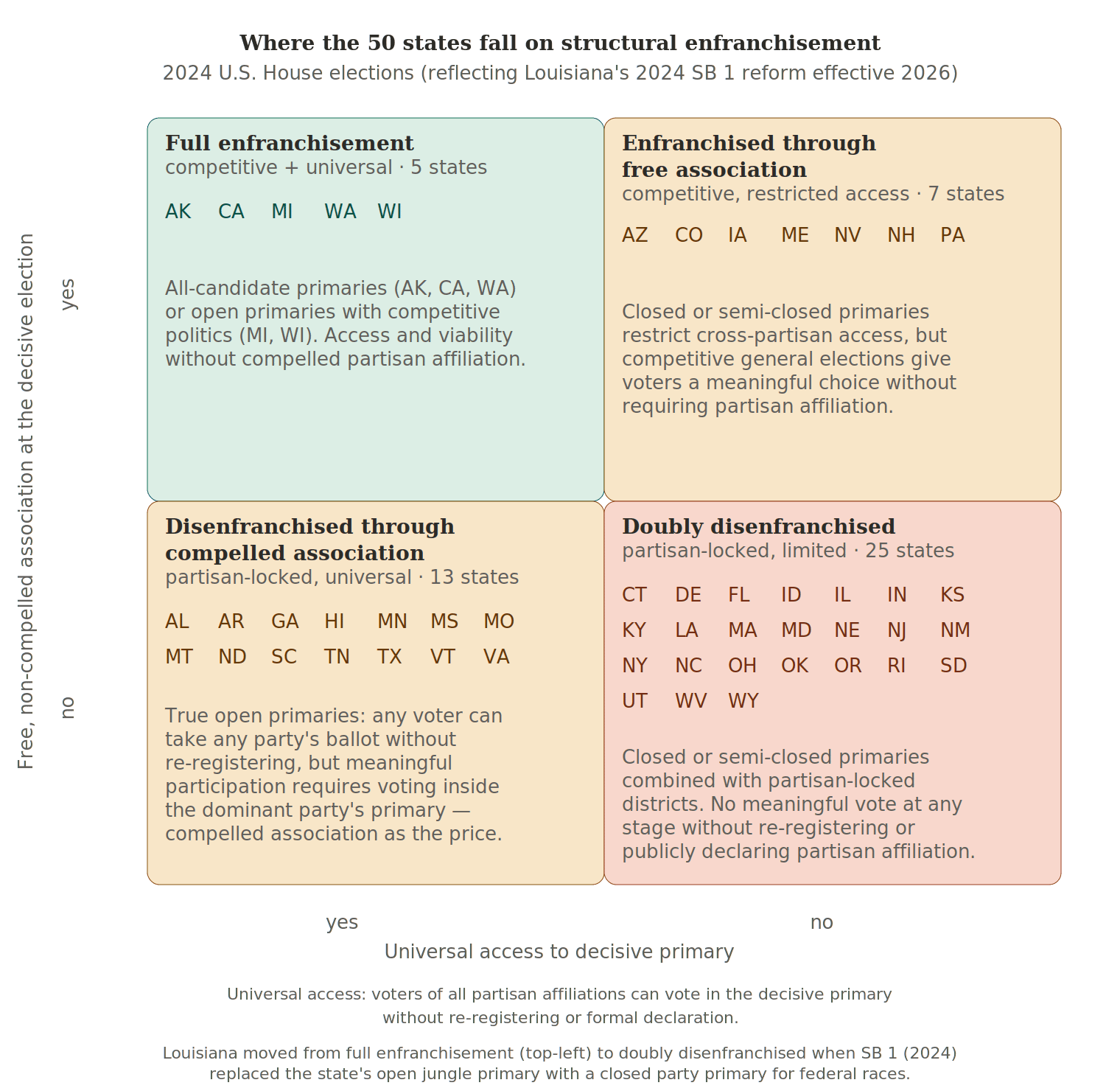
The states in the bottom row, where enfranchisement is only partial, face two problems. They are states largely without competitive general elections, whether because of gerrymandering or demography. In the absence of competitive general elections, voters can access a meaningful vote only through the dominant party’s primaries. In one set of states, voters do not need to pre-register or permanently register with the party to vote in the primary. Such voters have “universal access” to that primary. In other states, voters must be pre-registered with a party and/or temporarily choose party affiliation. In both sets of states, the price of a meaningful vote is affiliation with a party that some voters will not endorse. Voters who do not endorse the dominant party may have access to a meaningful vote (especially in states that grant universal access to party primaries), but only at the cost of compelled association, which raises concerns as a potential violation of the constitutional right to free association.
The First Amendment protects against state-coerced expressive identification. A series of cases, including Abood v. Detroit Board of Education (1977) and Janus v. AFSCME (2018), built on the First Amendment to rule that freedom of association implies a corresponding freedom not to associate. Can voters be called enfranchised if their only path to a meaningful vote is through compelled association in state-funded party primaries? We might ask the same thing about candidates. Can citizens be considered free to run if their only substantively meaningful path to the ballot is through compelled association?
In Janus, the court held that public employees can’t be forced to subsidize union speech they don’t endorse. I would argue that it should similarly hold that voters should not be forced to affiliate with parties they don’t endorse in order to access meaningful electoral participation. Of course, no one is forcing people to go to the polls to vote in the primary of a party they don’t endorse. But when states structure elections so that meaningful participation is conditional on partisan affiliation, a constitutional question arises: Has the state organized the electoral system to require compelled association as the price of a meaningful vote?
If we count up the voters in congressional elections in states in the bottom row of the chart who either voted for the non-dominant party and did not have a meaningful vote or else associated against their preferences and affiliated with the dominant party in order to vote in the meaningful election, a rough estimate suggests some 60 million Americans are routinely in the position of either casting an ineffectual ballot or accepting a partisan identity they don’t endorse. (Forty-seven million minority-party voters in the relevant states plus about 12 to 18 million estimated compelled-association voters.) This is roughly a quarter of American voters. Call this problem structural disenfranchisement.
This problem has grown over time, as the accidental consequence of Progressive-era decisions to convert party primaries from private associational convenings to state-administered and largely state-funded elections. The current gerrymandering wars are accelerating a pattern of disenfranchisement that has been building for the past four decades. We are not the only electoral system in history that has seen shrinking access to the franchise over time. In 18th century Britain, the share of the population with meaningful electoral voice declined over the century. We are experiencing a similar dynamic now.
This problem also bites in ways that connect to racial disenfranchisement. Louisiana recently transitioned away from a “jungle primary,” in which all voters had access to a primary ballot with all the choices, to a closed party primary, locking out Democrats from participating in the current contested Senate election. This means that the roughly 9 out of 10 Black voters in Louisiana who vote Democratic were structurally disenfranchised from the meaningful decision in the current Senate election. While they retain the right to vote in the general election, that vote will be in a non-competitive, non-consequential election. In other words, about 600,000 Black voters in Louisiana who had a meaningful vote in the last U.S. Senate election do not have one this year, or at least not without being compelled to change their party affiliation.
The comparative politics literature provides substantial evidence that the smaller the electorate and the less competitive the elections, the greater the corruption and the less responsive governance institutions are to the needs of the general population. Structural disenfranchisement of 25 percent of American voters is a major degrader of American democracy. We can be sure we will not have the quality of governance we all crave while one out of four of us is structurally disenfranchised.
In other words, we have a major voting rights crisis on our hands that extends even beyond the challenges introduced by Callais. It is time for us to reckon with the need to re-enfranchise 25 percent of the American electorate.
How can that be done?
Here is where the power of the analysis of structural disenfranchisement really comes into play. The reform movement swirls with debate about whether independent redistricting, semi-open or open primaries, or all-party primaries are the right way to go. The short answer is that it depends on context. Where underlying demographics would yield competitive elections in the absence of gerrymandering, then independent redistricting linked to open or semi-open primaries is the necessary step to re-enfranchise voters. Where states already have open or semi-open primaries and the necessary underlying demographics, they could take the single step of independent redistricting to achieve the necessary change. On the other hand, where underlying demographics would not yield competitive elections even with neutral districting, for instance in Wyoming and Massachusetts, then the only option is the all-party primary.
Of course, even if we know what reform would most efficiently re-enfranchise voters in each state, that does not mean those reforms are politically feasible. Please see the chart below for how the reform pathways apply to each state and an assessment of political feasibility. Fourteen states have institutional pathways through which reform could be enacted (typically through ballot initiatives), while 24 states do not. This brings our problem into crystal clear relief.
In states with initiative processes, the all-candidate primary is the strongest single reform and is achievable. In states without initiative processes, the all-candidate primary remains structurally necessary but is also politically blocked. For those states, what can we do to re-enfranchise voters whose Constitutional rights are going unprotected? Renovation will require federal-level intervention (currently absent), state or federal constitutional litigation (an uncertain path), or long-term electoral change (a slow journey).
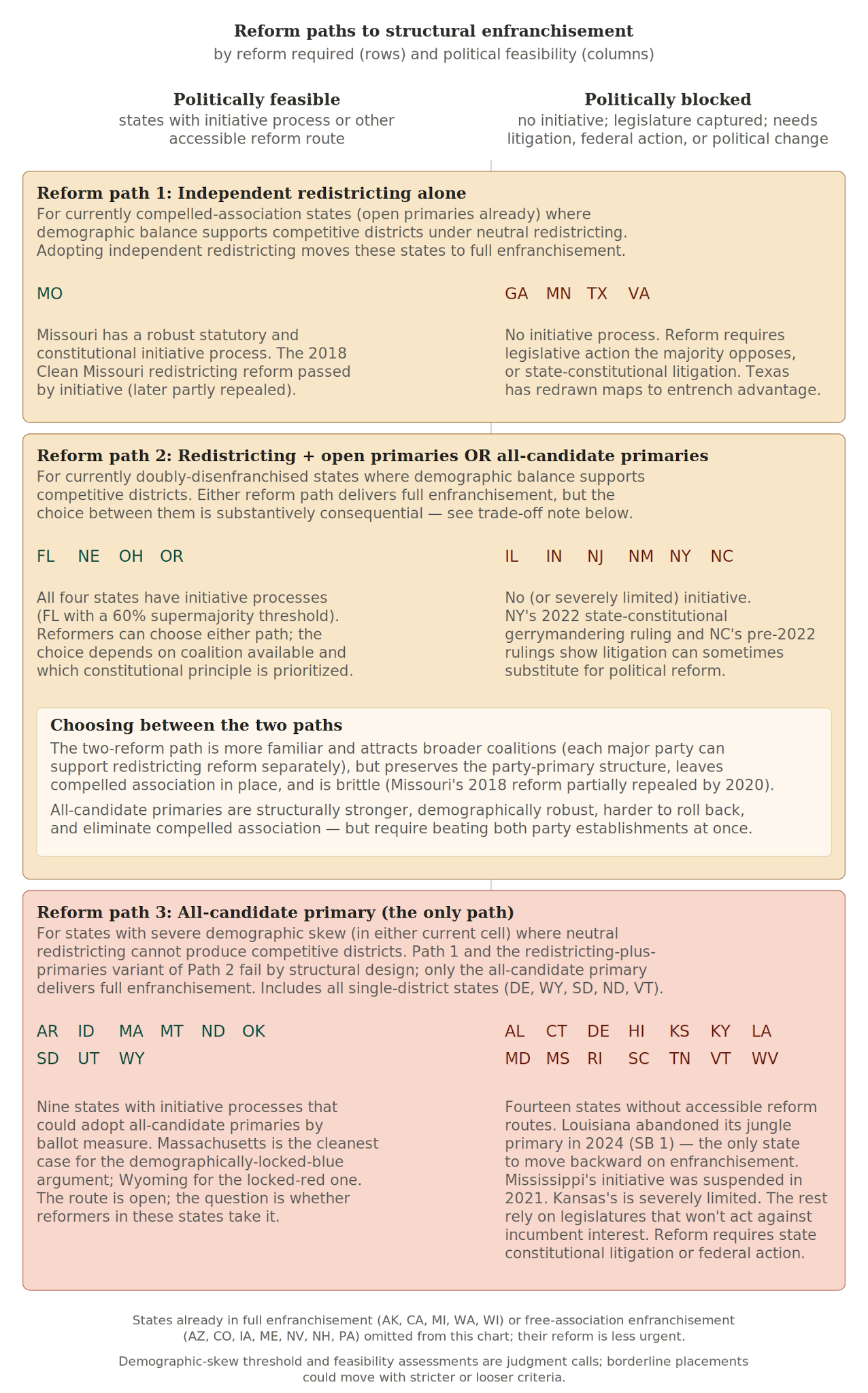
To open pathways to renovation in blocked states, we will need new political coalitions as well as fresh legal arguments to bring challenges. Here are some ideas.
First, on the litigation path:
A compelled-association challenge to closed primaries in safe-district states. Advocates could develop new arguments that conditioning meaningful electoral participation on partisan affiliation violates post-Janus principles. While this is an untested legal strategy, it merits exploration.
A right-to-run challenge. A case might be made under Bullock v. Carter (1972) and related cases that gerrymandered safe districts foreclose viable candidacies, violating the candidate-side of the right to participate in elections.
A Voting Rights Act/structural-enfranchisement intersection. The Louisiana fact pattern (a Black electorate that is 90 percent Democratic, new closed Republican-decisive primaries in safe Republican districts) might potentially anchor a hybrid VRA/compelled-association argument.
And on the federal legislation path, we might pursue the Beyer-Raskin Fair Representation Act, which achieves proportional representation via multi-member districts and ranked-choice voting. While the sponsors have been proposing this for several sessions running, its moment may have arrived.
Along any of these paths, I believe that to concentrate our attention and intensify our energies, we should focus on our urgent crisis of disenfranchisement.
We need to re-enfranchise the 60 million American voters who no longer have a meaningful vote. Are we ready for a new Voting Rights movement?
Note: Charts were created with assistance from Claude. While I have fact-checked them, I may have missed something; I have also made some judgment calls about how competitive states are, and I welcome challenges, corrections, and improvements to my categorizations. Also, to be clear, the number of American voters experiencing compelled association presented above is a very rough estimate based on scholarly data about voters who move across party lines in their voting behavior. I welcome further review and evaluation of that estimate.
Cryptographic voter ID and constitutionally mandated ranked choice voting for all!
Love this, Danielle! But I think you left DC out entirely. We're doubly disenfranchised ... frankly, triply or quadruply-- since we have no Senators and our one elected Delegate can't vote on the House Floor. (DC voters actually passed a referendum approving semi-open primaries, but our DC Council -- including one of my opponents for the Delegate seat -- voted not to fund it. So much hypocrisy.) In any case, add us to your bottom right quadrant -- or make a special, lower layer of the chart just for us ...