


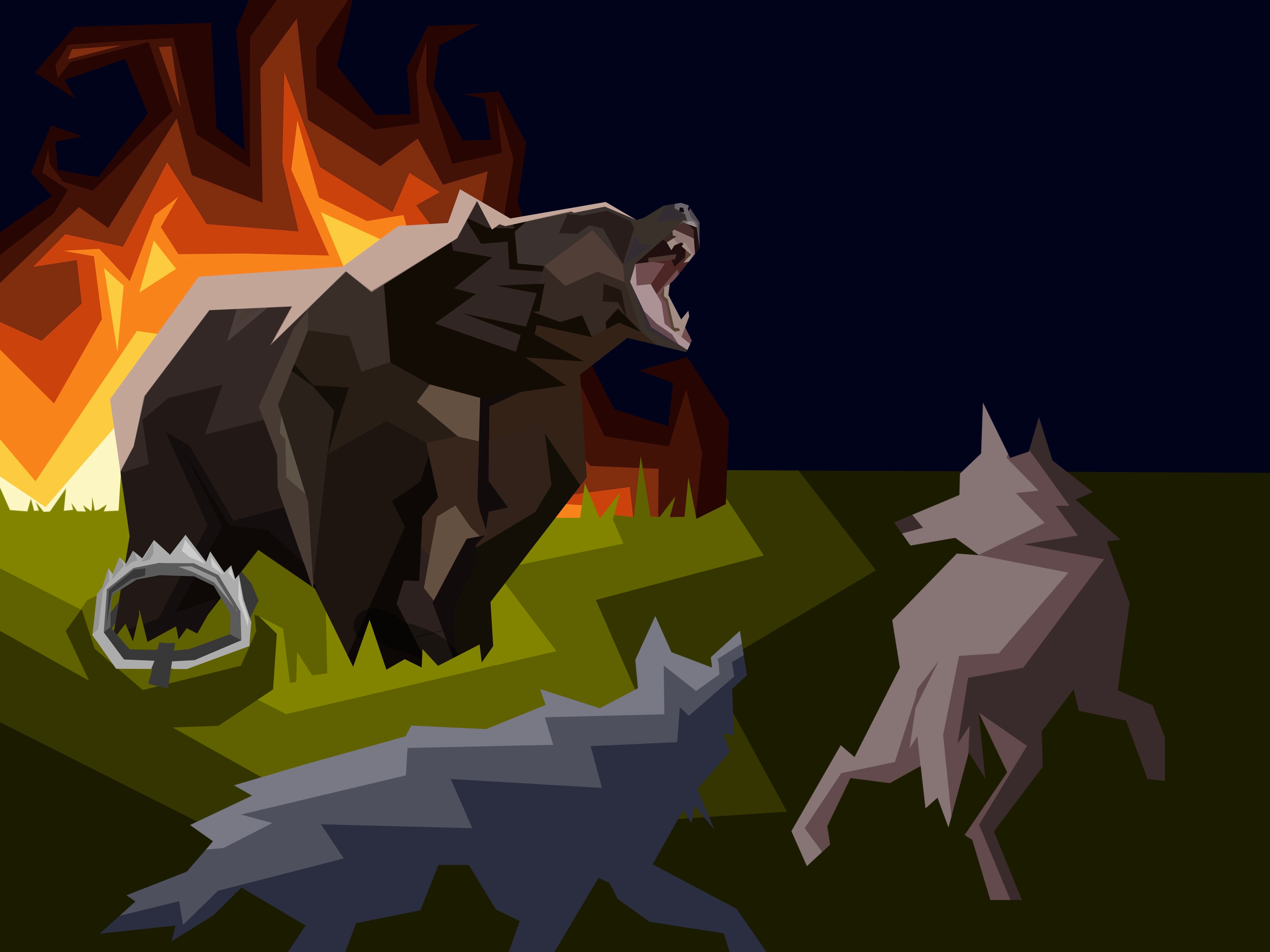
A good way to understand our current predicament as Americans is to imagine that we are a bear in the woods being attacked by hungry wolves. And our paw is caught in a trap. And a furnace of a wildfire is raging our way.
The wolves are politicians. Some are gray, some are black, but wolves are wolves. We are all of us, together, that bear. It doesn’t matter what side of America’s yawning political divide you stand on. Both sides feel like they’re being attacked by wolves.
And so we are driven to close ranks. As of July, Gallup tells us, a gob-smacking 93 percent of Republicans approve of the job that President Donald Trump is doing. Just 4 percent of Democrats do. Such a historically wide gulf tells us that each side fears it will get torn apart whenever the other side is in charge.
One side feels the shredding of safety nets, federal programs, and commitments to inclusion and honest history. The other side feels the destruction of traditional family mores, religion, and parental control.
Every two years, Americans spend an average of about $15 billion on campaign advertising trying to fend off the wolves attacking them. But we just end up changing which wolves are briefly ascendant.
Meanwhile, flames are bearing down on us from the edge of the forest. The wildfire is global economic turbulence fueled by, first, globalization (and now de-globalization) and, second, technological transformation. Both of these are also fueling climate change and historically unprecedented levels of human migration, which in turn sparks cultural destabilization in societies around the globe. Not to mention how economic turbulence shows up at home: our nationwide housing crisis.
Maybe we could fend off those wolves once and for all and also do something about the flames — if we could just get our foot out of that dang trap.
But what’s the trap?
The trap is an election system that has been captured by party processes gone wrong. We’ve had decades of changes — some of them well-intentioned, some about accruing power — to how our political parties operate. They have left us in a place where most members of Congress are elected by only 5 to 8 percent of the electorate in their districts. The combination of gerrymandering and low-turnout primaries means that as long as a candidate appeals to the most intense and active members of their partisan base, they can sail into office. After that, the incumbency advantage insulates them ever more.
Our members of Congress don’t work for us. They don’t work for the bulk of Americans — most of whom, these days, are independent, not registered in a party. They work for that 5 to 8 percent sliver of partisans. Their incentive is always to keep their base happy. And so they have little reason to make deals that would compromise the ideological positions for which they were elected.
Presto. You’ve got a Congress so split along ideological lines that only very rarely can it get any legislation past the Senate filibuster. And what does a dysfunctional Congress give you? A power vacuum. Also, a frustrated, anxious public. We do, after all, have problems that need attention. Remember that wildfire?
What happens when Congress stops legislating and leaves a power vacuum? Well, the executive will fill it.
Since FDR, over the course of the 20th century, the power of the president has only grown, but that growth accelerated with our last two presidents. Joe Biden leaned into the covid emergency to cancel student loans, require covid vaccinations, and extend a ban on apartment evictions, which Chris DeMuth has written well about.
Now, thanks to Project 2025, a theory of a unitary executive on steroids, and an assist from the Supreme Court’s presidential immunity decision, we have a president who is governing by executive order to an unprecedented degree. Now some of the wolves are acting like wolves not just because they’re out for themselves but to do the bidding of an overgrown presidency.
Back in England in the 1760s and 1770s, the complaint in London was that Parliament had lost legislative supremacy. That is why people began to call King George III a tyrant.
The U.S. Congress has lost legislative supremacy.
The American people, together, are strong as a bear. Stronger than all the wolves, faster than wildfire. But we are caught in a trap. The trap we’re in is that our national legislature no longer works for the American people as a whole.
Now, if you’re a bear in the woods, being attacked by wolves, with your paw in a trap, and a wildfire is bearing down on you, what would you do? Or ask it this way: if you were Tom Cruise in Mission Impossible and your character had become a bear in the woods, being attacked by wolves, with your foot in a trap…..etc. etc., what would you do?
You’d take a few wolf bites and concentrate with all your might on getting your foot out of the dang trap.
But what are we actually doing?
Pouring $15 billion into wolf defense, over and over, every time an election comes around.
Do you want to pay for wolf defense forever? Do you want to just swap which wolves lead the pack every two years? Wouldn’t the better way to solve our problems, the first step to beating back the wolves once and for all, be to get our foot out of that trap? Are you wondering how we could do that?
Stay tuned …
Allen Column: A Bear in a Trap, Part 2

We last left our bear under attack by wolves in the woods, with a wildfire fast approaching, and its paw snared in a nasty trap. Let’s now take a closer look at that trap, which has been created by the fact that our political institutions are controlled by two exceptionally unhealthy parties. The trap is cutting deeper with every passing day, especially…
Thomas Jefferson definitely agreed with the view of people who have power as being wolves. Jefferson even highlighted how people with power are worse than wolves because "man is the only animal which devours his own kind."
Jefferson's words are well worth bearing in mind when we think about how our Constitution was written and ratified to prevent abuses of power such as we are seeing today. The people of the founding generations (including those who wrote or ratified our Constitution and Bill of Rights) did not trust people with power. They did not trust even each other. As Jefferson shows, many knew better than to trust even themselves. That is why, Jefferson emphasized, the First Amendment expressly secures "the freedom of speech" and "press." That freedom (flowing from the sovereignty of the people) necessarily includes the power to vote and to criticize any public servant's public service.
"The people are the only censors of their governors: and even their errors will tend to keep [public servants] to the true principles of their institution. To punish these errors too severely would be to suppress the only safeguard of the public liberty. The way to prevent these irregular interpositions of the people is to give them full information of their affairs thro' the channel of the public papers, and to contrive that those papers should penetrate the whole mass of the people."
The most important principle in our Constitution and in state constitutions is that "[t]he basis of our governments" is "the opinion" (consent (i.e., speech, including votes)) "of the people," so "the very first object" all public servants "should be to keep that right; and were it left to me to decide whether we should have a government without newspapers, or newspapers without a government, I should not hesitate a moment to prefer the latter."
The truth about people in power is that "under pretence of governing" many public officials "have divided" people "into two classes, wolves and sheep. I do not exaggerate. This is a true picture[, for example,] of Europe. Cherish therefore the spirit of our people, and keep alive their attention. Do not be too severe upon their errors, but reclaim them by enlightening them. If once [the people] become inattentive to the public affairs, you and I, and Congress, and Assemblies, judges and governors shall all become wolves. It seems to be the law of our general nature, in spite of individual exceptions; and experience declares that man is the only animal which devours his own kind, for I can apply no milder term to [some so-called] governments [ ], and to the general prey of the rich on the poor."