

A Wake-Up Call For Those Who Want to Reach the Nation’s Future Inheritors
America’s 250th birthday is an opportunity to engage Gen Z, and we can’t afford to miss it.
If you’re 22 years old today, you’re becoming a voter, taxpayer, neighbor and consumer in a complex moment. Your entry into adult citizenship took place in the era of TikTok and ChatGPT, in the wake of the invasion of Ukraine and the murder of George Floyd, amid inflation, mass shootings, the January 6 insurrection and the second impeachment of a sitting president. In this post-truth world, you get almost 200 notifications every day and see disinformation online every week.
As the United States approaches its 250th birthday in 2026, the fate of American democracy lies in the hands of a generation that has grown up with political dysfunction, culture wars, and existential threats. Though Gen Z exhibits notably low levels of pride in being American, they have already taken up the mantle of engaged citizenship, ushering in a reckoning around race, climate, and work, and disrupting institutions from Wall Street to Monument Ave. They will soon out-earn and out-vote older generations.
Gen Z isn’t going to let democracy die. But do they have the tools to save it?
Institutions that care about civic engagement, including business, media and government, have met this generational tidal wave with a focus on their own concerns: how Gen Z will change the workforce, where they spend money and time, whether they share long-held American values, and whether they’re doing their “civic duty” as institutions define it (are they informed, are they voting, etc.).
While these measures are important, they don’t go far enough to incorporate the daily concerns of Gen Z. As a result, there is a disconnect between younger generations’ approach to shaping the country’s future and how institutions are equipping them to do so (or not). We’re measuring civic readiness — the knowledge, skills and ability to engage in civic activities — far more than civic opportunities, the conditions that drive such engagement. Our hundreds of experiments over the last six years at Made By Us have convinced us that opportunity matters most — and that it’s much more important to focus on what precedes a civic act, shoring up the reasons and promise of why someone might care about voting in the first place.
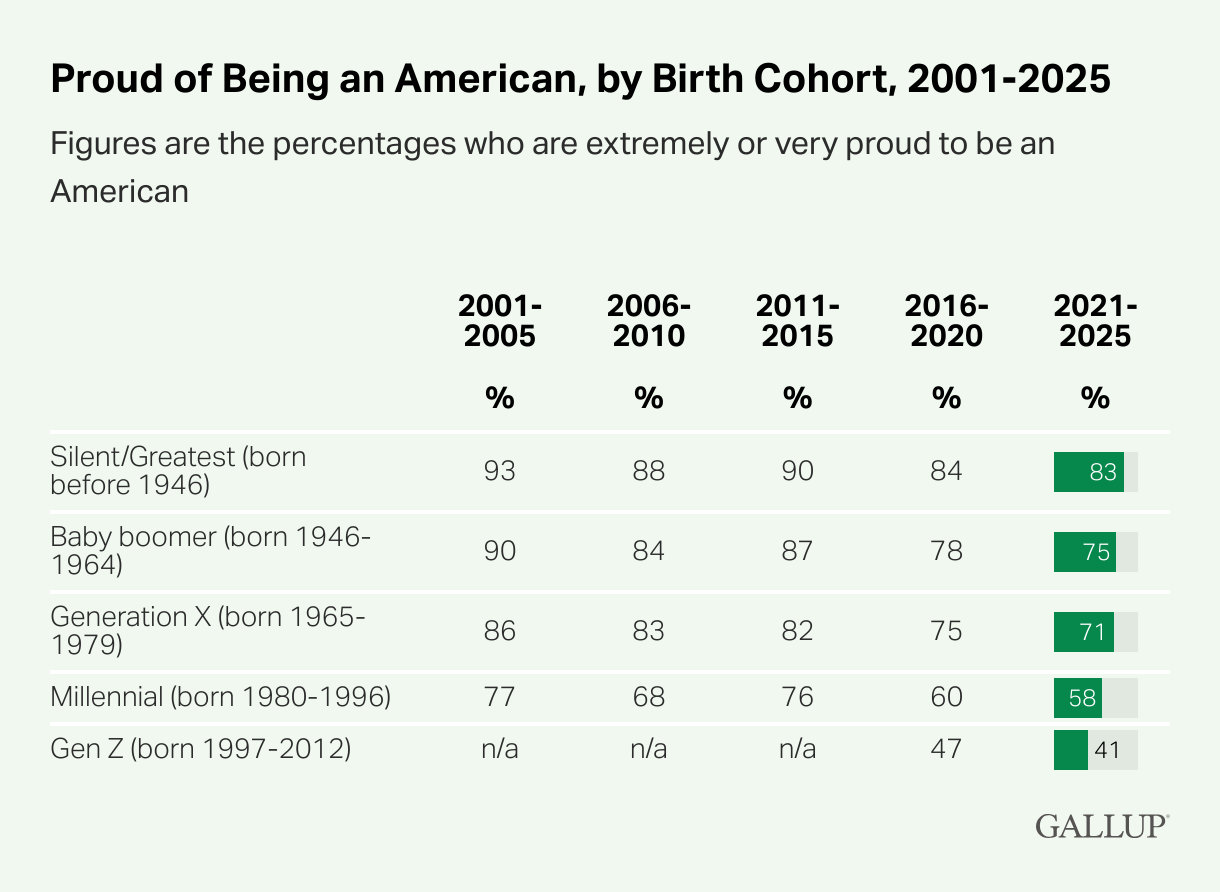
New interventions are needed to foster meaningful connections between younger generations and their role in their country. If we stick with business as usual, the disconnect will only grow.
As we begin the semiquincentennial year of 2026 — a huge opportunity to establish active citizenship in younger generations — we need institutions to take big steps toward young people to close the gap. What if we prioritized the concerns of Gen Z, redefined civic duty, and created avenues for young people to take charge — on their terms?
You can build it…but will they come?
In 2019, a group of history museum directors came together with a challenge: how might we empower Gen Z to shape America’s future with the context of history?
The answer was Made By Us, a collaborative project pooling knowledge, resources and expertise across cultural institutions to do together what no single organization could do alone. People in the 18–30 age range have the most at stake in a flailing democracy and the most to gain from high-quality civics and history education. But getting credible information into their hands requires constant iteration, coordination and capacity, because the currency of youth culture is always changing
We decided to try something different: Meeting young people where they are, bringing history to backyards, barstools and the ballot. We needed new ways to measure our progress, too. The question arose: if we’re using approaches not often seen in this field – personality quizzes instead of classroom assessment, pizza parties instead of symposia – how will we know if we’re successful?
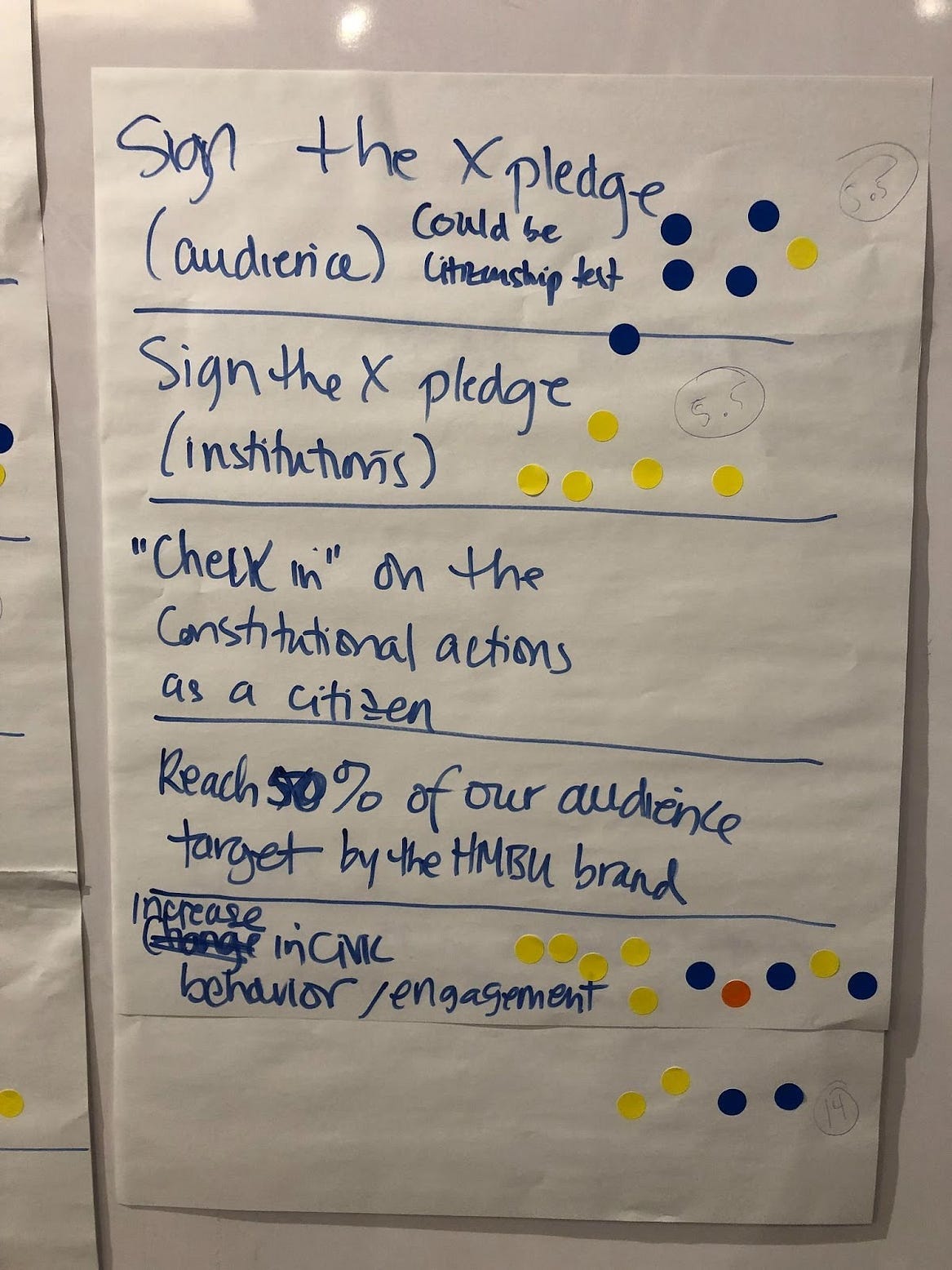
In an early workshop, hands went up around the room to advocate for new indicators: How about voting? (Not an everyday behavior and only addresses participation, not knowledge or motivation.) Should we administer a nationwide citizenship test? (This tackles knowledge, but not practice.)
Such metrics put the onus on the end user, assessing a 22-year-old’s competence rather than the ecosystem and circumstances around them. Does it matter if a 22-year-old can name the three branches of government if they don’t believe those branches are effective? If the top reason a young person doesn’t vote is because they don’t like the candidates, then the relentless drumbeat to increase voter registration and turnout appears to mishear the real need and only focus on winning an election, not improve civic participation.
Our rigorous audience-centered approach reminds us that there’s a reason the most innovative companies relentlessly focus on desirability first, before feasibility and viability. If you’re not meeting a real need, it doesn’t matter how great or important your offering is.
Does it matter if a 22-year-old can name the three branches of government if they don’t believe those branches are effective?
Civics and history are some of the last frontiers for audience-centered design.
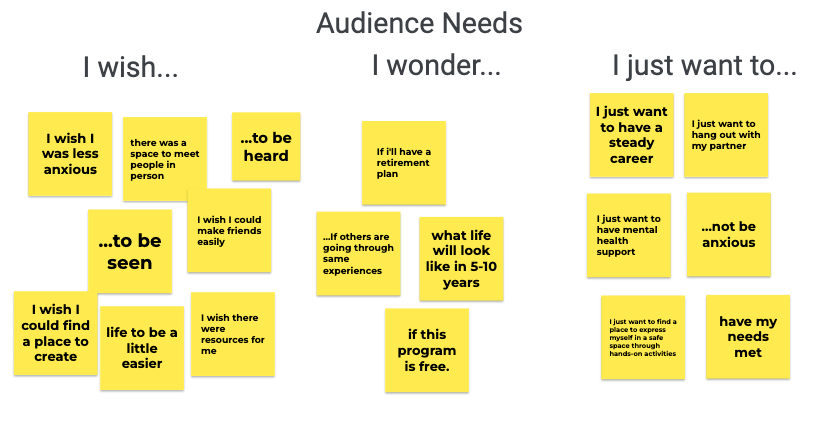
This process often starts with listening — sometimes our key differentiator at Made By Us has simply been what Malcolm Gladwell called “coolhunting,” looking around at what people are doing, saying, and consuming. You begin to understand what a user wants, their limitations and their preconceptions about what you offer. In addition to real needs like well-being, entertainment, economic security, rest, and socializing, our Gen Z fellows say the aesthetic and delivery of information is important, also; too many civics efforts look like school, are too “eat your vegetables,” or fail to utilize powerful message carriers like brands, influencers and social media.
We’ve taken this approach with many of our museum partners, with museum programming that emulates what young people are already doing elsewhere: festivals, pizza parties, Twitch streaming, book clubs, bike tours, yoga, dinner parties, no-phone zones and job fairs. We developed the Gen Z Scorecard to measure these kinds of investments by institutions in reaching youth, so that end-user measures like knowledge or participation don’t stand alone without the context of how much effort institutions have put into operating on youth terms and meeting their needs. 450 organizations have taken the Scorecard in the last year.
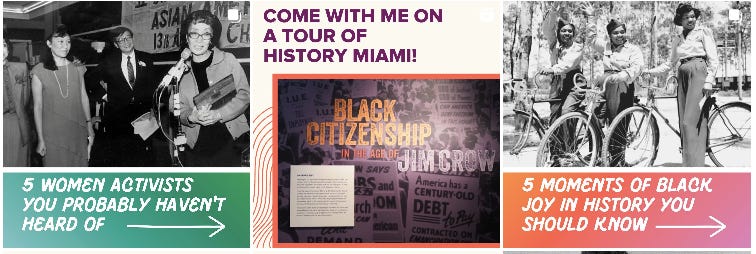
Language and context matter. When we asked our youth community to choose their favorite Civic Season events, they consistently picked events and activities with clear, simple titles: pizza parties, Experience a Lunch Counter Sit-In, Community Bike Ride. They wanted to know what they would be doing, who it was for, and what they’d get out of it. Program names like “Truth, Justice and Transformation, “Voices of the Past” or even “American Democracy” weren’t clear.
The Gen Z Scorecard illuminated another key gap: while organizations were often focused on serving young people, and sometimes even offered trainee roles like internships or fellowships where they can learn the ropes, they rarely if ever put a young person into a position where they could influence decisions. This mirrors, in spirit, the difference between teaching how our government works and asking whether it does or not. And this is a major blind spot in how we design, because the best way to do effective “coolhunting” is to ask your target user their opinion – and listen to the answer.
But when we suggested this back in 2023, with the 250th on the horizon, we encountered a consistent response from organizations: “We don’t really know any young people to ask.”
In response, we got to work building a first-of-its-kind national Youth250 Bureau, composed of 100 young adults that receive training and compensation in exchange for providing free advice to organizations looking to commemorate the 250th. We think of it like a Gen Z Hotline, unleashing 10,000 hours of youth input to better hit the mark on this incredible opportunity. In the last year, the Bureau has weighed in on everything from early-stage ideas to final marketing touches, from major national projects like Ken Burns’ American Revolution and the National Archives’ 100 Documents to small, local gatherings.
A year in, the results have been phenomenal. 150 organizations have used the Bureau’s services, reporting that they plan to implement more than 80% of youth recommendations within the year. Those organizations say this has been an investment in their own relevance and sustainability, like having an internal crystal ball. This experience has not only helped them understand the youth landscape better, they say, but how we can connect better with people of all ages.
For the young people involved, it’s clear that direct involvement in shaping systems and plans has more of an empowering effect than simply using those systems or attending events ever could. Among the Bureau, at the individual level we saw an increase in patriotism (+36 points on average), confidence in working with other generations (+23 points), comfort in speaking up (+14 points), sense of one’s influence on the country (+49 points) and feeling valued by older generations (+51 points).
Putting young people on boards, on committees and in decision-making roles is good for both youth and the institution, strengthening trust and resilience along the way. There’s no reason we can’t have a Bureau in other industries, or even in our government itself; imagine an inter-agency FutureDesk staffed by teenagers to clue decision-makers into what’s coming around the bend. It’s tactically effective, but it’s also symbolic: it says that we will have a future together as a nation and we’re investing in that future today.
Bringing it all together — and looking in the mirror
If we want to support Gen Z’s civic participation, it’s not enough to measure their readiness. We have to honestly assess the extent to which the ecosystem — institutions, government, media, business — supports their participation in audience-centered ways. If we feel confident we are offering highly-desirable avenues for civic learning and action, taking into account peoples’ daily concerns and habits, then the numbers of voters and test-passers and task-doers are more meaningful, in a fuller context.
Improving these measures is a long-term investment in future-proofing our institutions and our democracy. As the world changes faster than ever, the systems and ecosystem that support civic engagement must change too.