

A Parchment and a Promise
On the rules that bind us — and how we remake them

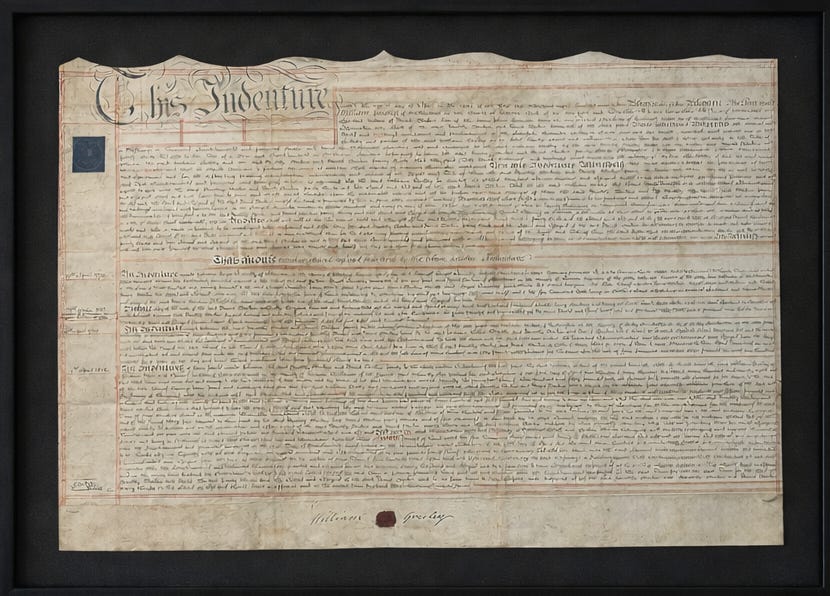
A few years ago, Kerry Kennedy gave me a large, framed goatskin parchment to mark the start of law school. Kerry — the youngest daughter of the late Senator Robert F. Kennedy and Ethel Kennedy — is a lawyer and human-rights advocate who has spent her life thinking about the relationship between legal form and moral power. The gift was deliberately unsettling.
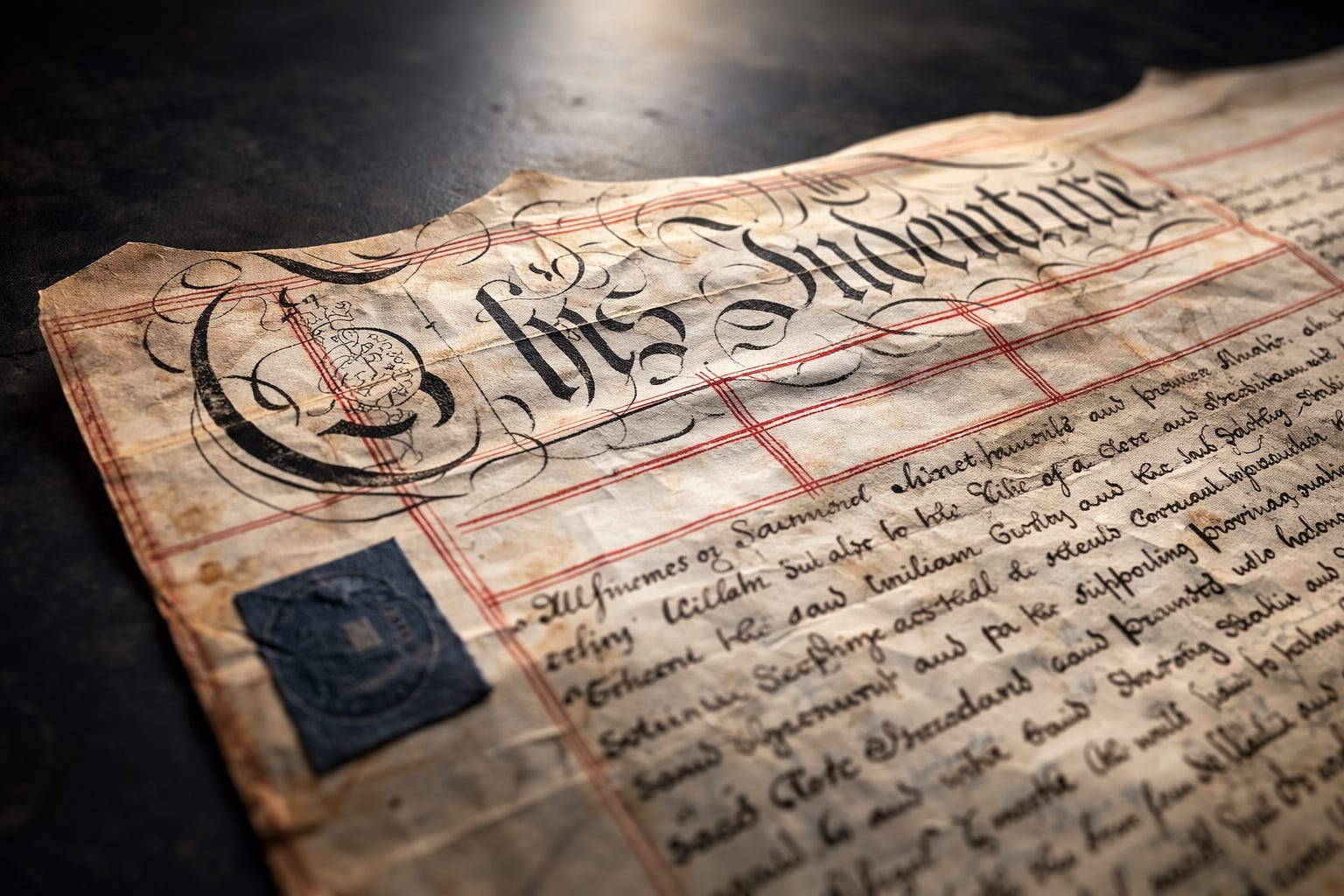
The script opens with the words This Indenture, dated March 1, 1719. It lays out the conditions by which a young man, unable to pay his passage across the Atlantic, surrendered years of his life to those who financed him. It specifies his duties, his obedience, and the penalties for flight. Then, halfway down the poster-sized sheet, the handwriting changes. A second clerk, decades later, records that the man’s term has ended. He is discharged. Nothing in the external world changes in that moment, yet the words on the page change, and with them the entire legal universe surrounding the man. His bondage was legal because it was written; now his freedom is.
The parchment forces a question at the center of law and democracy: What is it that makes words on a page capable of constituting a person’s rights and obligations? Why does writing carry such authority — sometimes unjust authority, sometimes emancipatory authority — that it can bind and release, elevate and degrade, simply by being inscribed in the correct form?
The question is older than the United States, but it has a particular hold on American constitutionalism. We are a nation that has repeatedly tried to settle our deepest conflicts through writing. We write down charters, amendments, contracts, and codes; we write down the terms of who belongs and who does not. Writing is how we declare independence, how we abolish slavery, and how we define citizenship. Relevant to recent events in Venezuela, our joining the U.N. Charter’s prohibition on the “threat or use of force” was an effort to replace conquest as a policy tool with justification, procedure, and collective judgment. Writing is the form through which power becomes legible — and therefore contestable.
Yet writing alone cannot tell us whether a law is just. The indenture shows how a rule may be perfectly valid in form yet profoundly insufficient in substance. This tension — between the authority of written law and the moral claims that sometimes contradict it — runs through the entire American legal tradition. It appears in debates over slavery, in Reconstruction’s transformation of national citizenship, in the civil-rights movement, and in the crises of constitutional discretion we confront today.
We live, in short, with two truths. Written law creates the framework in which a pluralistic society can coordinate its power. Written law also sometimes fails to reflect the minimal commitments that give it legitimacy. The challenge of constitutionalism is to determine how these two truths interact: when the written form must govern, and when the community must rewrite the form itself.
Law and Writing
The authority of written law is often explained in functional terms: writing makes rules public and stable, allowing people to plan their lives. This is correct as far as it goes. But the deeper reason we write law down is that pluralistic societies like ours require a shared method for organizing coercive power. Without writing, power would depend on the discretion of those who wield it. With writing, the exercise of power may be justified by a form external to any single person’s judgment.
Writing therefore becomes the lowest common denominator of freedom. Not freedom in its aspirational sense, but in the basic sense required for any legal order to avoid arbitrariness. A written rule is general rather than personal; durable rather than provisional; contestable rather than opaque. It forces rulers to announce in advance the conditions under which they may act. It gives the ruled a standard against which to measure those actions. It also allows the community — eventually — to revise what it has written.
This is what the 1719 indenture reveals beneath its injustice: Even at the outer edge of exploitation, writing served as a constraint on arbitrary will. The agreement was unconscionable by modern standards, but its written form prevented the master from inventing obligations after the fact. It required the relationship to be governed by articulated terms rather than shifting discretion. The document was unjust, but it was not invisible. And because it was not invisible, it could one day be rejected.
Writing, in this way, performs two functions. First, it channels the force of the state into rules that can be known, debated, and revised. Second, it supplies the standard against which we can judge when the state has exceeded the commitments we have publicly made. Written law is not morally sufficient, but it is morally indispensable: It is the medium through which we hold power accountable.
This sets the stage for a puzzle that recurs throughout legal history: What should we do when the written law appears to require an unjust result, or when it fails to capture a moral truth we believe is urgent? One answer — the answer sometimes imagined in religious narratives — is that a morally perceptive figure may simply set the written law aside.
But that is a posture available only to a character invested with divine authority. It is not a posture available to citizens who stand as equals, nor to judges who must justify their decisions in terms the community can recognize. Precisely because we are not such figures — because we are not Jesus — writing plays its disciplining role. We are bound to justify power by reference to rules we did not author.
The possibility of rewriting the law, however, is our democratic inheritance. Writing is not the end of moral argument; it is the beginning of collective revision. The task is not to stand above the law, dispensing unilateral mercy, but to work within and upon the written form to ensure that it reflects the minimal commitments of a free community.
This is the first installation in Adam Harper’s series exploring Law, Writing, and Democracy.
 | A guest post by
|
Speaking of re-writing the law, Gordon Wood in multiple on-line interviews has emphasized an insightful document written by James Madison, which explains why our Constitution was designed to rein in the process of making law that ran rampant in various states in the 1780's. It was entitled "Vices of the Political System of the United States" and was written in April 1787.
State legislators were elected every year or two, and they rapidly wrote and passed laws to favor those who elected them. As a result, as Madison highlighted in "Vices," the "multiplicity and mutability of laws prove a want of wisdom" and "their injustice betrays a defect still more alarming: more alarming not merely because it is a greater evil in itself, but because it brings more into question the fundamental principle of republican Government, that the majority who rule in such Governments, are the safest Guardians both of public Good and of private rights."
Madison didn't publish or publicize his "Vices" essay. But in Federalist No. 48, Madison fairly famously emphasized related ideas:
"The legislative department [of state governments] is everywhere extending the sphere of its activity, and drawing all power into its impetuous vortex. The founders of our [state] republics have so much merit for the wisdom which they have displayed, that no task can be less pleasing than that of pointing out the errors into which they have fallen. A respect for truth, however, obliges us to remark, that they seem never for a moment to have turned their eyes from the danger to liberty from the overgrown and all-grasping prerogative of an [executive] magistrate, supported and fortified by [complicit or compliant] branch of the legislative authority. They seem never to have recollected the danger from legislative usurpations [as they previously saw in Parliament], which, by assembling all power in the same hands, must lead to the same tyranny as is threatened by executive usurpations."
Love it......