

A Friend Asked Me a Fair Question About the Supreme Court’s Decision Gutting the Voting Rights Act
Here’s the quick answer I wish more people heard

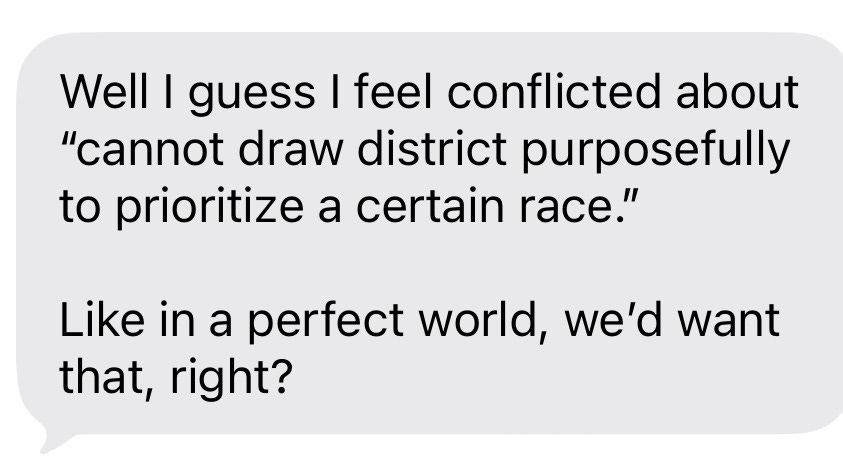
The other day, a friend asked a question in response to the Supreme Court’s recent decision gutting the landmark Voting Rights Act of 1965. He reached out because, over the course of my short legal career, I have helped bring several cases under the federal Voting Rights Act. Given the hostility to voting rights in the federal courts (ahem, the news), I have also worked on drafting state-level voting rights acts, including one in Colorado that just passed.
His question is a fair one—and one we should take seriously, because he is not alone in asking it. In a perfect world, shouldn’t we avoid drawing districts with race in mind? What follows is how I answered him.
* * *
At the threshold, it’s important to understand that the Voting Rights Act never said “draw districts because of race.” It said something narrower: imagine a city where Black voters mostly live in the same few neighborhoods, tend to vote together, and keep losing because the rest of the city votes as a bloc. If you split those neighborhoods across districts, they will never elect anyone they actually want.
So the rule under the VRA is functional, not formal: if a historically disenfranchised group is (1) geographically concentrated, (2) politically cohesive, and (3) consistently outvoted, the map may be denying them a real shot at representation. The fix isn’t “use race.” It’s: don’t design maps that predictably shut that group out of the political process.
Why are minority communities singled out here? Because that pattern—same neighborhoods, same voters, same repeated losses—is rarely random, even if it isn’t intentional. It reflects how many communities were formed: redlining, segregation, exclusion from housing, credit, and jobs that sorted people and shaped where they live today. Those structures left behind real disparities in wealth, mobility, and political power. Districting is what can make or break representation.
For example, the so-called “Black Belt” in the South is a direct result of how plantation slavery concentrated Black populations on fertile land. Those settlement patterns endured through Jim Crow and still shape where communities live today.
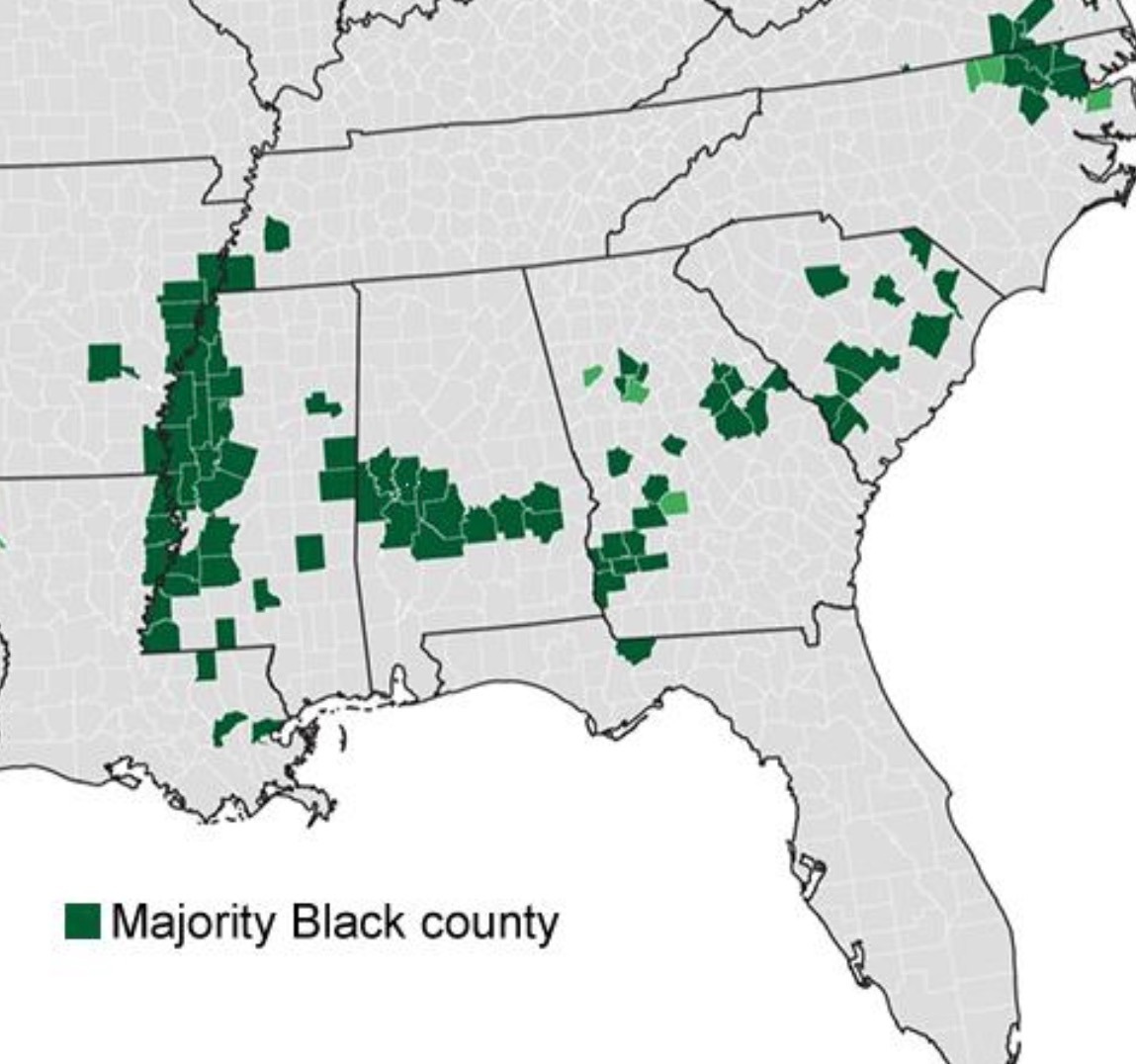
That, in turn, created a predictable risk: state and local legislatures could take those same communities—newly enfranchised but still politically vulnerable—and simply split them across districts, all while claiming to act on partisan grounds.
After seeing that dynamic, it is tempting to describe the problem as one solely about racial motive—“they are all racists, end of story.” But that framing plays directly into a familiar trap: it shifts the focus to intent, which is notoriously hard to prove and easy to deny.
Legislatures are driven by a mix of incentives—partisan advantage, incumbency, power, local concerns. Race may be one factor, but it is rarely the whole story. Reducing the problem to motive oversimplifies the institutional reality the law is trying to regulate.
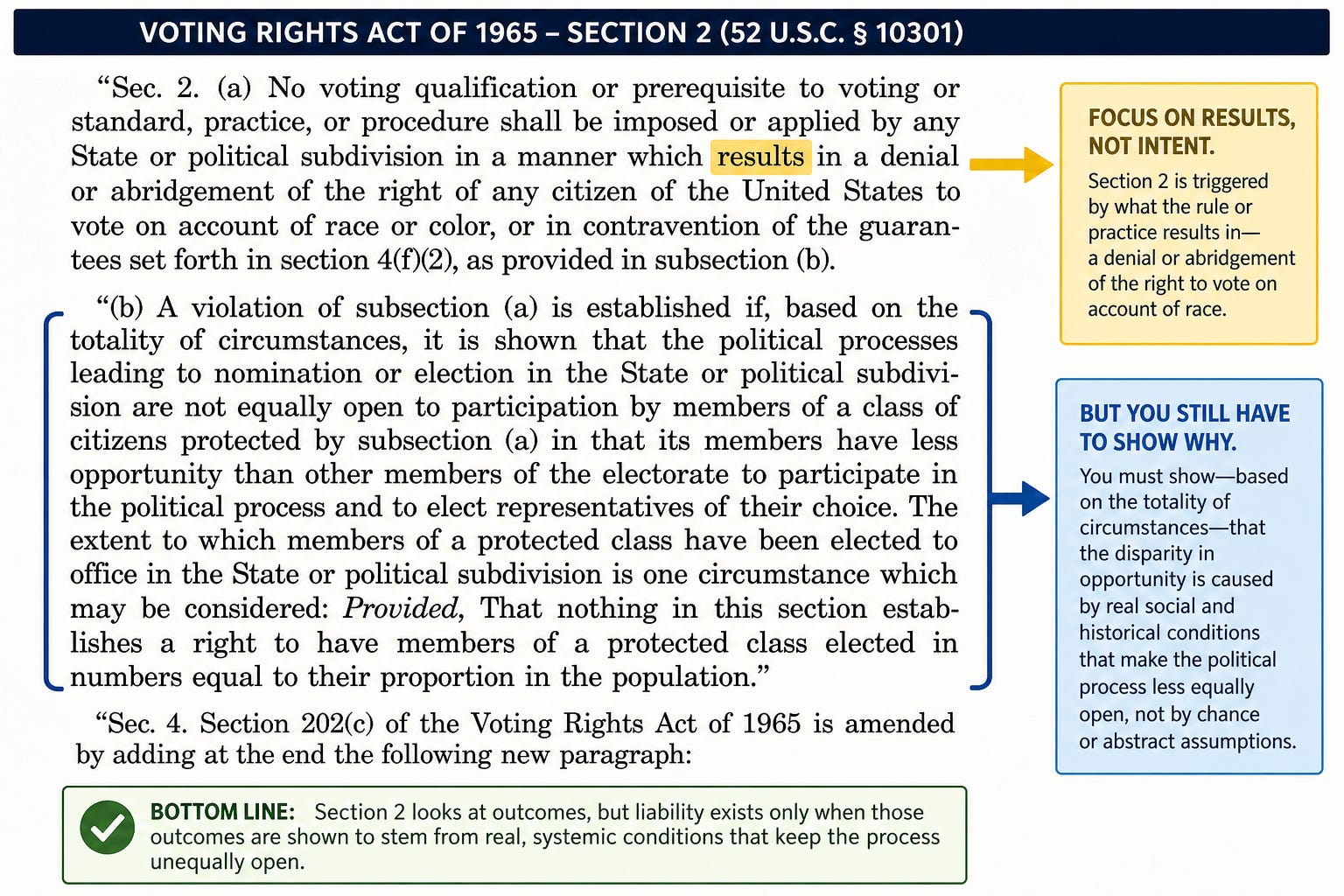
Congress wanted to prevent exactly that dynamic, where a group’s political voice could continue to be systematically drowned out under the guise of ordinary districting choices. So in 1982, bipartisan majorities in Congress revamped Section 2 of the Voting Rights Act to focus on results, not just intent. Courts and map drawers would ask whether a districting map interacts with those underlying conditions to keep the same group politically marginal, even without overt discrimination today.
A long time has passed since 1982. So return to the basic question: in an ideal world, wouldn’t we want no consideration of race at all?
Maybe. Part of why that instinct feels right is that none of us wants to be treated as politically predetermined. We do not want our political voice to depend on politicians manipulating electoral structures we did not choose and cannot control. Democracy depends on the premise that voters have agency—that they can change their minds, respond to arguments, and hold power accountable. A politics that treats people as fixed units to be arranged in advance of elections cuts squarely against that premise.
This is one reason why the recent partisan gerrymandering fights feel so corrosive. Gerrymandering treats citizens as inputs to be sorted rather than citizens to be persuaded. It lets politicians reduce democratic uncertainty by changing the structure of representation itself.
It also helps us understand why the VRA is still necessary. The point of the VRA was to address a related harm: the way the world as it is structured consistently robs people of political voice. Race is not incidental to that story, it is bound up with the arrangements we inherited—with where people live, what institutions they share, how political coalitions form, and whether votes can translate into representation.
The genius of the VRA’s compromise was that, unlike partisan gerrymandering, it did not simply assume voters were static racial blocs. It required proof that—in a particular place—race, history, geography, political cohesion, bloc voting, and unequal opportunity actually operated together in the real world to consistently disenfranchise a group of people.
In other words, a Black community isn’t a label. Where the VRA operates, it reflects shared neighborhoods, institutions, churches, and economic conditions. Race may identify the group, but what makes it politically coherent is the set of common experiences and structures that race has shaped over time. Often, those same structural conditions can make it harder to remedy the lingering effects of slavery, Jim Crow, and other forms of overt discrimination.
The intuition to ignore race is understandable. In a world without these disparities, it might be right. But where race still predicts political exclusion, ignoring it does not make the system neutral. It makes the exclusion harder to see—and harder to fix.
The Renovator has been discussing the redistricting wars and voting rights. Check out this fantastic new piece by Danielle Allen, elucidating the true scope and cross-partisan stakes of America’s structural disenfranchisement problem:
Are We Ready for a New Voting Rights Movement?

The recent Supreme Court decision in Louisiana v. Callais has prompted renewed debate about voting rights. The crisis is even worse than people realize — and it doesn’t stem just from Callais.
 | A guest post by
|
Anyone who asks a question such as "In a perfect world, shouldn’t we avoid drawing districts with race in mind?" and anyone who characterizes such a question as "fair" should consider how Frederick Douglass might answer or address such a question or characterization if he were here to do so.
A discussion of the propriety (or impropriety) of celebrating Juneteenth brought to my attention a speech by Douglass denouncing emancipation as "a stupendous fraud" after he had visited South Carolina and Georgia. See https://www.historyisaweapon.com/defcon1/douglassfraud.html.
Douglass made clear that he would be extremely disappointed to discover that so many people advocate celebrating mere emancipation. He was even more clear and emphatic about how disappointed he would be to learn that even well-intentioned people even today presume or pretend that discussion should revolve around the existence of an imaginary "perfect world."
Certainly, it's fair to take seriously such a question about the operation of the rule of law in the U.S. But--depending on who asked that question and why--I'm not at all sure I'd say that question was fair.
Is it ever fair to presume any people ever did or ever could live in an ideal or perfect world? Such a conception is clearly contrary to the very concept of government, in general, and of our written Constitution, in particular. As James Madison highlighted in Federalist No. 51, a crucial self-evident truth about "government" is that it is "the greatest of all reflections on human nature." "If men were angels, no government would be necessary. If angels were to govern men, neither external nor internal controls on government would be necessary. In framing a government which is to be administered by men over men, the great difficulty lies in this: you must first enable the government to control the governed; and in the next place oblige it to control itself."
Madison highlighted in Federalist No. 10 intimately related problems of human nature (which were among the primary reasons for having a written Constitution that declared the paramount law of the land):
"The latent causes of faction are [patently] sown in the nature of man; and we see them everywhere brought into different degrees of activity, according to the different circumstances of civil society. A zeal for different opinions concerning religion, concerning government, and many other points, as well of speculation as of practice; an attachment to different leaders ambitiously contending for pre-eminence and power; or to persons of other descriptions whose fortunes have been interesting to the human passions, have, in turn, divided mankind into parties, inflamed them with mutual animosity, and rendered them much more disposed to vex and oppress each other than to co-operate for their common good. So strong is this propensity of mankind to fall into mutual animosities, that where no substantial occasion presents itself, the most frivolous and fanciful distinctions have been sufficient to kindle their unfriendly passions and excite their most violent conflicts."
Isn't it true that the whole reason for the Voting Rights Act was to recognize and try to remedy "frivolous and fanciful distinctions" (as Madison put it) regarding a particular way in which Americans never did live in a perfect world? Isn't it true that one primary reason the VRA outlawed discrimination in voting "on account of race or color" was that discrimination by some Americans against other Americans on account of race or color was rampant in flagrant (and knowing) violation of clear and controlling provisions of our Constitution? The VRA didn't require proof of animus based on race or color, but it certainly recognized the existence of such animus. Our Constitution (even in 1788) and huge portions of American history and tradition clearly reflected the existence of animus based on race or color.
The Fifteenth Amendment also had long since specifically emphasized that no government had any power to deny or abridge the right "to vote . . . on account of race, color, or previous condition of servitude." That prohibition necessarily was an express acknowledgement of the extreme prevalence of the problem.
The Fourteenth Amendment also had long since emphasized that "No State" had any power whatsoever to "make or enforce any law" that would "abridge [any] privileges or immunities of citizens of the United States" or "deprive any person of life, liberty, or property, without due process of law" or "deny to any person" fully "equal protection of the laws." Those prohibitions necessarily were an express acknowledgement of the extreme prevalence of those problems.
Despite those amendments to the paramount part of the supreme law of the land, when the VRA was written and enacted (and even to this day), purported public servants in state or national government violate their oaths to support our Constitution by violating some or all the foregoing. So is it fair to phrase the question to imply that such discrimination started with or exists primarily because of the VRA?